

In October 2025, a seasoned owner realized their 2019 fifth wheel was costing $400 a month in storage and insurance while only being used twice a year. You likely started this journey for the freedom of the road, not the stress of a mounting balance sheet. It’s a common story. The hidden costs of motorhome ownership often stay buried until a major component fails or the annual registration bill arrives. You want to enjoy your investment, but the reality of surprise repairs and plummeting resale values can feel like a financial trap.
This guide breaks down the real financial impact of your vehicle and helps you identify when the lifestyle leak starts costing you more than the memories are worth. We’ll provide a clear framework to decide if it’s time to sell in 2026. You’ll learn how to stop the drain on your bank account and secure a fair cash offer without the hassle of private listings. As a nationwide buyer, we come to you, making the exit as simple as the day you bought it. Let’s get your finances back on track.
Key Takeaways
- Identify the “Hidden Trinity” of fixed costs and learn why motorhomes often lose up to 15% of their value in the first year alone.
- Master the industry-standard “2% Rule” to accurately budget for annual maintenance and avoid the shock of catastrophic repair bills.
- Uncover the hidden costs of motorhome ownership that accumulate while your rig is parked, including storage fees and “RV inflation.”
- Break down the true cost of a 1,000-mile road trip in 2026, accounting for fuel volatility and rising site hookup fees.
- Use our “leaking bucket” checklist to determine if it’s time for a clean exit before depreciation drains your remaining equity.
The Big Three: Depreciation, Financing, and Insurance
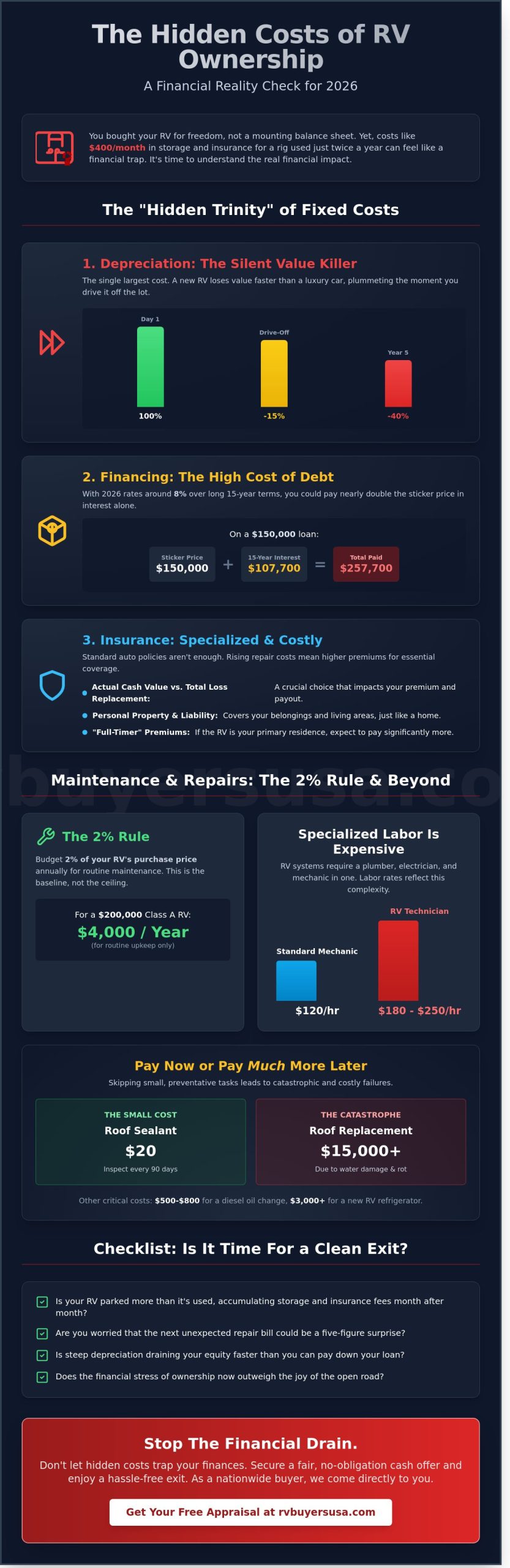
Owning a motorhome involves more than just fuel and camp fees. You face a “Hidden Trinity” of fixed costs: depreciation, financing interest, and specialized insurance. These expenses drain your equity every month, even if your rig stays parked. Understanding these hidden costs of motorhome ownership is the first step toward making a smart financial exit when you’re ready to sell for top dollar. At RV Buyers USA, we see owners lose thousands by ignoring these silent value killers.
Depreciation hits harder than luxury cars. A new recreational vehicle typically loses 10% to 15% of its market value the moment you drive it off the lot. By 2026, financing rates for these assets have stabilized around 8% for buyers with excellent credit. Over a 15-year loan term, you might pay nearly double the original sticker price in interest alone. This interest doesn’t add value; it just increases your total debt while the asset’s worth continues to plummet.
The Depreciation Cliff: Why Timing Matters
The 5-year mark is a critical milestone for every owner. By this point, a Class A motorhome often loses nearly 40% of its original MSRP. Depreciation is the silent cost that only becomes visible at resale. Don’t wait for a surprise at the dealership when you try to trade it in. Use NADA guides to track your specific unit’s value monthly. Knowing your equity position allows you to sell fast before the next major value drop occurs.
Insurance Premiums and Specialized Coverage
Standard auto insurance is insufficient for motorhomes. You need specialized policies that cover living areas, plumbing, and personal property. In 2026, premiums are rising due to higher repair costs and specialized labor rates. You must choose between “actual cash value” and “total loss replacement” coverage. Total loss replacement costs more but prevents you from being “underwater” if an accident happens. If you live in your rig full-time, expect to pay a “full-timer” premium. This coverage mimics a homeowners policy and costs significantly more than occasional-use plans. These hidden costs of motorhome ownership add up quickly. A hassle-free cash sale is often the best way to stop the bleed and move on to your next adventure.
Maintenance and Repairs: The “2% Rule” and Beyond
Own a motorhome and you will quickly learn that the sticker price is just the beginning. Industry experts recommend the 2% rule. You should budget 2% of your RV’s total value every year for basic upkeep. For a $200,000 Class A diesel pusher, that means setting aside $4,000 annually. This figure covers routine items but rarely accounts for major mechanical failures. Ignoring these specialized needs is one of the most significant hidden costs of motorhome ownership.
Repairing a motorhome costs more than repairing a standard vehicle. While a local car mechanic might charge $120 per hour, specialized RV technicians often command $180 to $250 per hour. According to data from the RV Industry Association, the complexity of modern motorhomes requires specialized training that drives these costs up. You aren’t just paying for an engine mechanic; you are paying for a plumber, an electrician, and a carpenter all at once. Specialized systems like hydraulic leveling jacks, complex slide-out mechanisms, and onboard generators require frequent, expensive calibrations to stay functional.
Preventative Maintenance: Paying Now to Save Later
Don’t skip the small stuff. A standard oil change for a large diesel engine can cost $500 to $800. Servicing your generator every 150 hours is equally vital. The most critical task is inspecting roof seals every 90 days. A tube of sealant costs $20, but ignoring a small crack leads to structural rot. Skipping an $800 annual service often results in a $15,000 bill for roof replacement or mold remediation. Keeping detailed professional service records is essential. These documents prove you cared for the rig, which helps you secure a higher cash offer when you decide to sell.
The Unexpected Repair Bill: A Reality Check
Unexpected breakdowns happen at the worst times. Water damage remains the leading cause of RV insurance claims, often totaling a rig entirely. Appliance failures are also common. Replacing a specialized RV refrigerator can cost $3,000 including labor. If you own an older or discontinued model, parts are becoming increasingly difficult to find. This scarcity drives prices higher and leaves your motorhome sitting in a repair shop for weeks. The financial strain is compounded by the emotional stress of a ruined vacation. Understanding the hidden costs of motorhome ownership helps you realize that sometimes, selling for a fair price is better than facing another five-figure repair bill. We provide a hassle-free exit if the maintenance becomes too much to handle.
Carrying Costs: The Price of Standing Still
Ownership expenses don’t stop when you park the rig. Your motorhome quietly drains your bank account even while sitting in the driveway or a lot. These recurring monthly and annual expenses represent a significant portion of the hidden costs of motorhome ownership. Many owners fail to budget for the price of inactivity, focusing only on fuel and campsites.
Storage Fees and Security
Deciding where to keep your Class A or Class C affects your long-term bottom line. An outdoor gravel lot might cost $100 monthly, but exposure to the elements accelerates depreciation. Indoor climate-controlled facilities provide the best protection. However, you should expect to pay between $250 and $600 per month for these premium spaces in 2026. Secure storage is an investment in your rig’s resale value.
“Free” driveway storage often carries a heavy price tag. HOA fines can reach $50 per day in strictly regulated neighborhoods. Constant sun exposure causes “sun rot” on roof seals and sidewalls. This leads to expensive water damage repairs later. You must also factor in the cost of battery tenders and professional winterization. Professional winterization services typically cost between $150 and $300 annually to prevent burst pipes.
Registration, Property Taxes, and Tag Fees
Paperwork costs vary wildly by location and often surprise new buyers. States like Arizona or Nevada use ad valorem systems. These taxes are based on the vehicle’s current market value. For a high-end diesel pusher, this annual tax bill can exceed $2,000. It is a recurring fee that provides zero utility to the owner.
- Annual Inspections: Many states require safety and emissions testing for large diesel engines, costing $100 or more.
- Specialized Permits: Certain jurisdictions require overweight permits or specific endorsements for rigs over 26,000 pounds.
- Weight-Based Fees: Registration fees often scale with the GVWR (Gross Vehicle Weight Rating) of the motorhome.
The “Tire Trap” is another silent budget killer. Tires on a motorhome are a ticking time bomb. Most manufacturers recommend replacing RV tires every 5 to 7 years regardless of how much tread remains. Rubber compounds break down and dry rot when the vehicle sits. A full set of tires for a Class A motorhome can easily cost $4,000 to $6,000. If you buy a used rig that has been sitting for three years, you are already halfway to a massive expense. Stop paying for a vehicle you aren’t using. If these hidden costs of motorhome ownership are stacking up, it might be time to consider a hassle-free exit.
Operating Expenses: Fuel, Hookups, and “RV Inflation”
Owning a motorhome feels like total freedom until you pull up to a diesel pump or check into a luxury resort. These ongoing expenses represent the most persistent hidden costs of motorhome ownership. In 2026, the price of mobility is higher than ever. You aren’t just paying for the vehicle; you’re paying for the massive infrastructure required to keep it functional and comfortable on the road.
The Fuel Reality: Budgeting for the Pump
Planning a 1,000-mile cross-country trip? Don’t just look at the distance on a map. A typical Class A diesel pusher averages between 6 and 10 MPG. If diesel prices sit at $4.50 per gallon, that 1,000-mile journey costs you roughly $560 in fuel alone. This number climbs quickly when you account for external factors. Towing a “toad” vehicle adds significant weight and drag, often dropping your fuel efficiency by 15%. Idling your engine in traffic or running your onboard generator for climate control also siphons fuel directly from your main tank. While fuel is a visible expense, it often accounts for less than 20% of total annual ownership costs, yet it’s the one that causes the most immediate sticker shock during your travels.
Campground Fees and Membership Dues
The days of reliable $30 nightly stays at state parks are fading into the past. Modern RVers now face luxury resort pricing that can hit $150 per night in high-demand areas like Florida or the Pacific Northwest. Many parks have introduced utility surcharges for 50-amp electricity usage and premium Wi-Fi access that wasn’t standard five years ago. To mitigate these costs, owners often turn to memberships. Programs like KOA, Good Sam, or Harvest Hosts require annual dues ranging from $30 to over $100. While these offer discounts, the ROI only makes sense if you spend more than 20 nights a year on the road. Without a clear travel schedule, these memberships become another unused subscription fee that drains your bank account.
Don’t forget the “RV tax” on basic supplies. Specialized rapid-dissolve toilet paper and heavy-duty water filters cost 40% more than standard household equivalents. These small “RV inflation” items add hundreds of dollars to your annual operating budget. If these rising costs are making your dream feel like a financial burden, it might be time for a change. We offer a fast, fair way to exit your investment without the stress of private listings. Get an instant cash offer for your motorhome today and stop worrying about the next fuel hike or resort fee.
When the Costs Outweigh the Joy: Your Exit Strategy
Sometimes the hidden costs of motorhome ownership simply outweigh the memories made on the road. If your RV spends 340 days a year in a storage lot, it is a “leaking bucket” draining your bank account. You need to recognize when the asset has become a liability. Use this checklist to determine if your motorhome is costing you more than it’s worth:
- Annual storage and insurance premiums exceed $3,500.
- The unit was used fewer than 12 nights in the last calendar year.
- Maintenance backlogs like roof resealing or tire aging exceed $4,000.
- The monthly loan payment is higher than your monthly usage value.
Ownership is about freedom, not financial stress. When the math no longer works, a fast exit is the smartest move you can make.
The “Keep vs. Sell” Decision Matrix
Calculate your “Cost Per Night” to see the reality of your investment. Add your annual insurance, storage, registration, and maintenance costs. Divide that total by the number of nights you actually slept in the RV last year. If your cost per night is $500 or more, you are paying luxury hotel prices for a depreciating asset.
Waiting until next year to sell is a common mistake. Most motorhomes lose 10% to 15% of their market value annually. When you add that depreciation to your yearly carrying costs, holding onto the unit for one more “maybe” season can cost you $8,000 or more. A professional cash offer today captures the current market peak. It stops the hidden costs of motorhome ownership from compounding further.
Selling for Cash: The Stress-Free Alternative
Private sales are notorious for being a “headache” for a reason. You spend money on listings and hours on the phone with “tire-kickers” who never show up. Then there is the safety risk of inviting strangers to your home or storage facility. RV Buyers USA provides a direct, professional alternative. We offer a streamlined process that prioritizes your time and security.
Our process is simple. We provide a free appraisal and an instant cash offer. We come to you, nationwide, to pick up the unit. You don’t need to spend thousands on professional detailing or mechanical repairs. We buy Class A, B, and C motorhomes along with fifth wheels and travel trailers in their current condition. We handle all professional title and DMV paperwork to ensure a clean break from the asset. You get your cash, we take the RV, and the financial bleeding stops immediately. Contact us today to start your hassle-free exit.
Take Control of Your RV Investment Today
Owning a motorhome should feel like freedom, not a growing financial burden. By 2026, the hidden costs of motorhome ownership have become increasingly difficult to manage. Between the standard 2% annual maintenance rule and the reality that many Class A coaches lose 30% of their value within the first three years, the math often stops adding up. You shouldn’t have to watch your equity evaporate while your rig sits in expensive storage. Whether you’re facing rising insurance premiums or the recent 15% spike in repair labor costs, you have a clear path forward.
Stop the financial drain today. We make selling simple and transparent. With over 20 years of professional RV acquisition experience, our team provides immediate cash offers without the typical dealership runaround. We handle every detail. You won’t pay hidden fees or spend weeks waiting for a private buyer to secure financing. We even come to you for a nationwide free pickup, ensuring your transition is completely stress-free.
Stop the financial leak. Get a fair cash offer for your motorhome from RV Buyers USA today.
It’s time to trade those monthly expenses for total peace of mind.
Frequently Asked Questions
How much should I budget for annual motorhome maintenance?
You should budget between 2% and 5% of your motorhome’s purchase price for annual maintenance. For a $150,000 Class A unit, this means setting aside $3,000 to $7,500 every year for routine service. These figures cover essential tasks like oil changes, generator service, and roof inspections. These recurring expenses represent a major portion of the hidden costs of motorhome ownership that many buyers overlook.
Is it cheaper to rent an RV or own one?
Renting is more cost-effective if you plan to travel for fewer than 25 days per year. Industry data from 2024 shows that average rental rates for a Class C motorhome range from $150 to $250 per night. When you calculate the annual expense of insurance, storage, and interest on a loan, owning a vehicle often costs $10,000 more annually than occasional renting for short trips.
Why do motorhomes depreciate so quickly compared to cars?
Motorhomes depreciate faster because they are complex structures that face extreme stress from road vibrations and weather exposure. A new motorhome typically loses 20% of its value the moment you drive it off the dealership lot. According to historical valuation trends, a coach often loses 50% of its original MSRP within the first eight years. This rapid loss in value is a primary factor in the hidden costs of motorhome ownership.
What is the average cost of RV storage in the US?
Monthly storage costs range from $75 for an outdoor lot to over $500 for a premium climate-controlled facility. National averages for 2025 indicate that most owners pay approximately $1,800 per year for secure, covered storage. Prices fluctuate based on your location, with urban centers charging 40% more than rural areas. Many Homeowners Associations prohibit driveway parking, making this an unavoidable monthly expense for most owners.
Do I need special insurance for a Class A motorhome?
Yes, you must carry a specialized RV insurance policy rather than a standard auto policy. These policies include specific coverage for full-timer liability, personal effects, and specialized equipment like satellite dishes or awnings. Annual premiums for a high-value Class A coach usually range from $1,500 to $3,500. We recommend policies that offer total loss replacement to protect your investment if the vehicle is totaled within its first five years.
What happens if I try to sell my RV with a bank lien?
Selling an RV with a lien requires the lender to be paid in full before they release the title to the new buyer. At RV Buyers USA, we simplify this by paying your bank directly and giving you the remaining cash on the spot. We handle all the paperwork and title transfers nationwide. This process removes the stress of coordinating with your bank and ensures you get your money without the typical 30 day waiting period.
How often do RV tires actually need to be replaced?
Replace your RV tires every five to seven years regardless of the remaining tread depth. The Michelin Service Bulletin states that tires degrade from the inside out due to UV exposure and inactivity. Check the four-digit DOT date code on the sidewall to confirm the age of your rubber. A single blowout can cause over $5,000 in damage to your wheel well and plumbing systems, making proactive replacement a smart financial move.
Is a diesel motorhome more expensive to maintain than a gas model?
Diesel motorhomes cost roughly 30% more to maintain than gas models due to specialized parts and higher fluid capacities. A standard oil change for a diesel pusher requires 15 to 25 quarts of oil, costing $400 to $700 at a professional service center. While diesel engines often last for 300,000 miles, the costs for air brake service and fuel filter replacements are significantly higher than the components found on a Ford V10 or V8 gas chassis.