

What if that “total loss” label on your paperwork didn’t mean your investment was a total waste? Most private buyers vanish the moment they hear the word “salvage,” and insurance companies often refuse to cover the next owner. It’s frustrating to watch a high-value asset sit idle because of red tape and buyer hesitation. Selling an rv with a salvage title in 2026 requires a specific strategy that bypasses the traditional retail headache. You need a solution that prioritizes speed and fairness over endless negotiations.
We understand the stress of dealing with state-specific DMV requirements and new 2026 regulations like the California CARS Act. This guide will show you exactly how to handle the salvage market and discover the fastest way to turn your damaged motorhome or travel trailer into immediate cash. You’ll learn about current wholesale value trends, the impact of new emissions fees, and why professional acquisition is the only reliable path to a clean transaction. Stop worrying about the “salvage” label and start focusing on your next move.
Key Takeaways
- Understand the “50% Rule” to calculate a realistic market value using NADA or JD Power clean-title benchmarks as your starting point.
- Learn why the “Financing Wall” makes private sales nearly impossible and how to avoid the trap of waiting for buyers who cannot secure insurance.
- Simplify selling an rv with a salvage title by following a clear roadmap for state-mandated disclosures and technical DMV paperwork.
- Discover why professional acquisition firms are the most efficient path to immediate cash without the need for repairs or retail preparation.
- Protect your legal interests by mastering the transparency requirements that prevent future lawsuits and ensure a clean title transfer.
What Does a Salvage Title Mean for Your RV?
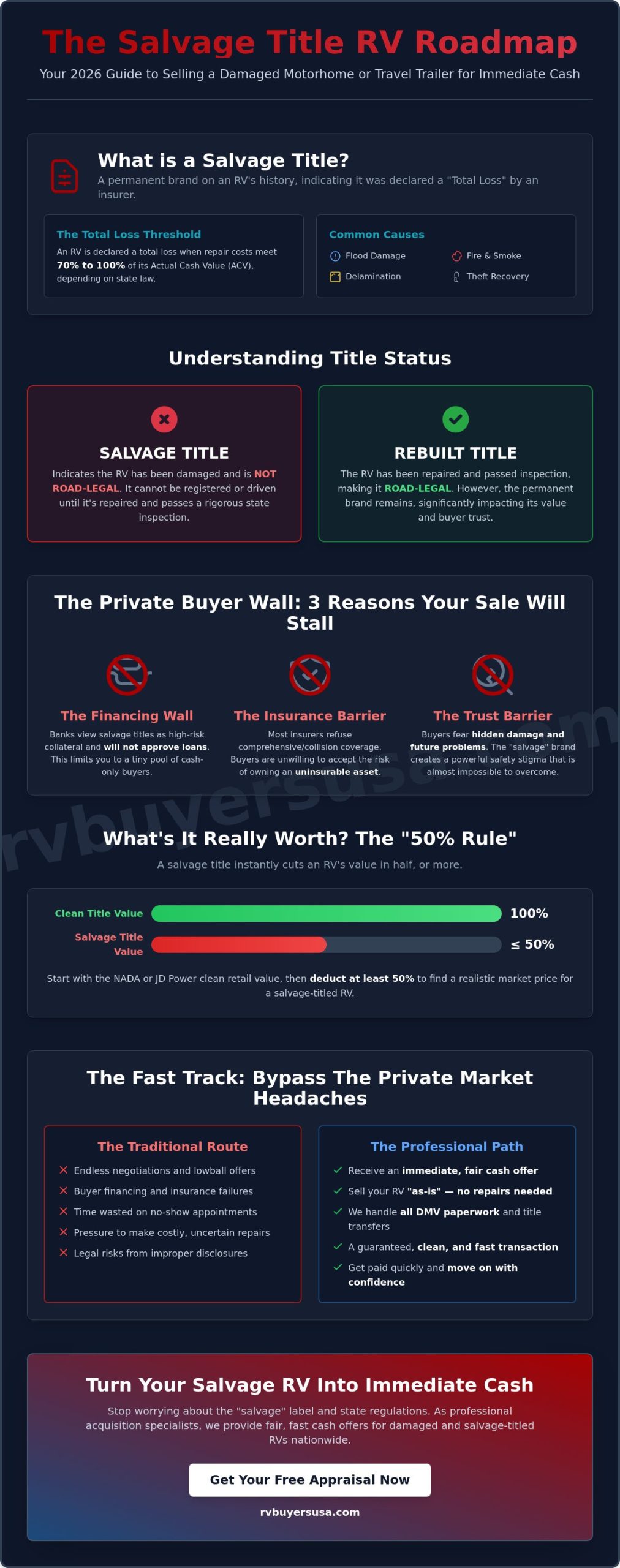
Selling an rv with a salvage title starts with understanding the math behind the brand. A salvage title is a permanent mark on your vehicle’s history. It tells every future buyer, dealer, and insurance adjuster that the unit was once declared a total loss. This usually happens when an insurance company decides that the cost of repairs is too high compared to the vehicle’s worth. This “Total Loss Threshold” isn’t a single number nationwide. It typically ranges from 70% to 100% of the actual cash value, depending on your specific state’s regulations. If you own a Class A motorhome or a travel trailer that hits this limit, the insurer pays out the claim and brands the title to warn future owners.
Understanding what is a salvage title? requires looking at why these brands are issued in the first place. Beyond standard highway accidents, several common scenarios trigger a salvage brand:
- Flood Damage: Water often destroys sensitive electrical systems and creates mold issues that are nearly impossible to fully remediate.
- Fire and Smoke: Even small galley fires can cause structural damage to the lightweight materials used in RV construction.
- Severe Delamination: When exterior walls separate from the internal frame, the structural integrity of a fifth wheel or toy hauler is compromised.
- Theft Recovery: If an RV is stolen and stripped of its components before being found, it’s often totaled by the insurer.
Title branding is a legal disclosure of significant past damage. It is different from a “junk” title, which indicates the vehicle should never be driven again and is only good for scrap parts. A salvage title is a middle ground that suggests the unit might be repairable but currently carries a major red flag.
The Difference Between Salvage and Rebuilt Titles
A salvage title means the RV is currently not road-legal in most jurisdictions. To move to a “rebuilt” status, you must complete all necessary repairs and pass a rigorous state-mandated inspection. This process proves the unit meets basic safety standards. While a rebuilt title is slightly more attractive than a raw salvage title, it still carries a heavy stigma. Most retail dealers will refuse a rebuilt unit for trade-ins, and finding a private buyer for a branded Class B motorhome remains a significant hurdle. The history of the damage stays with the VIN forever.
Why Insurance Companies Issue Salvage Brands
Insurance adjusters use a cold, financial calculation to determine an RV’s fate. They compare the Actual Cash Value (ACV) against the estimated repair costs. For older Class C motorhomes or specialized toy haulers, parts availability is a major factor. If a manufacturer has gone out of business or a specific body panel is no longer in production, labor costs skyrocket as shops try to fabricate solutions. This uncertainty makes insurance companies nervous. They prefer to “total” the unit, pay you the ACV, and move on. This leaves you with a branded asset that requires a specialized buyer to unlock its remaining value.
The Hard Truth: Why Private Buyers Avoid Salvage RVs
Private buyers are notoriously risk-averse. The moment they see “salvage” or “rebuilt” on a title, the negotiation usually ends before it begins. It isn’t just about the physical damage; it’s about the logistical nightmare of future ownership. Selling an rv with a salvage title to a private individual often fails because the retail buyer pool shrinks significantly the moment the title brand is disclosed. Most families looking for a Class A motorhome or a travel trailer want a turn-key experience, not a project with a complicated history.
The Financing and Insurance Barrier
Most retail buyers rely on specialized vehicle loans to purchase high-value assets. Banks and credit unions view salvage RVs as high-risk collateral with unpredictable recovery values. Because a lender cannot easily determine the resale price if they have to repossess the unit, they simply decline the loan. This forces you to find a cash-only buyer, which is a rare find in the premium motorhome market.
Insurance presents an equally tall wall. Many major carriers refuse to provide comprehensive or collision coverage for branded titles. At best, a buyer might secure “liability only” protection. This means if a storm damages the roof or a small electrical fire occurs, the owner has zero financial recourse. For most owners, that level of risk is a deal-breaker. If you want to skip the retail runaround and the endless “no-shows,” you can request a fair cash offer from a professional acquisition firm instead.
Hidden Damage and Long-Term Reliability Concerns
The “safety stigma” is a powerful deterrent. RV construction relies on lightweight materials and complex seals that don’t handle stress well after an accident. Buyers fear bent frames, compromised slide-out mechanisms, and the “silent killer” of RV value: mold. Even if repairs look professional, the lack of a factory warranty or a certified repair history creates massive anxiety for a second-hand owner.
Verifying repair quality is difficult for a layman. While a buyer might check the official NADA RV valuation to see what a clean unit is worth, they have no reliable baseline for a salvage one. Research shows that a salvage title typically reduces a vehicle’s value by 25% to 50%. Private buyers often assume the worst-case scenario and offer even less. They fear they’ll be stuck with a “money pit” that they can never trade in or sell later. This resale anxiety is exactly why your branded title unit sits on the market while clean units sell in days.
How to Value an RV with a Branded Title
Determining the worth of a branded vehicle requires moving past emotional attachment and looking at the hard numbers. While a clean-title unit follows a predictable depreciation curve, selling an rv with a salvage title forces you into a more aggressive valuation strategy. You must start with a reliable baseline. Use the J.D. Power (NADA) “Clean Trade-In” value as your anchor point. This represents the unit’s value if it had zero history of major damage. From there, the market dictates a steep reduction to account for the risk a future owner must assume.
The 50% Rule of Thumb
Most professional acquisition experts and specialized dealers use the “50% Rule” as a starting point. This rule suggests that a salvage-title RV is worth roughly half of its clean-title counterpart. This percentage shifts based on the nature of the damage. Cosmetic issues, like hail-damaged siding on a travel trailer, might allow for a valuation closer to 60% or 65%. Structural damage, such as a twisted frame on a fifth wheel or a compromised chassis on a Class A motorhome, will push the value toward the lower 40% range. For a $100,000 Class A motorhome with a salvage title, a realistic starting negotiation point is approximately $50,000 before accounting for specific repair quality.
Specific factors will either stabilize or further sink your valuation. If you have a stack of receipts from a certified repair facility and a recent third-party inspection report, you can justify a higher asking price. Conversely, certain types of damage are “value killers” that even the best repairs can’t fully fix. If the unit has a history of flood damage or deployed airbags, expect the value to drop significantly below the 50% mark. These issues signal long-term electrical and safety risks that most buyers won’t touch at any price.
Using Market Comparables for Branded Titles
Don’t rely solely on national averages. Look for local market comparables on salvage auction sites or specialized classifieds to see what similar branded units actually fetch. The goal is to find “sold” prices, not just asking prices. If you are selling my rv using professional valuation principles, you must document the entire repair process. High-quality “before and after” photos combined with a detailed parts list prove to a buyer that the work was done correctly. This transparency is your best tool for defending your price. Without it, you are just another seller with a branded title and an unverified story.
Legal Requirements and Disclosures for a Transparent Sale
Selling an rv with a salvage title isn’t just about finding a buyer; it’s about protecting yourself from future liability. Transparency is your strongest defense. Many states have specific “Salvage Disclosure” forms that you must sign and provide to the buyer before any money changes hands. If you fail to mention the title brand, you open yourself up to lawsuits and potential criminal charges. Be direct. Show the buyer the paperwork upfront and document that they acknowledged the vehicle’s history in writing. This isn’t just a courtesy; it’s a legal shield.
The Importance of Full Disclosure
Fraudulent concealment occurs when a seller intentionally hides a material fact, like a flood brand or structural damage, to close a deal. The legal consequences are severe and often include heavy fines or the forced reversal of the sale. You don’t want a buyer coming back six months later claiming they didn’t know the unit was a total loss. Avoid this by providing the original insurance adjuster’s report. This report details exactly why the insurer totaled the unit and what specific components were damaged. It builds instant trust by removing the mystery. Create a comprehensive paper trail that includes repair receipts, inspection certificates, and a signed disclosure form. This documentation proves you acted in good faith.
Handling DMV Paperwork Correctly
Every state has its own rules for transferring a branded title. Some require a specific Bill of Sale that explicitly mentions the salvage status in the vehicle description. In states like California, the CARS Act (SB-766), effective October 1, 2026, imposes strict disclosure requirements for used vehicles under $50,000. This law even gives certain buyers a three-day right to return the vehicle. You must also include an Odometer Disclosure Statement, even for older motorhomes or towables. Many sellers see their titles rejected at the DMV because of simple clerical errors or missing signatures on state-specific “Branded Title” transfer documents.
Don’t forget the notary requirements. While some states allow a simple signature, others require a notary to witness the title transfer for any salvage vehicle. Check your local DMV website to verify if you need a mobile notary before you meet the buyer. Managing this level of red tape is exhausting and leaves no room for error. If you want to skip the paperwork hurdles and the risk of legal mistakes, you should sell your salvage RV to a professional buyer who handles all the title work for you. We specialize in navigating complex state regulations so you can walk away with cash and total peace of mind.
The Fast Track: Selling Your Salvage RV for Cash
Stop wasting time on marketplace listings that only attract tire-kickers and low-ballers. Selling an rv with a salvage title to a private buyer is a recipe for frustration. Most retail shoppers will vanish the moment you disclose the title brand, regardless of how well the repairs were performed. You don’t have to settle for endless no-shows or insulting offers. Professional acquisition firms offer a streamlined alternative that prioritizes your time and provides immediate liquidity for an asset that the traditional market often rejects.
Working with a professional buyer eliminates the “financing wall” entirely. Since these firms use their own capital, they don’t need to wait for bank approvals or worry about insurance company restrictions. This allows you to bypass the biggest hurdles in the branded title market. You get a firm price, a clear timeline, and a guaranteed exit strategy. It’s the most reliable way to convert a difficult asset into cash without the typical retail drama.
Why Professional Buyers Are Different
Professional buyers evaluate the intrinsic value of your unit differently than a family looking for a weekend camper. They see the value in the chassis, the high-end components, and the structural potential of your Class A motorhome or fifth wheel. This expertise allows them to make fair offers based on wholesale reality rather than fear. One of the biggest advantages is the “as-is” nature of the sale. You don’t need to spend thousands on detailing, minor repairs, or professional staging.
The administrative burden also disappears. As we discussed earlier, state-specific DMV paperwork for salvage vehicles is a minefield of potential errors. A professional acquisition firm handles the entire title transfer process for you. They ensure every disclosure form is signed correctly and every legal requirement is met. This removes the risk of future liability and ensures the transition is clean and uncomplicated for the owner.
Streamlining the Process with RV Buyers USA
We make the acquisition process simple and transparent. Whether you have a compact Class B motorhome, a spacious Class C, or a heavy-duty toy hauler, we provide a direct path to a sale. Our reach is broad, allowing us to offer logistical convenience that local dealers simply cannot match. If your unit is non-operable or you simply don’t want to deal with the hassle of transport, our service model includes the logistical arrangements to get the unit from your location to ours.
Our goal is to strip away the anxiety of selling a high-value asset with a complicated history. We focus on speed, fairness, and the total absence of hidden costs. You provide the details, and we provide the solution. It is time to stop worrying about the branded title and start focusing on your next adventure. Get a fast cash offer for your salvage RV today and see how easy it is to move on from your branded travel trailer or motorhome with a seasoned expert by your side.
Secure Your Cash Payout Today
You now have the roadmap for selling an rv with a salvage title in today’s complex market. We’ve covered why the “financing wall” stops private buyers and how the 50% valuation rule sets realistic expectations for your return. You don’t have to stay stuck with a branded asset that feels like a constant liability. While the legal disclosures and state-specific DMV paperwork are often daunting, they don’t have to be your problem to solve alone.
Since 2003, our team has helped owners bypass the retail headache and get paid fairly for their motorhomes and trailers. We provide nationwide pickup for your convenience and handle every technical detail of the title transfer process. Don’t let your salvage unit sit idle while its market value drops further due to age or neglect. It’s time to choose a professional solution that values your time and provides immediate results. Get a Professional Cash Offer for Your Salvage RV and move forward with total confidence. Your next adventure is waiting, and we’re here to help you fund it.
Frequently Asked Questions
Can you sell an RV with a salvage title to a dealership?
Most traditional retail dealerships will refuse a salvage unit. They cannot offer financing or warranties to the next owner, which makes the unit a liability on their lot. Selling an rv with a salvage title is much more effective when you deal with specialized acquisition firms. These professionals have the capital to buy branded assets directly without needing third-party lender approval or retail-ready condition.
How much does a salvage title devalue an RV?
A salvage title typically reduces the vehicle’s value by 25% to 50% compared to an identical unit with a clean title. This reduction depends on the severity of the damage and the quality of the repairs. Market data from early 2026 shows that larger Class A and Class C motorhomes often see the steepest drops. This is due to higher perceived risks regarding structural integrity and expensive chassis damage.
Is it legal to sell an RV with a salvage title without telling the buyer?
No, it is illegal to withhold title branding information from a buyer. Failing to disclose a salvage or rebuilt status is considered fraudulent concealment. This carries heavy legal penalties and can lead to the forced reversal of the sale. Always use state-mandated disclosure forms to create a paper trail. Transparency protects you from future lawsuits and ensures the transaction remains legally sound.
Can a salvage title RV be insured for road use?
You can insure a rebuilt RV for road use, but options are usually restricted to liability-only coverage. Most major insurance carriers refuse to provide comprehensive or collision protection for branded titles. The vehicle’s true value is too difficult for them to determine. If you are selling an rv with a salvage title to a private buyer, warn them that securing full coverage will be a significant challenge.
What is the difference between a salvage title and a rebuilt title?
A salvage title indicates the RV was declared a total loss and is currently not road-legal. A rebuilt title is issued after the vehicle has been repaired and passed a state-mandated safety inspection. While a rebuilt title allows the unit to be registered and driven, it still carries the “branded” history. This history permanently impacts its long-term resale value and trade-in potential at most dealerships.
Why do insurance companies total RVs so easily?
Insurance companies total RVs when repair estimates reach the “Total Loss Threshold” of 70% to 100% of the actual cash value. High labor rates and the limited availability of specialized components often make repairs financially unfeasible. For older motorhomes or travel trailers, even moderate cosmetic damage or a single delaminated wall can trigger a salvage brand. The insurer prefers a payout over unpredictable repair costs.
Do I need a special inspection to sell my salvage RV?
You don’t need a special inspection to sell the unit in its current salvage state, but it is required to move to a rebuilt status. If you want to retitle it as road-legal, a state-certified safety inspection is mandatory. Most professional buyers conduct their own internal appraisal. This saves you the cost and logistical hassle of hiring a third-party inspector before the sale is finalized.
How can I get the most money for a branded title RV?
Maximize your return by providing full documentation of all repairs and professional receipts. Transparency builds buyer confidence and justifies a higher price. The most efficient way to get top dollar without the “tire-kicker” discount is to sell to a professional firm. They understand the intrinsic value of Class A motorhomes, fifth wheels, and toy haulers, offering a fair price based on market reality.