

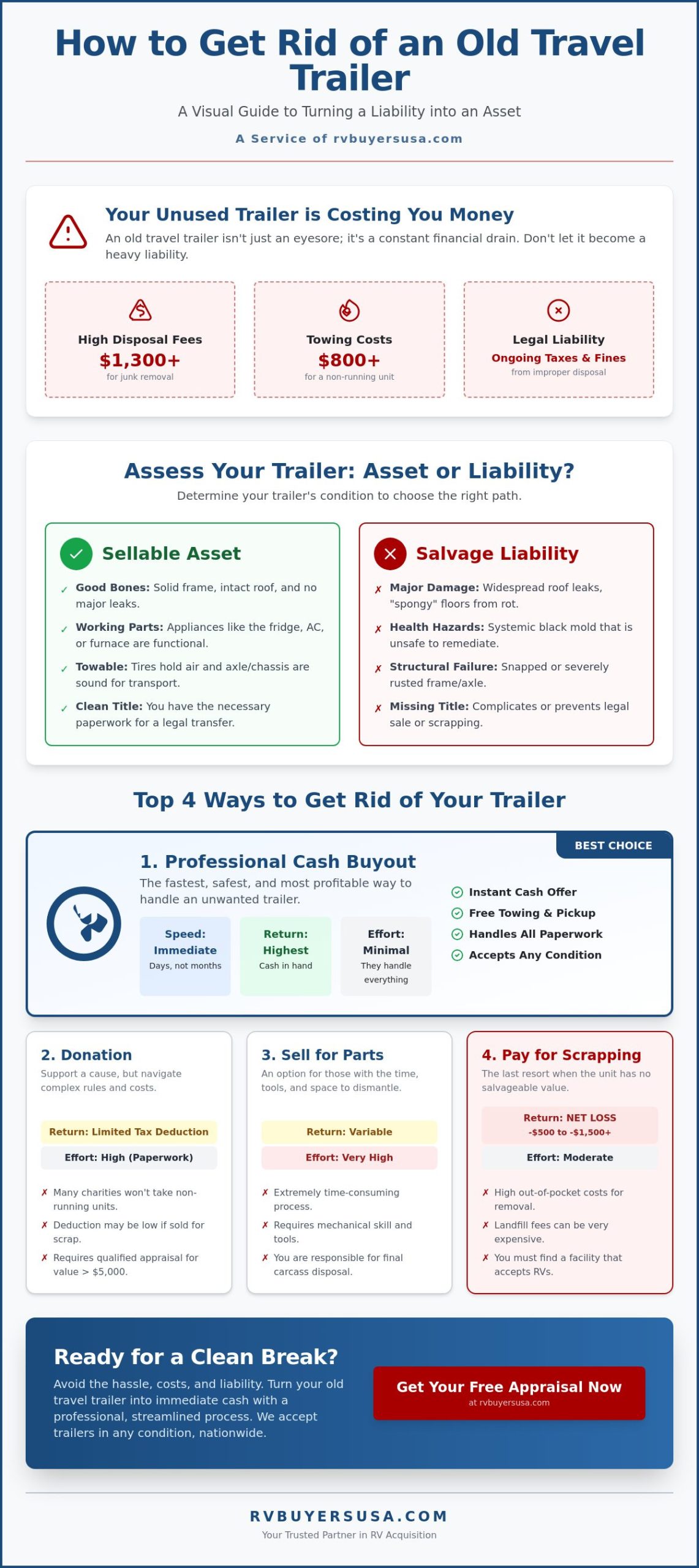
That rusted eyesore in your driveway isn’t just a nuisance; it’s a growing financial drain that costs you money every day it sits there. Between ongoing property taxes and the risk of municipal fines, an unused asset quickly becomes a heavy liability. You need to know how to get rid of an old travel trailer without losing money on high towing fees or complicated disposal processes. Many owners feel stuck because professional junk removal for a 20-foot unit can now cost $1,300 or more, while local landfill fees often range from $500 to $1,500.
We understand the frustration of managing an aging unit. Don’t let title transfer hurdles or high towing costs, which can reach $800 for a non-running trailer, stall your progress. This guide provides the most efficient strategies to clear your property and avoid these unnecessary expenses. You’ll learn how to navigate May 2026 scrap metal values, understand the latest IRS donation rules, and identify the fastest way to secure immediate cash for your travel trailer. It’s time to swap a mounting liability for a clean, professional transaction.
Key Takeaways
- Identify whether your unit is a salvage candidate or a sellable asset by checking for critical structural issues like roof leaks and floor rot.
- Master the most efficient methods for how to get rid of an old travel trailer while avoiding high disposal fees and legal complications.
- Ensure a clean break from ownership by correctly handling title transfers and Bill of Sale documentation to release yourself from future liability.
- Prepare for safe transport by verifying tire integrity and braking systems to avoid hazardous roadside breakdowns during removal.
- Transition from a liability to immediate liquidity by choosing a streamlined acquisition process that accepts trailers in any condition.
Assessing Your Old Travel Trailer for Salvage or Sale
You cannot effectively decide how to get rid of an old travel trailer until you determine if it is a liability or an asset. Start by distinguishing between a “vintage” unit and a “salvage” unit. A vintage trailer has aesthetic appeal or structural potential that attracts restoration enthusiasts. A salvage unit, however, is strictly worth the sum of its raw materials and functioning parts. Check the roof and floors immediately. If the roof has been compromised for years, the internal wall studs are likely rotted, making the unit a safety hazard during transport.
RV salvage value is the market price of usable components minus removal costs. Beyond the shell, evaluate your appliances. A working 2-way refrigerator, furnace, or water heater can still command hundreds of dollars on the secondary market. Finally, inspect the chassis and axle. If the frame is snapped or the axle is rusted through, the unit cannot be safely towed on public roads. This assessment dictates whether you can sell the unit for cash or if you must pay for professional disposal.
The “Beyond Repair” Checklist
Identify dealbreakers that strip a trailer of its resale value. Systemic black mold is the primary culprit; it’s a health hazard that most buyers won’t touch. Look for “spongy” floors, which indicate advanced rot in the subfloor. Check the main frame rails for heavy scaling or holes. If the cost of basic structural repairs exceeds the potential market price of a clean unit, it is officially beyond repair. The process of Vehicle recycling is often the most responsible choice for these units, ensuring hazardous fluids are drained before the metal is processed.
Evaluating Component Value
Even a rotted trailer contains valuable inventory. Test the AC unit and roll out the awning to check for fabric tears or arm damage. Restoration enthusiasts constantly hunt for original vintage hardware, windows, and light fixtures. If the unit is truly scrap, focus on the metal. As of May 2026, aluminum scrap prices average $0.66 per pound in some regions, while steel sits around $0.10 per pound. Identifying these high-value materials helps you negotiate better when figuring out how to get rid of an old travel trailer while recouping some costs.
Top 4 Ways to Get Rid of an Old Travel Trailer
You have four clear options when deciding how to get rid of an old travel trailer. Each path offers a different balance of speed and financial return. You can sell to a professional firm, donate for a tax break, sell parts to restorers, or pay for scrap removal. Avoid the “free” listings on social media; these often leave you liable if a stranger’s DIY towing job ends in a highway accident. Professional solutions prioritize your safety and legal protection.
Professional Cash Buyouts
Direct buyers are the fastest route to clearing your property. This method provides immediate liquidity and removes the asset from your sight. The biggest advantage is the administrative relief. A professional firm handles the DMV title transfers and release of liability paperwork. This ensures you aren’t stuck with future taxes or fines. Plus, you can sell my travel trailer without the burden of paying for towing. Professional acquisition firms typically include mobile pickup in their service. If you want a clean break, you can get a valuation for your travel trailer to see if it qualifies for a buyout.
Donation and Scrapping Options
Donating is an option for the 2026 tax year if you want to support a cause. Vet the charity carefully first. Many organizations won’t accept non-running units because the towing and disposal costs exceed the potential donation value. Remember that your deduction is usually limited to the gross proceeds from the sale. If the charity sells your trailer for scrap, you won’t get a fair market value deduction. For donations over $5,000, the IRS requires a qualified appraisal. This can be a complex process that delays the removal of the unit.
If the unit is a total loss, you might have to pay for removal. National average junk removal costs are approximately $241, but a travel trailer is a large, complex item. Some companies charge $65 per foot for trailers in poor condition. This means a 20-foot trailer could cost you $1,300 to remove. You’ll also need to find a landfill that accepts hazardous RV materials like fiberglass and old insulation. Landfill fees for large items often range from $50 to $100 per ton. This makes selling the unit “as-is” the most financially sound way to figure out how to get rid of an old travel trailer while avoiding high out-of-pocket costs.
Listing for “parts only” is a final alternative for those with extra time. Local hobbyists or restorers may want specific vintage fixtures or windows. This takes patience and requires you to manage multiple visitors to your property. It’s a slow process but can recoup some value if the chassis is too damaged for a standard sale.
Navigating Title and Legal Requirements for Disposal
Legal loose ends are the most common reason owners fail when figuring out how to get rid of an old travel trailer. You cannot simply watch a trailer disappear down your driveway and assume your responsibility has ended. Without the proper paperwork, you remain the owner of record. This means you are liable for any accidents, environmental fines, or abandoned vehicle fees associated with that unit. Protecting yourself requires a clean paper trail that proves you no longer possess the asset.
Start by securing a comprehensive Bill of Sale. This document must include the Vehicle Identification Number (VIN), the sale price, the date, and the contact information for both parties. Once the unit is gone, notify your local DMV immediately. Most states allow you to file a “Notice of Transfer and Release of Liability” online. This step is non-negotiable. It officially severs your legal connection to the trailer and stops the clock on personal property tax assessments. If you skip this, your local tax authority will continue to bill you for a useless asset you no longer own.
Transferring Ownership Safely
Never let a trailer leave your property without a signed title. Some private scrap haulers suggest using an “open title” where the buyer’s name is left blank. This is a massive legal risk. It allows the unit to be sold multiple times while you remain the liable owner on the DMV’s books. If the unit is being destroyed, ask the disposal facility for a permanent disposal certificate. This document is your ultimate shield. It proves the trailer has been decommissioned according to state environmental regulations. If your title is lost or missing, you must apply for a duplicate through your state DMV before any legal transfer can occur. This process usually requires a small fee and a few weeks of processing time, but it is the only way to ensure a legitimate transaction.
Dealing with Liens and Back Taxes
Financial encumbrances can stall your disposal plans. If an old bank lien still shows on the title, you must obtain a lien release letter from the original lender. For very old units where the bank may no longer exist, you might need to petition the DMV for a bonded title. Additionally, check for unpaid property taxes. Some municipalities won’t allow a title transfer until the back taxes are settled. You can often negotiate with tax authorities if you can prove the unit has been uninhabitable for years. Keep in mind that selling my rv requires a clear title or payoff authorization to complete a professional acquisition. Clearing these hurdles early ensures that when you find a buyer, the transition is rapid and uncomplicated.
Solving Logistics: Towing, Tires, and Safety
Moving a trailer that has been stationary for years is a high-risk operation. You cannot simply hitch up and drive away. Physical deterioration happens silently, and the most dangerous issues often hide in plain sight. When you are figuring out how to get rid of an old travel trailer, the logistics of transport are usually the most expensive and stressful part of the process. You must address the mechanical integrity of the unit before it touches a public road.
Start with the tires. Rubber degrades over time regardless of tread depth. Look for sidewall cracking and “alligatoring” which indicate severe dry rot. If the tires are more than five years old, they are likely unsafe for highway speeds. A blowout can lead to a total loss of control or shred the trailer’s wheel well. Additionally, test the braking system and all exterior lighting. In many jurisdictions, towing a unit without functioning signal lights or trailer brakes is a major traffic violation that carries heavy fines. Finally, manage your hazardous materials. Purge propane tanks and ensure black and gray water tanks are completely empty. Hauling hundreds of pounds of wastewater is dangerous and increases the risk of a structural failure during transport.
Preparing for Transport
Mechanical preparation is essential for a successful move. Grease the wheel bearings immediately; if they have sat for years, the old lubricant has likely hardened. Bone-dry bearings will overheat and weld themselves to the spindle within a few miles of travel. Secure every loose exterior panel and roof vent with heavy-duty tape or fasteners. Wind resistance at 60 mph acts like a crowbar on old, brittle fiberglass and aluminum skin. Inspect the hitch assembly and safety chains for deep-pitting rust. If the metal is compromised, the connection to your tow vehicle could fail under the stress of a sudden stop.
Professional Removal vs. DIY
DIY towing is a massive liability. If a compromised trailer causes an accident, your standard insurance may not cover the damages if the unit was not roadworthy. Professional towing for a non-running RV typically costs between $300 and $800 for local distances. If the unit is so degraded it requires a specialized flatbed, those costs can double or triple. Often, the price of the tow exceeds the actual scrap value of the trailer. Professional buyers solve this problem by providing free nationwide pickup as part of the acquisition. They handle the specialized equipment and assume all transport risks. To avoid these logistical nightmares and high out-of-pocket fees, sell your travel trailer to a professional buyer who manages the removal for you.
The Fast Track: Selling to RV Buyers USA
Stop struggling with the logistics of an aging unit. Most owners assume their only options are expensive landfills or donation programs with zero financial return. We provide a better path. Selling to a professional acquisition firm is the most efficient way to solve the problem of how to get rid of an old travel trailer while putting money in your pocket. We simplify the entire transaction so you can move on with your life without the typical property burdens.
We specialize in travel trailer acquisition and fifth wheel acquisition across the country. Our process is designed for maximum speed and zero stress. We buy your unit in its current condition. You don’t need to patch roof leaks, replace rotted subfloors, or scrub the exterior. We manage the entire administrative burden, including all DMV filings and title transfers. This ensures your legal liability ends the moment we take possession of the unit. You get a clean break without the paperwork headache or the fear of future tax assessments.
Logistics are no longer your concern. We offer complimentary nationwide pickup for every unit we purchase. We send our own transport teams to your location with the specialized equipment needed to handle compromised axles or rotted tires safely. This service removes the threat of $800 towing fees and $1,300 disposal costs from your balance sheet. Our goal is to provide a fair, transparent transaction that respects your time and your property. We handle the heavy lifting while you focus on what comes next.
Immediate Liquidity vs. Disposal Costs
Turn your property burden into a liquid asset in days, not weeks. Private listings often attract “tire kickers” who waste your time with endless questions and low-ball offers. Our professional appraisal process is direct and transparent. We provide a fair, no-nonsense offer based on the actual market value of your specific model. You avoid the stress of private negotiations and the high cost of professional demolition. It’s the fastest way to swap a mounting liability for immediate cash without any hidden fees or preparation requirements.
How to Get Started Today
Getting started takes less than five minutes. We only need basic information about your trailer’s make, model, and general condition to provide a free appraisal. Once you accept our offer, we coordinate a pickup time that fits your schedule. We arrive, verify the paperwork, and provide payment on the spot. It is the most efficient solution for anyone wondering how to get rid of an old travel trailer without the typical market delays. Get your free cash offer and clear your property today!
Take Control of Your Property Today
You now have a clear roadmap for how to get rid of an old travel trailer without the stress of hidden fees or legal liabilities. By assessing your unit’s structural integrity and understanding the latest 2026 scrap market values, you can make a decision that protects your finances. Don’t let a useless asset continue to drain your bank account through property taxes or municipal fines. You’ve seen the risks of DIY towing and the complexities of title transfers; now it’s time to choose the most efficient path forward.
Since 2003, we’ve served as a direct cash buyer for owners looking for a clean, professional transition. We handle all the heavy lifting, including professional title and DMV handling and free nationwide pickup. You don’t need to worry about rotted tires or missing paperwork. We provide immediate liquidity and a streamlined process that removes the burden from your land in days. Get a Professional Cash Offer for Your Old Travel Trailer and experience the simplicity of a fair, expert transaction. Clear your space and put cash in your pocket today.
Frequently Asked Questions
Can I sell a travel trailer that has been sitting for 10 years?
Yes, you can sell a trailer regardless of how long it has been stationary. Professional acquisition firms frequently buy older units that have sat for a decade or more. While the tires are likely dry-rotted and the wheel bearings may be seized, the unit still holds value in its chassis, appliances, and aluminum skin. You don’t need to perform repairs; simply ensure you have the title ready for a clean transfer of ownership.
How do I get rid of a trailer with no title?
You must obtain a replacement title from your state DMV before you can legally dispose of the unit. Most scrap yards and professional buyers cannot accept a vehicle without proof of ownership due to liability laws. If the title is lost, apply for a duplicate or research your state’s process for a bonded title. This documentation is the only way to ensure you are legally released from future taxes and responsibilities.
Will a scrap yard pay me for my old travel trailer?
Scrap yards pay for the raw metal weight, but they often charge labor fees to strip away non-metal materials like fiberglass, wood, and insulation. As of May 2026, steel scrap averages $0.10 per pound and aluminum averages $0.66 per pound. In many cases, the cost of labor and hazardous waste disposal for the interior components cancels out the metal’s value, leaving you with little to no profit.
How much does it cost to have an RV hauled to the dump?
Professional hauling and landfill fees typically range from $1,000 to $3,000 depending on the trailer’s size. Some junk removal services charge roughly $65 per foot for units in poor condition, meaning a 20-foot trailer could cost $1,300 just for the labor. Landfill tipping fees for large items generally add another $50 to $100 per ton. Selling the unit “as-is” is often the only way to avoid these high out-of-pocket expenses.
Can I donate an old travel trailer for a tax break?
You can donate to a qualified non-profit, but the tax benefit is usually limited to the amount the charity receives when they sell it. For the 2026 tax year, if the charity sells your trailer for scrap, your deduction is capped at that low scrap price. Additionally, many charities refuse older, non-running units because the towing and disposal costs are higher than the trailer’s actual value.
What happens if I leave an old trailer on my property?
Leaving an abandoned unit on your land leads to ongoing property tax assessments and potential municipal fines for code violations. It also creates a significant liability risk if the structure collapses or if hazardous fluids leak into the soil. Proactively learning how to get rid of an old travel trailer prevents these legal headaches and protects your property value from the stigma of an eyesore.
Do I need to fix the tires before selling an old trailer?
You don’t need to replace the tires if you sell to a professional buyer who manages their own transport. Fixing dry-rotted tires is an unnecessary expense that you won’t recoup in the sale price. Professional transport teams use specialized equipment to move units with compromised tires safely. This allows you to avoid the cost and physical labor of preparing a non-roadworthy unit for the highway.
How do I stop paying taxes on a trailer I no longer use?
You must file a release of liability or a notice of transfer with your local DMV and tax assessor’s office. This officially records that you no longer own the asset. This is the most critical step in the process of how to get rid of an old travel trailer. Once the state processes your Bill of Sale or disposal certificate, they will stop issuing annual personal property tax bills for that unit.