
What if a single missing signature on your paperwork left you legally liable for an accident involving an RV you sold months ago? It’s a nightmare scenario that happens when the rv title transfer paperwork explained in your state isn’t followed to the letter. Before diving into the paperwork, it helps to understand the best way to sell an rv so you know which path fits your situation. You need a document trail that terminates your responsibility the moment the buyer drives away.
You’ve likely felt the anxiety of wondering if a bank lien release was handled correctly or if a simple bill of sale is enough to protect your assets. We at RV Buyers USA understand that the administrative side of selling can feel like a minefield of shifting deadlines and state-specific fees. This guide simplifies the chaos. You’ll learn how to craft a bulletproof bill of sale and navigate the specific 2026 requirements, addressing everything from diverse notification deadlines to varied registration regulations. We’re stripping away the confusion to ensure your next transaction is fast, fair, and final.
Key Takeaways
- Secure your transaction by moving beyond a simple receipt to a comprehensive bill of sale that terminates your legal liability immediately.
- Get the rv title transfer paperwork explained to ensure you accurately record critical identifiers like VINs and vehicle classes to prevent DMV rejection.
- Master the logistics of handling active bank liens and discover which states mandate a notary signature for a valid 2026 title transfer.
- Avoid common pitfalls that void sales, such as inaccurate VIN entries or failing to document high-value accessories like solar power systems.
- Discover how professional acquisition services for motorhomes and towables eliminate administrative burdens by managing all title and DMV paperwork on your behalf.
Understanding the RV Bill of Sale: Your Essential Legal Safety Net
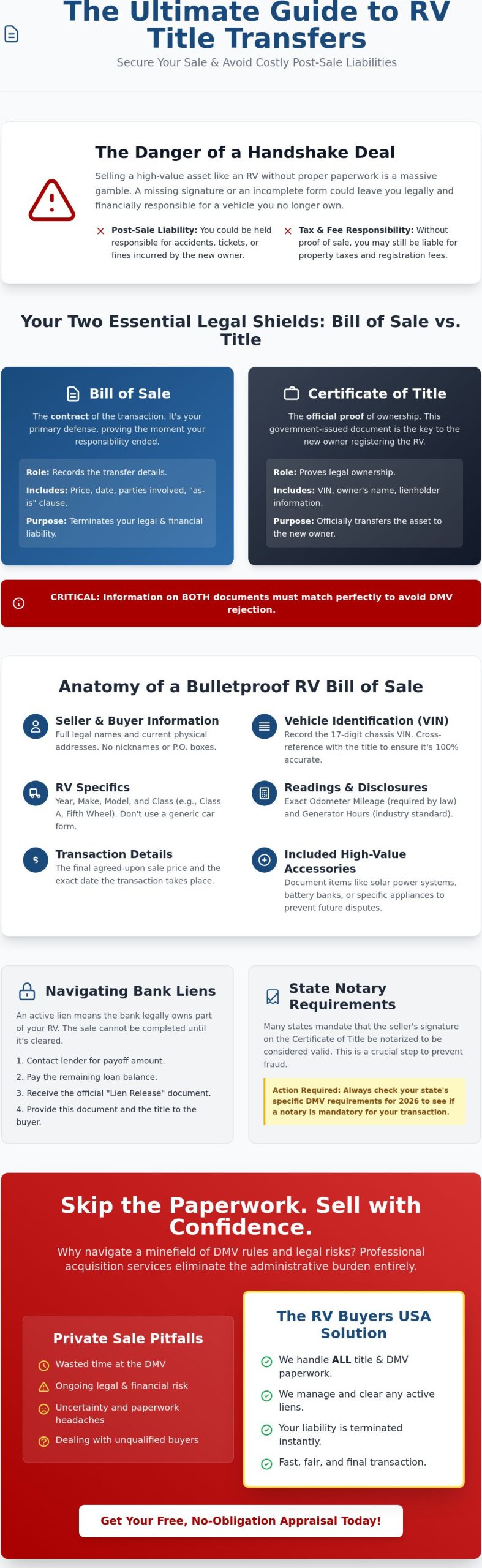
A handshake might work for a lawnmower, but it’s a dangerous gamble for a motorhome. When you sell a high-value asset, you need a document that stands up in court. An RV Bill of Sale acts as your primary defense. It is a legally binding contract that records the transfer of property from the seller to the buyer. Without it, you risk being held liable for an RV you no longer own. This is why having the rv title transfer paperwork explained becomes vital for your financial security.
This document does more than just record a price. It serves as your official exit from the vehicle’s history. Once signed, it provides the evidence needed to cancel your insurance policy and notify tax authorities that you aren’t responsible for property taxes or registration fees. A simple receipt lacks the technical detail required by most state DMVs to verify a change in status. To understand the broader context, you can review the legal definition of a bill of sale, which highlights its role in documenting a transfer of rights and protecting both parties in a transaction.
Why You Need a Specific RV Form
Recreational vehicles aren’t standard cars. They are rolling homes with complex systems. A generic automotive form won’t account for Class A motorhome specifics or the technical details of a Fifth Wheel. You need to document specialized components that impact value and liability:
- Generator run hours and recent maintenance history
- Solar power arrays and battery bank capacities
- Specific appliance models and slide-out functionality
- Onboard plumbing and waste system status
In the 2026 market, transparency is your best protection. Using a specific RV form ensures no critical detail is overlooked. This shields you from future claims about the vehicle’s condition at the time of sale. It turns a verbal agreement into a bulletproof record.
The Bill of Sale vs. The Title
Many sellers confuse the Bill of Sale with the Certificate of Title. They are separate but equally important. The Bill of Sale is a record of the transaction, including the date, price, and parties involved. The Title is the ultimate proof of legal ownership and lien status. You can’t have a successful transfer without both. If the information on your Bill of Sale doesn’t match the Title exactly, the DMV will reject the application. This synchronization is the core of having the rv title transfer paperwork explained correctly. Ensure every VIN digit and name spelling is identical across both documents to avoid costly delays and administrative headaches.
Step-by-Step: How to Accurately Fill Out an RV Bill of Sale
Precision is your best ally when completing an RV sale. A single digit error on a 17-character VIN can trigger a DMV rejection, forcing you to restart the entire process with a frustrated buyer. Having the rv title transfer paperwork explained means understanding that this document is the bridge between your ownership and the buyer’s new title. Start by gathering the full legal names and current addresses of all parties. Don’t rely on nicknames or P.O. boxes if the state requires a physical residence. Verification is the first step toward a clean break from the asset.
Identifying the Vehicle: VINs and Serial Numbers
Accuracy starts with the Vehicle Identification Number (VIN). For Class A, Class B, and Class C motorhomes, the 17-digit VIN is typically found on the steering column or the driver’s side dashboard. High-end trailers and Fifth Wheels often feature both a chassis VIN and a separate coach serial number. You must record the chassis VIN as the primary identifier. Cross-reference this number against your official title to ensure they match perfectly. If you’re unsure about specific state standards, reviewing official DMV title transfer requirements can help you identify which codes are mandatory for your local registration office.
Recording Odometer and Generator Readings
Federal and state laws require an Odometer Disclosure Statement for most motorized RVs. If your motorhome is less than 20 years old, you must record the mileage exactly as it appears on the dash at the moment of sale. For vintage campers where the odometer has “rolled over,” check the box indicating the mileage exceeds the mechanical limits. Don’t forget the generator. While not a legal requirement for the title, documenting generator hours is a standard industry practice. It provides a clear snapshot of the vehicle’s usage and protects you from claims that the engine or power systems were misrepresented.
Defining the Sale Price and Payment Terms
Clarity in the financial section prevents future tax disputes and legal headaches. List the final purchase price in U.S. Dollars. If you’ve accepted a deposit, subtract that from the total and clearly state the remaining balance due. If the transaction involves a trade-in, such as a smaller Travel Trailer being swapped toward a Class A, document the trade-in’s VIN and agreed-upon value. Before you sign, it’s a good idea to learn how to value your RV to ensure the price on the paper reflects the current 2026 market. Once you’re confident in the numbers, capture the final signatures of all owners listed on the title. If you want to skip the stress of private negotiations and complex forms, you can sell your RV to a professional buyer who handles all the administrative heavy lifting for you.
Navigating Liens, Notaries, and DMV Requirements
The DMV acts as the final gatekeeper for your transaction. Having the rv title transfer paperwork explained means recognizing that your local office won’t accept a document that lacks the proper stamps or signatures. This stage of the process often causes the most anxiety, especially when a bank still holds the title. You must coordinate with the lender and the buyer to ensure the transition of ownership is seamless and legally recognized across state lines. Your goal is a clean break that leaves no room for future disputes.
Selling an RV with an Outstanding Loan
If you still owe money on your Class A motorhome or Fifth Wheel, the bank is the legal title holder. Start by requesting a formal payoff quote from your lender. This document specifies the exact amount needed to release the lien. Most buyers are hesitant to hand over cash without seeing the physical title, so you may need to use a Power of Attorney form. This allows the buyer or a representative to act on the bank’s behalf to complete the transfer once the loan is satisfied. Escrow services provide an additional layer of security by holding the buyer’s funds until the lender confirms the lien release and sends the title to the new owner.
Notary Public and Witness Requirements
State laws vary significantly regarding notarization. If you are selling your RV in Louisiana, Maryland, Montana, New Hampshire, or West Virginia, a notary stamp is mandatory for a valid Bill of Sale. Even in states where it isn’t required, having a third-party witness sign the document is a smart move. It provides an extra layer of protection against future claims of fraud or coercion. You can find a notary at most banks, shipping centers, or local government offices. Bring a valid government-issued ID to the appointment and ensure all parties sign the document in the notary’s presence to make it official.
Multi-state sales add another layer of logistical complexity. For example, California requires the seller to notify the DMV within five days of the sale. If your buyer is from Oregon, they face a $101 title fee for their motorhome and a 30-day deadline to avoid a $50 late penalty. These regional differences are why many sellers prefer professional acquisition services. Experts handle the logistical heavy lifting, ensuring every state-specific requirement is met without you ever stepping foot in a DMV. This approach guarantees that the rv title transfer paperwork explained in this guide is executed perfectly for your specific location.
Common Mistakes to Avoid When Drafting Your Sales Document
Small mistakes on legal forms lead to massive delays at the DMV. When you have the rv title transfer paperwork explained correctly, you realize that precision is more than a suggestion; it is a requirement. If the buyer’s name on the Bill of Sale doesn’t match their government-issued ID exactly, the state will likely reject the transfer. This forces you back to the negotiating table with a buyer who may already be hundreds of miles away. Avoid using nicknames or shortened versions of names. Stick to the legal text to ensure the sale remains final and binding.
The Danger of Clerical Errors
A single digit error in a 17-character VIN can freeze a title transfer for months. Most DMV offices have zero tolerance for corrections on official documents. If you make a mistake, do not use white-out or cross out the text. You must start over with a fresh form. Using a blue or black ink pen is standard practice, as pencil or colored inks are often rejected by digital scanners. Double-check that the date of the sale matches the date listed on the title assignment section. If these dates are out of sync, it can trigger red flags regarding the timeline of ownership and insurance coverage.
Protecting Yourself with the “As-Is” Clause
Private sellers often forget to protect themselves from post-sale repair demands. Without an explicit “As-Is” clause, a buyer might try to hold you liable for a water leak or engine issue that appears a week after the transaction. You must clearly state that there are no warranties, expressed or implied. To make this legally sound, include a sentence stating: “The buyer has inspected the vehicle and accepts it in its current condition without any guarantees.”
You should also define the scope of the sale by listing included accessories. If you are keeping the weight-distribution hitch or the portable solar panels, write it down. Conversely, if these high-value items are staying with the Class A motorhome or Fifth Wheel, documenting them prevents future disputes over the final price. If you want to avoid the risk of clerical errors and the stress of drafting complex clauses, you can sell your RV to a professional acquisition expert who handles all the legal documentation for you. This ensures a clean transition without the administrative burden.
Skip the Paperwork: Why Professional Acquisition Beats Private Selling
Private sales often turn into a part-time job you never wanted. Between managing “tire kickers” who never show up and decoding the complex rv title transfer paperwork explained in this guide, the process can drag on for weeks. You also face the very real risk of fraudulent cashier’s checks or escrow scams that target high-value assets like motorhomes. Choosing professional acquisition eliminates these variables. You trade the uncertainty of the open market for a guaranteed, secure transaction that respects your time and your safety. It’s the most reliable way to ensure your liability ends the moment the keys change hands.
A professional buyer acts as your administrative partner. They assume the burden of communicating with the DMV and ensuring all state-specific forms are filed correctly. This is especially valuable if you’re dealing with a lost title or a complex bank lien that requires precise coordination with a lender. Instead of waiting for a private buyer to secure financing, you receive immediate liquidity. This allows you to stop paying for storage, insurance, and maintenance on a vehicle you no longer use. Speed and certainty are the primary benefits of this streamlined model.
The RV Buyers USA Advantage
We specialize in the rapid acquisition of Class A, Class B, and Class C motorhomes, along with Fifth Wheels, Travel Trailers, and Toy Haulers. Our team understands that your goal is a clean break. We manage every detail of the transfer, including the technical rv title transfer paperwork explained earlier, so you don’t have to. We even offer complimentary nationwide pickup; we come to your location to finalize the deal. This mobile service model removes the logistical headache of transporting a large vehicle to a dealership or meeting a stranger in a parking lot.
A Streamlined Path to Liquidity
Every month your RV sits on the market, it loses value through depreciation and carrying costs. Private buyers often lack the immediate funds to close a deal quickly; this leads to endless negotiations and broken promises. A professional transaction provides a secure, transparent alternative. You avoid the stress of multiple showings and the liability of a private test drive. When you are ready to move on, choose the efficient route. Get a fast cash offer and let us handle the paperwork to ensure your transition is simple, fair, and final.
Finalize Your RV Sale with Confidence
A successful sale requires more than just finding a buyer. It demands a precise paper trail that terminates your liability and secures your profit. You’ve seen how a detailed bill of sale acts as your legal shield and why avoiding clerical errors is the only way to bypass DMV delays in 2026. With the rv title transfer paperwork explained, you now have the tools to approach your transaction with total clarity. Whether you’re navigating a complex bank lien or ensuring your “As-Is” clause is ironclad, the right documentation is your best defense against future disputes.
If the administrative burden still feels overwhelming, there’s a faster way to reach the finish line. You can bypass the tire kickers and the endless DMV lines entirely. We provide immediate cash offers for Class A, B, and C motorhomes with professional title and DMV management included in every deal. Our team handles every signature and filing while providing complimentary nationwide pickup at your convenience. Skip the paperwork and sell your RV for cash today. You deserve a transition that is fast, fair, and completely stress-free.
Frequently Asked Questions
Is an RV bill of sale the same as a title?
No, these are two distinct documents with different legal functions. The title is a government-issued document that serves as the ultimate proof of ownership. The bill of sale is a private contract that records the specific details of the transaction, including the price and the date of the transfer. You need both to complete a valid sale for a Class A motorhome or a travel trailer.
Do I need a notary to sign my RV bill of sale?
Notarization requirements depend entirely on your state’s laws. As of 2026, states such as Montana, Louisiana, and Maryland mandate a notary stamp for the document to be legally recognized. Even if your state doesn’t require it, having the rv title transfer paperwork explained and witnessed by a notary provides a powerful layer of protection against future claims of fraud or identity theft.
How do I fill out a bill of sale if the RV has a lien?
Record the full purchase price and explicitly mention the lienholder’s information in the financial section. You must coordinate with your lender to obtain a payoff quote and ensure the lien is satisfied before the title can be released to the buyer. Many sellers use a Power of Attorney form to allow the buyer to finalize the title transfer once the bank receives the funds and releases its interest.
What happens if I make a mistake on the bill of sale form?
A clerical error usually means you must start over with a fresh document. DMV offices have zero tolerance for white-out, crossed-out text, or illegible entries on official transfer forms. If you realize a VIN digit or a name is incorrect, print a new form immediately. Submitting a flawed document can freeze the ownership transfer for months while the state verifies the information.
Is a bill of sale required for a travel trailer or 5th wheel?
Yes, most states require a bill of sale for all towables, including Fifth Wheels and Toy Haulers. This document is necessary for the buyer to register the vehicle and for the state to calculate the appropriate sales tax. It also serves as your primary evidence to terminate your liability and cancel your insurance policy once the trailer leaves your property.
Can I write my own RV bill of sale on a plain piece of paper?
While a handwritten agreement can be legally binding, it is risky for high-value assets. A plain piece of paper often lacks critical fields for generator hours, chassis VINs, or the essential “As-Is” clause. Using a professional template ensures all the rv title transfer paperwork explained in this guide is captured correctly to prevent future legal disputes or DMV rejections.
Does the bill of sale protect me if the buyer gets in an accident?
Yes, the bill of sale is your shield against post-sale liability. It records the exact date and time the buyer assumed ownership and responsibility for the vehicle. If an accident occurs after the transaction, this document proves you are no longer the owner. It’s the evidence you need to provide to your insurance company and the DMV to confirm the transfer is complete.
What information is absolutely required for the DMV to accept the form?
The DMV requires the 17-digit VIN, the final sale price, and the full legal names of both the buyer and the seller. You must also include the exact date of the sale and the signatures of every owner listed on the current title. If your motorhome is less than 20 years old, an accurate odometer reading is also a mandatory requirement for a successful transfer.