
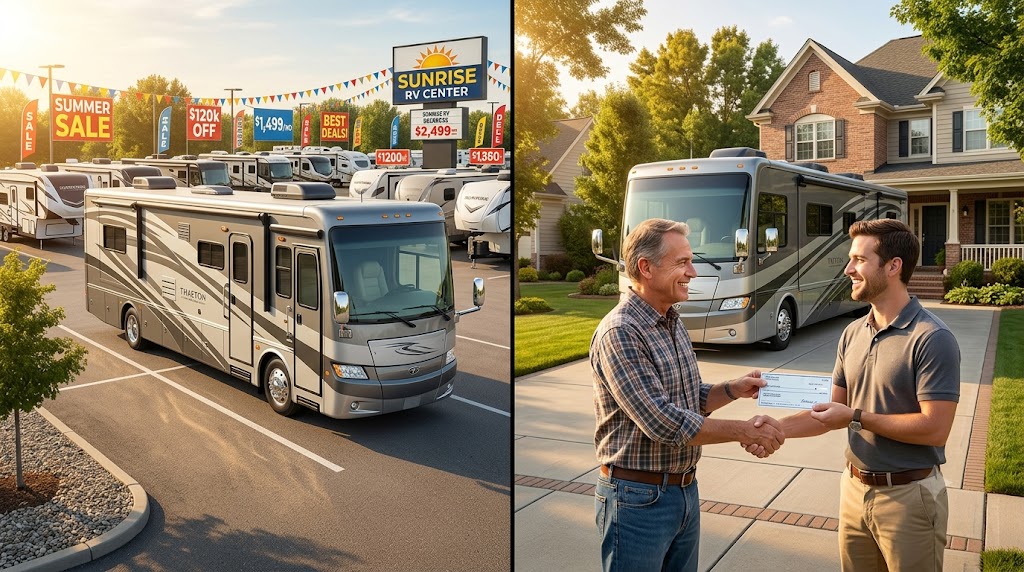
You are standing on a dealer’s lot, eyeing a newer rig, and the salesperson floats a number for your current RV. It sounds convenient. Drive in with the old one, drive out with the new one, sign a stack of papers, done. But that convenience has a price, and on an RV it is usually measured in thousands of dollars.
The choice between selling your RV and trading it in is really a choice about who keeps the resale profit: you or the dealer. Trade it in, and the dealer pockets the spread between what they pay you and what they sell it for. Sell it yourself or to a direct cash buyer, and that spread stays with you.
This guide breaks down what each route actually pays in 2026, where the trade-in math can tilt back in your favor, and how to figure out which option puts the most money in your account with the least hassle.
What a Trade-In Really Pays You
A trade-in value is not the same as your RV’s market value. When a dealership quotes a trade-in number, they are working backward from what they can resell your unit for, minus reconditioning costs, minus lot fees, minus the profit margin they need on the resale. What is left over is your offer.
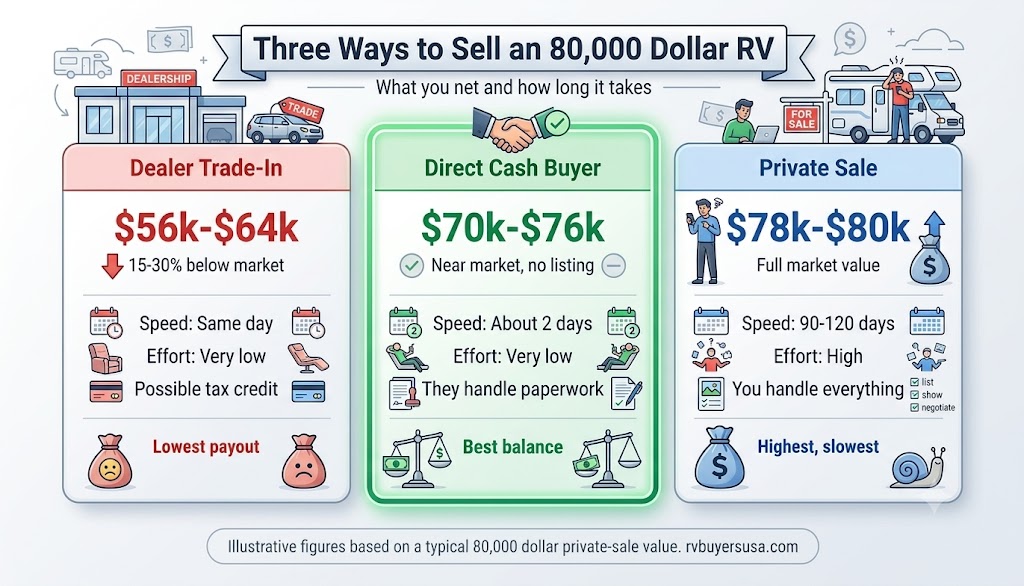
That is why trade-in figures track closely to wholesale value, not retail. Wholesale is the price the trade industry uses internally, and it sits well below what a private buyer would pay. In practice, RV trade-in offers tend to land 15 to 30 percent under what you could get from a private or direct cash sale.
Run the numbers on a real example. Say your motorhome would sell for 80,000 dollars in a private deal. A 20 percent trade-in discount drops the offer to 64,000 dollars. A 30 percent discount drops it to 56,000 dollars. That is 16,000 to 24,000 dollars handed to the dealer in exchange for the convenience of not selling it yourself.
Here is the thing about that convenience. It is genuinely worth something if your time is tight and you are buying from the same dealer anyway. But most sellers overestimate how painful the alternative is and underestimate how much the trade discount costs them.
What a Private Sale Pays (and What It Costs You)
Selling your RV privately captures the highest number on paper. You set the price, you negotiate directly, and there is no middleman taking a cut. For a clean, well-maintained rig with good photos and an honest listing, you can realistically reach close to full market value.
The catch is what it takes to get there. A private RV sale is a project, not an afternoon. Consider what the process actually involves:
- Time on market. Private RV sales average 90 to 120 days. Big motorhomes and specialty rigs can sit even longer because the buyer pool is small.
- Showings and strangers. You are scheduling test drives, answering the same questions over and over, and letting people you have never met into your driveway and your rig.
- Tire-kickers and lowballers. A chunk of the inquiries never had the cash or the intent. You sort through them anyway.
- Paperwork and payment risk. Title transfer, bill of sale, DMV steps, and the very real danger of a bad check or a scam wire.
None of that is impossible. Plenty of owners do it and come out ahead. But the gap between the private-sale price and the trade-in price is not pure profit. Part of it is payment for three or four months of work and worry. The question is whether there is an option that captures most of that higher price without the months of effort.
The Direct Cash Sale: The Option Most Sellers Overlook
There is a third path that sits between the two extremes, and it is the one most owners never seriously consider. A direct cash buyer is a company that purchases your RV outright, for cash, without reselling it to you the way a dealer does on a trade.
Because a buyer like RV Buyers USA is not running you through a new-RV sale, there is no trade markup baked into the offer. The number reflects what your rig is actually worth, based on current market data and recent comparable sales. That is how a direct cash offer can beat dealer trade-in values by 15 to 30 percent while still closing fast.
The process is built to remove the parts of a private sale people dread. You share basic details about your RV, you get a cash offer within 24 hours, and if you accept, the buyer drives to your location anywhere in the contiguous 48 states. They handle the title transfer, the bill of sale, and the DMV paperwork. They can even pay off an existing loan and pay you the difference. Start to finish, it usually takes about two days.
So why do most sellers still try the trade-in or the private route first? Because nobody tells them a fast sale and a fair price can be the same transaction. They assume speed always means a discount. With a direct cash buyer, it does not.
When a Trade-In Actually Makes Sense
Trading in is not always the wrong move, and it would be dishonest to pretend otherwise. There are a few situations where the math gets closer, and a couple where a trade-in genuinely wins.
The biggest one is sales tax. In many states, when you trade an RV in, you only pay sales tax on the difference between the new RV’s price and your trade-in credit. If you are buying a 150,000 dollar motorhome and trading in one worth 60,000, you could avoid tax on that 60,000. At a 7 percent rate, that is roughly 4,200 dollars in savings.
That savings can narrow the gap, but it rarely closes it. If the trade-in offer is 16,000 dollars below a cash sale and the tax break is 4,200 dollars, you are still ahead by selling for cash and paying full tax on the new rig. And in states with no vehicle sales tax or a low rate, the trade-in tax advantage shrinks to almost nothing.
A trade-in makes the most sense when three things are true at once: you are buying a new RV from the same dealer right now, your state offers a meaningful trade-in tax credit, and you value speed and simplicity over squeezing out the last few thousand dollars. If even one of those is missing, it is worth getting a cash offer before you sign anything.
How to Decide in Under an Hour
You do not need a spreadsheet and a weekend to make this call. You need three numbers, and you can gather them quickly.
- Get the trade-in offer in writing. Ask the dealer for their trade number as a standalone figure, separate from any discount on the new RV. Dealers love to blur those together so the trade looks better than it is.
- Get a direct cash offer. Request a free appraisal from a cash buyer. It takes a couple of minutes and there is no obligation, so you have a real market-based number to compare against.
- Estimate your private-sale ceiling. Check recent sold listings for your exact make, model, year, and condition. That is your best-case price if you are willing to wait months.
Lay the three side by side. Then subtract any trade-in tax credit your state offers from the gap between the trade and the cash offer. In the large majority of cases, the cash offer wins on dollars, ties on effort, and beats both other options on speed. That is the combination most sellers are actually looking for, even when they walk onto the lot expecting to trade.
Frequently Asked Questions
Do you get more money selling an RV or trading it in?
In most cases you get more money selling your RV, either privately or to a dedicated cash buyer, than trading it in at a dealership. A dealer has to resell your RV at a profit, so the trade-in offer is built around wholesale value. A private or direct cash sale skips that markup, which often puts thousands of dollars more in your pocket.
How much less is an RV trade-in value compared to selling?
RV trade-in offers commonly come in 15 to 30 percent below what you could get from a private or direct cash sale. On a motorhome worth 80,000 dollars in a private sale, that gap can mean 12,000 to 24,000 dollars left on the table.
Is trading in an RV worth it for the sales tax savings?
A trade-in can lower the sales tax on your next RV in many states, because you are only taxed on the difference between the new RV price and your trade-in credit. That savings is real, but it rarely makes up for the larger trade-in discount, especially in states with no sales tax on vehicles or lower tax rates.
What is the fastest way to sell an RV without a dealer?
The fastest no-dealer option is selling to a direct cash buyer. Companies like RV Buyers USA give a cash offer within 24 hours, come to your location anywhere in the contiguous 48 states, handle the paperwork, and close in about two days. That is far quicker than a private listing, which averages 90 to 120 days.
Can I sell my RV if I still owe money on it?
Yes. A direct cash buyer can pay off your remaining loan as part of the transaction and pay you the difference if your RV is worth more than the payoff. You sign the paperwork, the lender gets paid directly, and the title clears without you fronting the balance.
Does a trade-in or a cash sale involve less paperwork?
Both can be low-effort if you pick the right buyer. A dealer handles trade-in paperwork because they are also selling you a unit. A reputable cash buyer handles the title transfer, bill of sale, and DMV documents too, so the paperwork load is similar while the payout is usually higher.
Get a Real Number Before You Trade
The worst time to find out your RV was worth more is after you have already signed it over to a dealer. Before you accept any trade-in offer, get a free, no-obligation cash appraisal from RV Buyers USA. It takes about two minutes, you get your offer within 24 hours, and there is zero pressure to accept. Worst case, you walk back to the dealer with a stronger number. Best case, you sell in two days for thousands more and skip the lot entirely. Request your free RV appraisal today and see what your rig is really worth.