
Most people selling an RV make the same mistake before they even post a listing or call a buyer: they pick a number out of thin air. They remember what they paid three years ago, subtract something for wear, and call it a price. Then they’re surprised when buyers walk away or offers come in far below what they expected.
Before you accept any offer, trade your unit in, or list it anywhere, you need an accurate picture of what your RV is actually worth in today’s market. That number is different from what you paid. It’s different from what your neighbor got for a similar rig two years ago. And it’s different from what NADA says, at least in some cases.
This guide breaks down how RV valuation actually works, what factors move the number up or down, and how to arrive at a price you can defend no matter which selling route you choose.
Start With the NADA Number — But Don’t Stop There
NADA Guides (now part of J.D. Power) is the standard starting point for RV valuation. You enter the year, make, model, length, and optional features, and the tool returns a baseline value broken down by suggested retail, low retail, and average trade-in.
That number is a calculated average pulled from historical sales data across the country. It’s useful as a baseline, but it’s not the final word on what your specific unit is worth.
Here’s the thing: NADA doesn’t know your local market. A travel trailer priced at $28,000 in NADA might sell for $32,000 in the upper Midwest during spring camping season, and $24,000 in a saturated market with ten similar rigs already listed. Regional demand matters, and NADA can’t account for it.
Use it as your anchor. Then go check what’s actually happening around you.
Check Active Listings for Real Market Data
After you get your NADA number, search RV Trader, Facebook Marketplace, and Craigslist for rigs that match yours as closely as possible. Same type (Class A, Class C, fifth wheel, travel trailer), similar year, similar length. You’re looking for asking prices on active listings, not sold prices, because sold data for private RV sales isn’t easy to access the way it is with real estate.
Look at 8 to 10 comparable listings. Notice the range. Notice whether the listings near the top have upgrades your unit doesn’t have. Notice whether the cheaper ones have clear issues in the photos or descriptions.
That range is your real market window. Your NADA value should sit somewhere inside it. If it doesn’t, you have information worth thinking about before you set your price.
How Depreciation Works (And Why It Matters More Than You Think)
RVs are depreciating assets. That’s not a complaint, just a fact worth understanding before you have expectations about your sale price.
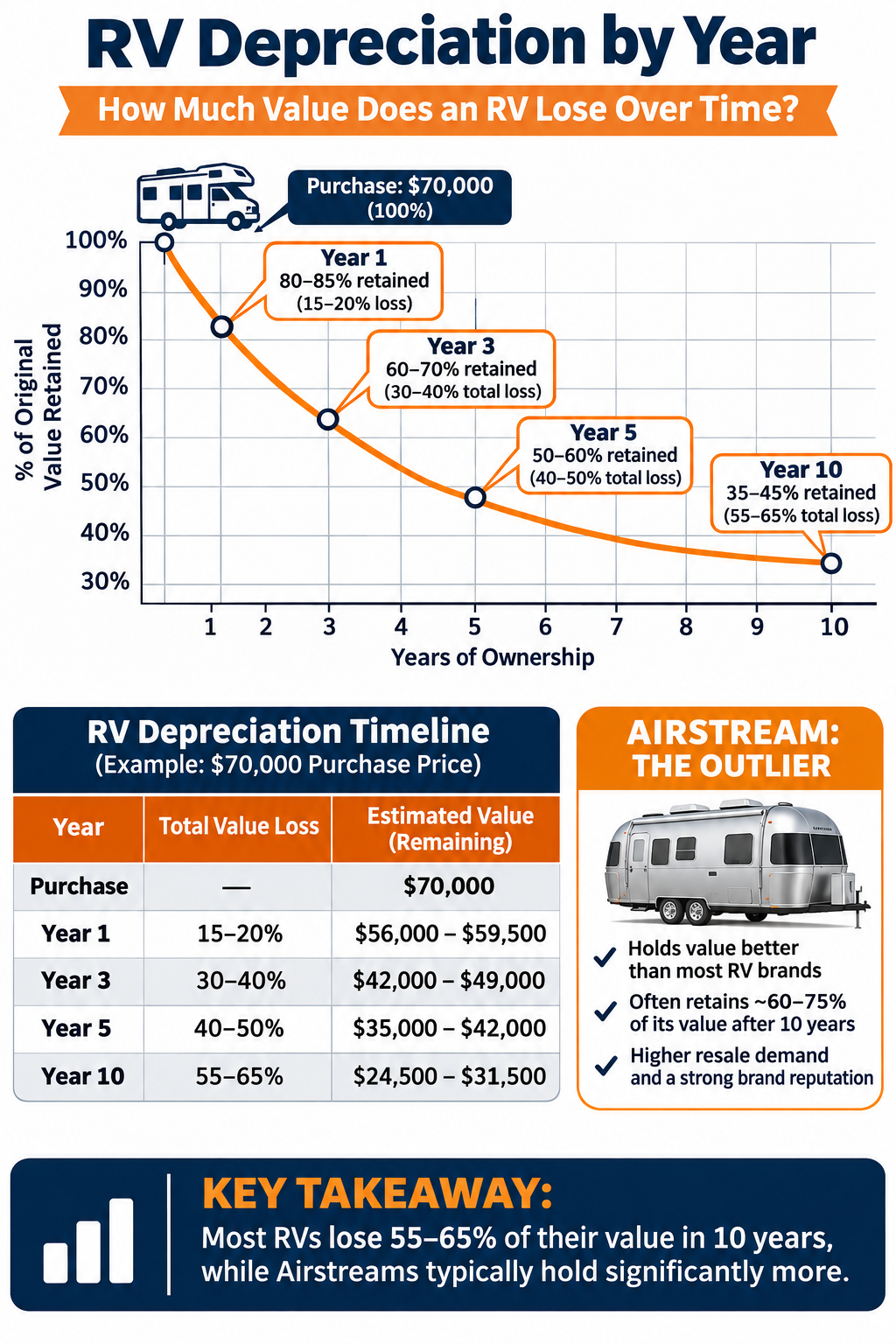
A typical RV loses 15 to 20 percent of its value in the first year. After that, depreciation runs around 10 to 15 percent annually for years two through five, then slows to roughly 5 to 10 percent per year once the unit hits the five-year mark. A brand-new $80,000 fifth wheel can realistically be worth $55,000 to $60,000 by year three, even in good condition.
There are exceptions. Airstreams hold their value better than almost any other trailer type, often selling within 10 to 15 percent of their original price after a decade. High-quality diesel pushers from reputable manufacturers also tend to retain value well. But for most entry- and mid-range RVs, depreciation is steep and starts the day you drive off the lot.
Why does this matter? Because the gap between what you paid and what you’ll get can be significant. Going in with clear expectations prevents you from walking away from a fair offer because it felt lower than you hoped.
The Factors That Move Your Number Up or Down
Two RVs from the same year and model line can be worth very different amounts. Here’s what actually affects the number:
Condition of the roof and seals. Water damage is the single biggest value killer in the RV market. Buyers and appraisers check the roof first. Any sign of delamination, soft spots, or staining from a leak drops the value considerably. A clean roof with intact seals is one of the best things your unit can have going for it.
Mechanical history. For motorized units, engine and transmission condition matter significantly. A documented service history is worth real money. An unknown history raises flags.
Interior condition. Dingy upholstery, worn flooring, and dirty appliances all knock down perceived value. Buyers form strong impressions fast, and first looks in an RV carry a lot of weight. A clean interior can make an older unit feel younger than it is.
Mileage (for motorhomes). High mileage affects value, but condition can offset it. A 90,000-mile Class A that has been serviced religiously will often sell for more than a 60,000-mile unit with no maintenance records.
Slide rooms and upgrades. Additional slides, solar packages, residential refrigerators, and upgraded entertainment systems all add real value. If your unit has features that entry-level models don’t, make sure those are reflected in your price.
Time of year. RV values are seasonal. Listings in February and March attract buyers planning spring trips. Winter listings in cold climates compete for a smaller pool of buyers. Timing your sale to align with buying season can add meaningful dollars to your outcome.
What a Cash Buyer Will Offer — And Why
If you’re considering selling to a cash buyer rather than listing privately or trading in at a dealership, it helps to understand how cash buyers arrive at their numbers.
Cash buyers offer below private-sale retail. That’s not a trick — it’s the trade-off for a guaranteed, fast, paperwork-light transaction. Think of the spread between what a car dealership pays for a trade-in and what they list it for on the lot. There’s a gap there, and that gap covers their risk, overhead, and profit when they resell the unit.
A cash buyer offer will typically land somewhere between NADA trade-in and NADA average retail. If your private-sale asking price is $32,000 and the NADA trade-in is $22,000, a cash buyer might offer somewhere in the $25,000 to $28,000 range depending on condition and market demand.
Whether that trade-off makes sense depends entirely on your situation. If you need a fast, certain sale without the hassle of showings, negotiations, and strangers visiting your property, the convenience premium is real. If you have time and patience to find the right private buyer, you might do better going that route.
Frequently Asked Questions
How do I find out what my RV is worth?
Start with NADA Guides (nadaguides.com) or J.D. Power’s RV valuation tool. Enter your RV’s year, make, model, and length to get a baseline value. Then check active listings on RV Trader or Facebook Marketplace to see what comparable rigs are actually selling for in your region. The market price is often different from the book value, so check both.
Do RVs hold their value well?
Most RVs do not hold their value well compared to real estate or certain vehicles. A typical RV loses 15 to 20 percent of its value in the first year alone, then continues depreciating 10 to 15 percent annually after that. Exceptions include Airstream trailers and high-end diesel pushers, which tend to retain value better than average.
What year RVs lose the most value?
The steepest drop happens in years one through three. A brand-new RV can lose 20 to 30 percent of its purchase price the moment it leaves the dealership lot. After year five, depreciation slows considerably and tends to level off around 5 to 10 percent annually, depending on how well the unit has been maintained.
Does condition affect RV value more than age?
Yes, condition can outweigh age significantly. A 10-year-old RV that has been garaged, serviced regularly, and kept free of water damage will often command more than a 6-year-old unit that has been stored outside and shows deferred maintenance. Buyers and cash buyer services both pay attention to roof condition, interior cleanliness, mechanical history, and appliance function.
What is the difference between NADA value and actual market value?
NADA provides a standardized baseline calculated from historical sales data and regional averages. Actual market value is what buyers in your specific area are willing to pay right now. In a strong seller’s market, your RV might sell above NADA. In a slow market or saturated region, it might go for less. Always check active local listings alongside the NADA number.
Will a cash buyer offer me fair market value for my RV?
A cash buyer typically offers slightly below private-sale market value in exchange for speed, convenience, and a guaranteed close. Think of it like the spread between retail and wholesale. If you price your RV right for a private sale, you might get more money, but you also take on the time and risk of finding a qualified buyer. Cash buyers eliminate that uncertainty entirely.
Ready to see what RV Buyers USA will pay for your unit? We buy RVs of all types, ages, and conditions across the Midwest. Get a no-pressure cash offer by calling us directly or filling out our quick online form — most sellers hear back within 24 hours.