
You’re making payments on an RV you no longer use. Maybe your travel plans changed. Maybe the kids are grown. Maybe the storage fees alone are starting to feel absurd. Whatever the reason, you’re ready to sell — but there’s a loan attached to the title, and you’re not sure what that means for you.
Here’s the short answer: yes, you can sell an RV you still owe money on. People do it all the time. The process has a few extra steps compared to selling a unit you own free and clear, but it’s not complicated once you understand what those steps are.
What gets people into trouble isn’t the loan itself — it’s not knowing the process and going into a transaction unprepared. This guide walks you through exactly what happens when you sell an RV with an outstanding balance, including what to do if you owe more than the unit is worth.
Step One: Get Your Payoff Amount
Before you do anything else, call your lender and ask for a formal payoff statement. This is the most important number in the transaction, and it’s not the same as your current loan balance.
Your current balance is a snapshot of what you owe today. Your payoff amount is the precise figure needed to fully satisfy and close the loan, including any accrued interest calculated through a specific date. Interest on RV loans accrues daily, so the payoff amount will be slightly different tomorrow than it is today.
Ask for a written payoff statement good through a date at least two weeks out. That gives you enough time to complete a sale before the number changes. Keep that document handy — a buyer, cash buyer, or dealership will ask for it.
Step Two: Know Whether You Have Equity or Not
Once you have your payoff amount, compare it to what your RV is actually worth in today’s market. If the market value is higher than what you owe, you have equity. That equity is yours at closing after the loan gets paid off.
If the payoff amount is higher than the market value, you’re upside down on the loan. That’s a harder situation, but it doesn’t mean you’re stuck.
Being underwater on an RV loan is more common than people realize, especially with units purchased new in the last three to five years. RVs depreciate fast — 15 to 20 percent in year one, then steadily after that — and many buyers finance at full retail price. The loan balance can outpace the value for years before the two numbers cross.
What Happens When You Have Equity
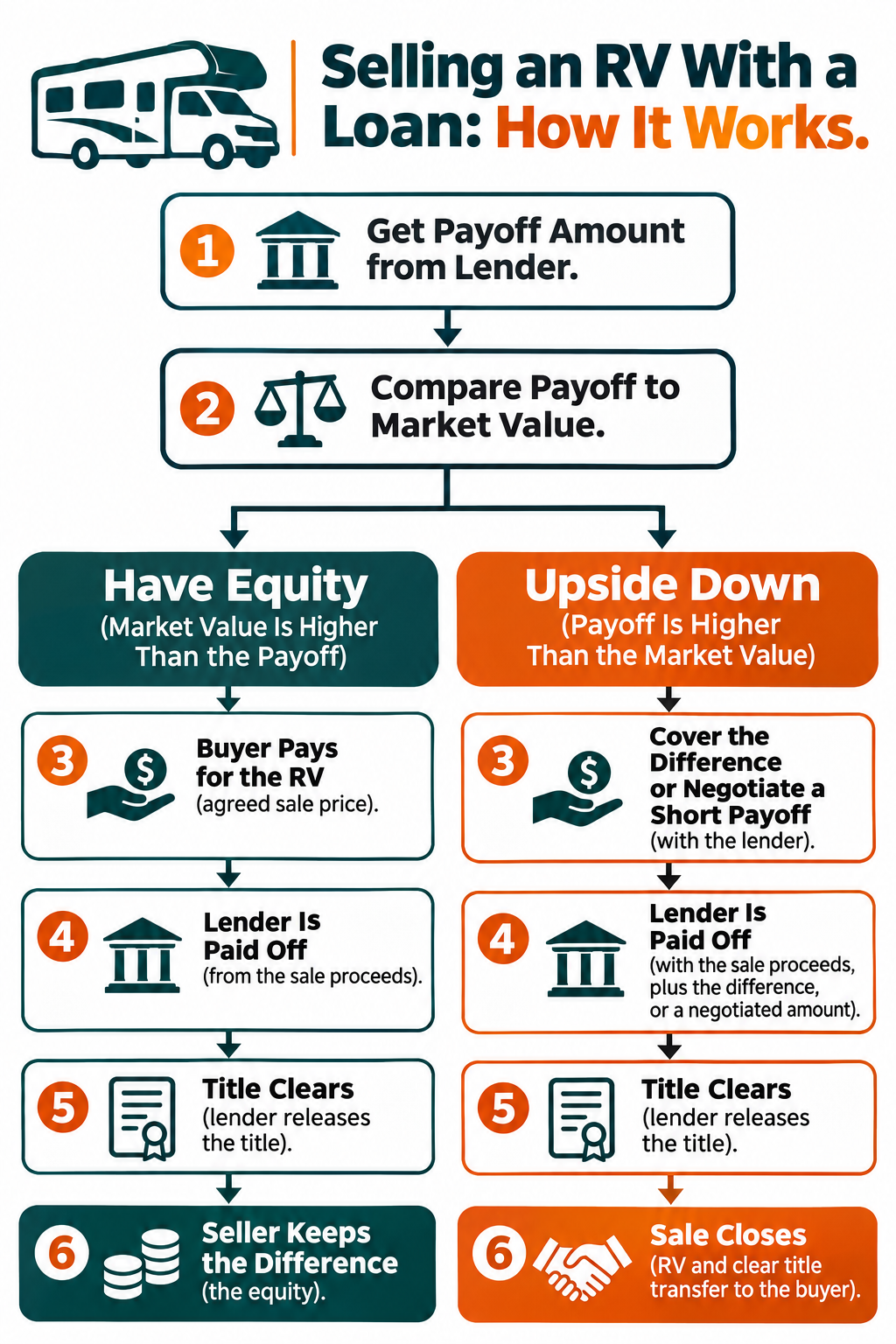
This is the straightforward scenario. The buyer pays for the RV, that money goes to your lender to satisfy the loan, the lien gets released, and the remaining balance after payoff comes to you. The sequence looks like this:
- You and the buyer agree on a price.
- The buyer’s funds (or the cash buyer’s payment) are directed to your lender in the payoff amount.
- The lender confirms the payoff and releases the lien.
- The title transfers to the buyer, clean and clear.
- Any remaining funds after the payoff go to you.
The exact mechanics vary slightly depending on whether you’re selling to a private buyer, a dealership, or a cash buyer company. The basic flow stays the same.
What Happens When You’re Underwater
If you owe more than the RV is worth, you have a few options. None of them are particularly fun, but they’re all manageable.
Pay the difference at closing. If the RV sells for $24,000 but you owe $29,000, you bring $5,000 to the table to close the loan. The lender gets paid in full, the title clears, and the sale closes. This only makes sense if getting out from under the monthly payments and storage fees saves you more in the long run than that lump sum costs you.
Wait until you have equity. Keep making payments until the loan balance drops below the market value, then sell. How long that takes depends on your interest rate, payment size, and how quickly the market value is declining. In some cases it’s a matter of months. In others, it takes longer.
Negotiate a short payoff with your lender. Some lenders, particularly for RVs, will accept less than the full payoff amount to close a loan if the alternative is a default or repossession. This isn’t guaranteed and requires the lender’s agreement, but it’s worth asking about if you’re significantly underwater.
Sell to a cash buyer who handles the lien directly. Professional cash buyers deal with lien payoffs regularly. They’ll contact your lender, confirm the payoff amount, structure the transaction so the lender gets paid, and handle the title transfer. You don’t have to coordinate between a private buyer, a bank, and a DMV on your own.
The Title: What You Need to Know
A lien on an RV title is publicly recorded. When a buyer or their representative does a title search — and any serious buyer will — the lien shows up immediately. You can’t transfer a clear title to a buyer until that lien is released by the lender.
If you’re dealing with a private buyer who isn’t experienced buying financed vehicles, this part can get awkward. They may not understand why they can’t just get the title the day of the sale. The lender has to process the payoff and issue a lien release, which can take a few business days to a few weeks depending on the institution.
Cash buyers and dealerships know this process and handle it without drama. They’ve done it hundreds of times. Private buyers may not have, which adds friction to an already multi-step transaction.
Frequently Asked Questions
Can I sell an RV I still owe money on?
Yes. Selling an RV with an outstanding loan is legal and common. You’ll need to pay off the remaining loan balance as part of the transaction, either from the sale proceeds or out of pocket if you owe more than the RV is worth. The lien on the title gets cleared before or at the time of closing, and then the title transfers cleanly to the buyer.
What happens if I owe more on my RV than it is worth?
This is called being underwater or upside down on the loan. You still have options. You can pay the difference between the sale price and the loan balance out of pocket at closing. Some lenders will work with you on a short payoff arrangement. You can also continue paying down the loan until you have equity, then sell. A cash buyer or dealer can sometimes help structure the transaction so the lender is paid directly.
How do I get my RV payoff amount?
Call your lender and ask for a formal payoff statement. This is different from your current loan balance — it includes any accrued interest up to a specific date and may vary day to day. Ask for the payoff amount good through a date at least 10 to 14 days out to give yourself room to close the transaction before it changes.
Does the buyer need to know about the loan on my RV?
Yes. Any lien on the RV title is publicly recorded and will show up during the title check. Trying to sell without disclosing an active lien creates legal problems. In a legitimate transaction, the lien gets paid off as part of closing — either the buyer’s funds go directly to the lender, or you pay it off first and then transfer a clear title.
Can a cash buyer handle an RV that still has a lien on it?
Yes. Cash buyers who regularly purchase RVs handle lien payoffs as part of their standard process. They’ll request your payoff amount, contact your lender directly if needed, and structure the transaction so the loan is satisfied and the title clears — without you having to coordinate all of that yourself. It’s one of the main advantages of selling to a professional buyer over a private individual.
If you’re ready to move on from an RV you’re still making payments on, RV Buyers USA can walk you through the process and make you a cash offer — loan or no loan. We handle the lien coordination so you don’t have to. Reach out today and find out exactly where you stand.