
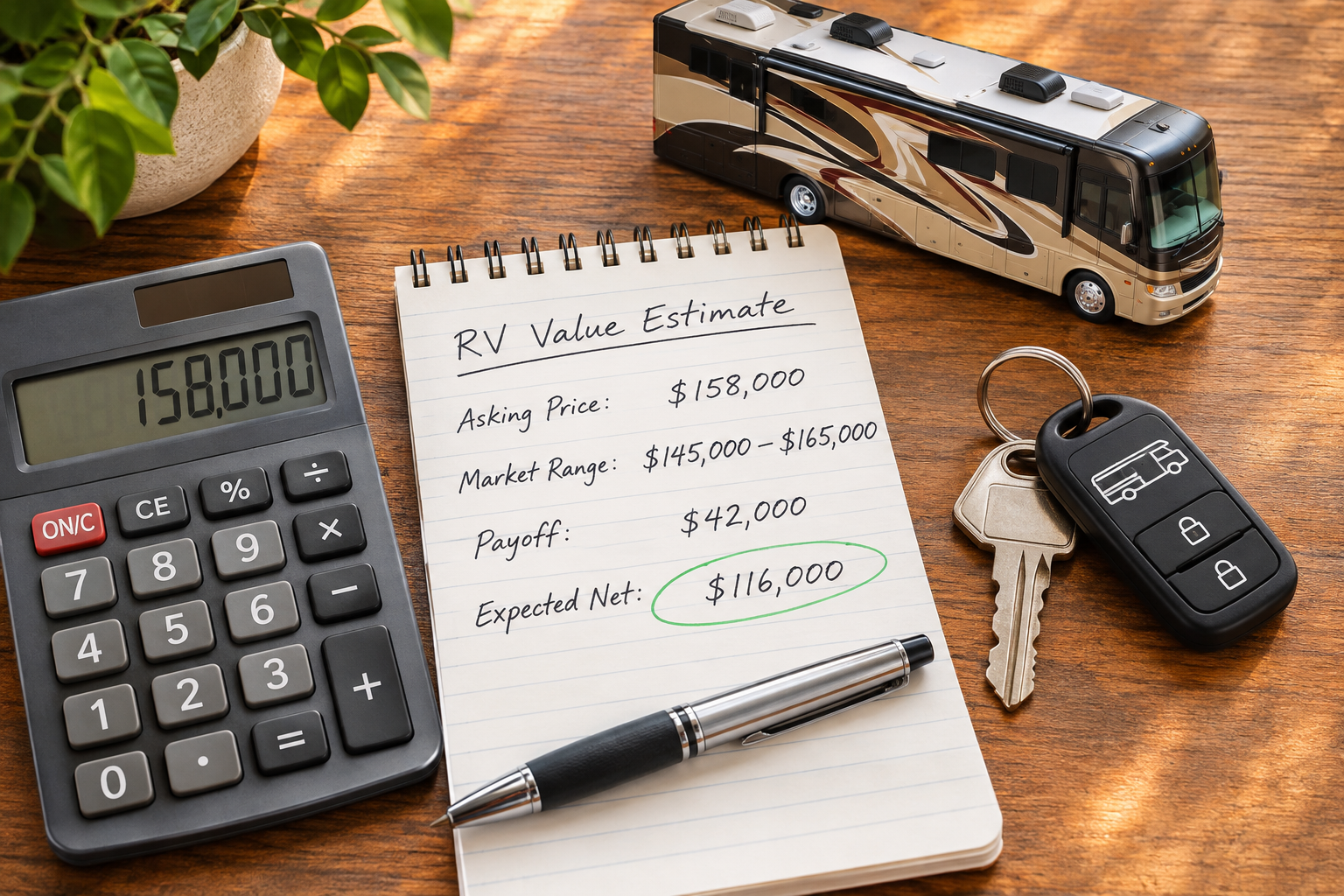
Most people asking this question are picturing one number: a listing fee, maybe a commission. The real answer is that selling a motorhome costs more than a single line item, and the biggest expense is usually the one nobody writes down.
Let’s put actual figures on it. Here’s what each way of selling really costs, so you can pick the route that leaves the most money in your pocket instead of the one that just looks cheapest.
Consignment: the commission is the headline, not the whole story
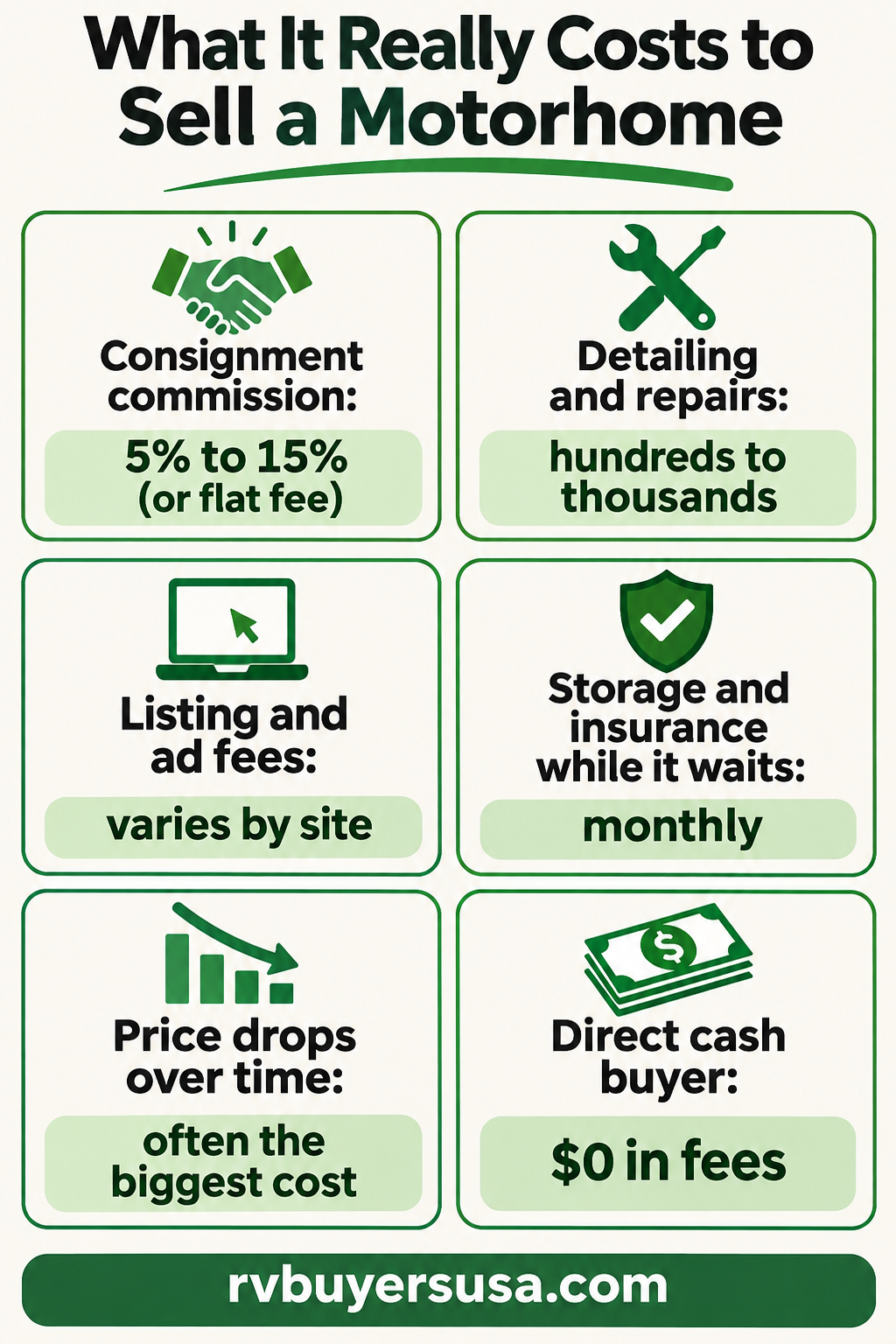
Consignment sounds easy. The dealer parks your motorhome on their lot, handles the buyers, and sells it for you. In exchange, they take a cut. That cut is usually a commission of 5% to 15% of the sale price, or a flat fee, and some dealers use a tiered rate that shrinks as the price climbs.
Run the math on a real number. If your Class C sells for $60,000 and the dealer takes 10%, that’s $6,000 gone before you see a dime. On a higher-end diesel pusher, the same percentage is a much bigger check written out of your proceeds.
Then read the fine print, because the commission often isn’t the end of it. Consignment contracts can add prep and detailing charges, a minimum fee if it sells cheap, storage fees, and deductions for repairs the dealer decides it needs to move. Ask one blunt question before you sign anything: what, exactly, comes out of my check? Get the commission, who controls the asking price, and how long they’ll hold it, all in writing.
Private sale: cheaper on paper, costly in time
Selling it yourself skips the commission, which is why it looks like the money-saver. And the direct costs are genuinely low. A listing on a major site like RV Trader runs a modest fee, more if you want featured placement. Facebook Marketplace and Craigslist are cheaper or free. Add some detailing and a few small fixes to show well, and your out-of-pocket might be a couple hundred dollars.
The catch is that a private sale bills you in a currency that doesn’t show up on a receipt: your time and your patience. You’re writing the listing, answering messages, scheduling showings, sitting through no-shows, and vetting strangers, sometimes for months. That’s the real price of the private route, and only you can decide what your weekends are worth.
The carrying costs almost everyone forgets
Here’s the expense that quietly beats every commission. While your motorhome waits to sell, it keeps costing you money every single month. Insurance. Storage or a lot fee. Registration. If you still have a loan, interest. And underneath all of that, the market value keeps sliding, because a motorhome is a depreciating asset that doesn’t pause while you wait for the right buyer.
Say your unit costs you $250 a month to insure and store, and it sits for five months. That’s $1,250 in carrying costs, and it doesn’t even count the loan interest or the couple thousand in value it shed over those same five months. Stack that against a consignment commission and the “expensive” quick sale often turns out cheaper once the calendar gets involved. Time is the fee nobody quotes you.
Price drops: the cost that hides as a decision
There’s one more cost worth naming, because sellers rarely count it as a cost at all. When a motorhome sits, the fix is almost always a price cut. Drop it five thousand, wait, drop it again. Each of those cuts is money you decided to give up, but because you made the choice yourself, it doesn’t feel like a fee. It spends exactly like one.
Overpricing at the start is what triggers this cycle, so the cheapest thing you can do in any private or consignment sale is price it right on day one using real comparable listings, not the number you wish it were worth.
Selling to a cash buyer: what it costs and what it doesn’t
A direct cash sale is the one route with no commission, no listing fee, and no prep charges. At RV Buyers USA there’s nothing deducted from what you’re paid. You tell us the year, class, and condition of your motorhome, we send a no-obligation cash offer within 24 hours, and if you accept, we come to you anywhere in the contiguous 48 states, handle the title and DMV paperwork ourselves, and can pay off your existing loan. We buy as-is, so there’s no detailing or repair bill either.
The honest trade-off: a direct offer is built for speed and certainty, not for wringing out the last possible dollar a patient private seller might eventually find. What you’re buying is a clean, fast, fee-free exit with a known number and no carrying costs piling up while you wait. For a lot of owners, once you subtract the commission, the prep, and the months of holding costs, that number nets out better than it first looks. One note on fit: we buy motorized Class A, B, and C units, model year 2016 and newer, and we don’t buy travel trailers, fifth wheels, or other towables.
Frequently Asked Questions
How much does it cost to sell a motorhome?
It depends entirely on how you sell. A private sale can cost little more than a listing fee and some detailing, though you pay in time and carrying costs. Dealer consignment usually takes a 5% to 15% commission or a flat fee that can run into the thousands. Selling directly to a cash buyer typically costs nothing in fees.
What percentage do RV consignment dealers take?
Most consignment dealers charge a commission somewhere between 5% and 15% of the sale price, or a flat fee, and some use a tiered structure. On a motorhome that sells for $60,000, a 10% commission is $6,000 out of your proceeds. Always get the fee, the pricing control, and the timeline in writing before you sign.
Are there hidden fees when selling a motorhome on consignment?
Sometimes. Beyond the commission, a consignment contract can include prep or detailing charges, a minimum fee, storage fees, and deductions for repairs the dealer decides are needed to sell it. Read the contract closely and ask what comes out of your check before the motorhome ever hits the lot.
Do I have to pay to list my motorhome for sale?
On the big marketplaces, usually yes. Sites like RV Trader charge a listing fee, and enhanced or featured placement costs more. Facebook Marketplace and Craigslist are cheaper or free but bring more low-quality inquiries. Either way, the listing fee is small next to the carrying costs of a motorhome that sits unsold.
What are the hidden costs of a motorhome that takes months to sell?
Every month it sits, you keep paying insurance, storage or a lot fee, registration, and often loan interest, while the market value keeps sliding. Those carrying costs plus depreciation are frequently the single largest cost of selling, and they never show up as a line item, which is why so many owners underestimate them.
Is there a way to sell a motorhome with no fees?
Yes. Selling directly to a cash buyer like RV Buyers USA has no commission, no listing fee, and no prep charges. You get a cash offer, the buyer handles the title and DMV paperwork, and there’s nothing deducted from what you’re paid. The trade-off is that a direct offer prioritizes speed and certainty over squeezing out the last dollar.
See your number with zero fees attached
Before you sign a consignment contract or pay for a single listing, find out what a fee-free cash offer looks like. Tell RV Buyers USA your motorhome’s year, class, and condition, and we’ll send a no-obligation number within 24 hours, nothing deducted. Call (619) 993-1439 or request your offer online, then compare it against the commission and carrying costs of every other route.