
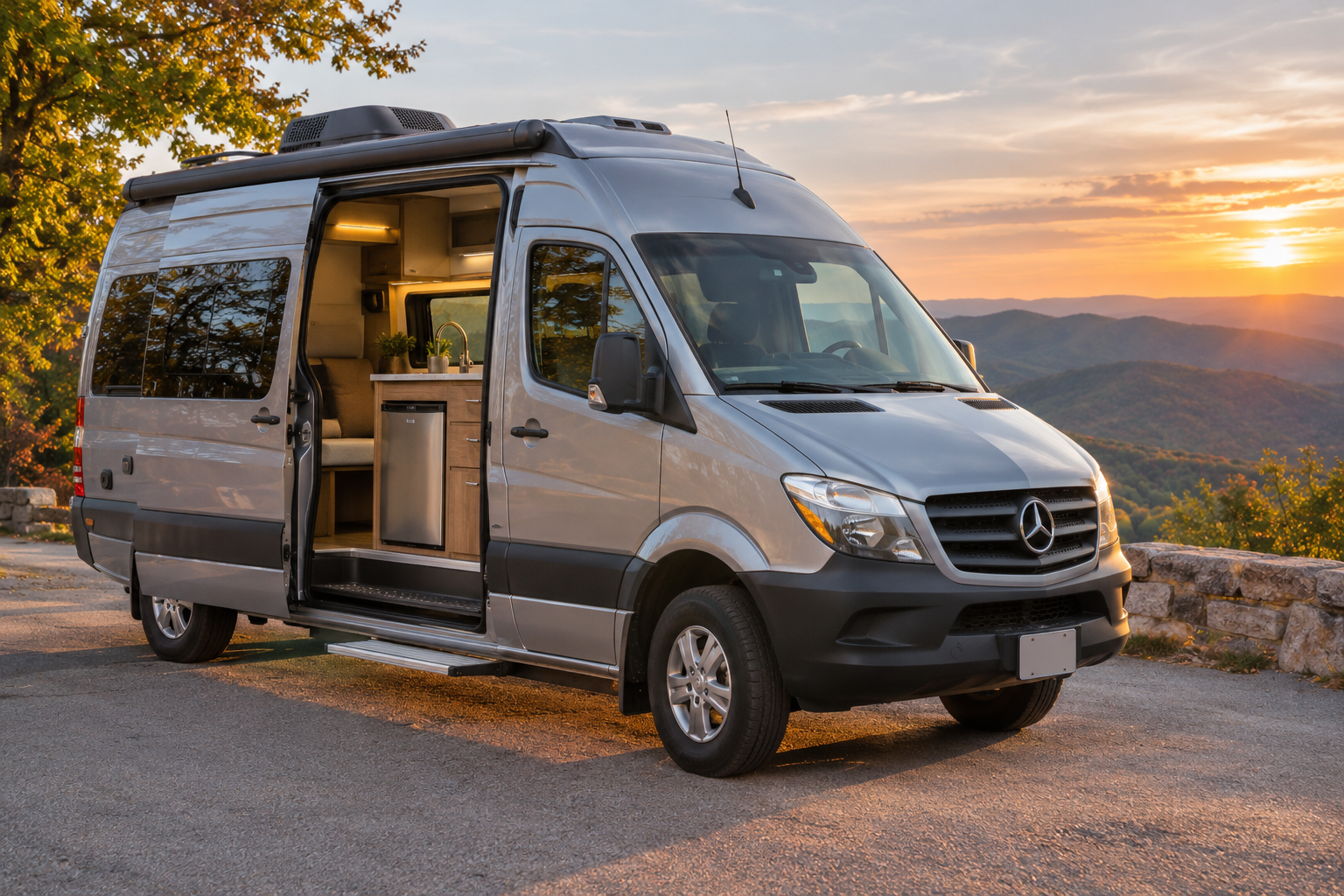
You bought the Roadtrek because it did everything a big rig couldn’t. It fit a normal parking spot, drove like a van, and let you disappear for a weekend without a three-day checklist. Now life has shifted. Maybe you’re downsizing, maybe a health thing changed the plan, maybe an inheritance left you with a van you never intended to own. Whatever it is, you’ve typed some version of “sell my Roadtrek motorhome” into a search bar and landed here.
Here’s the good news. Of every RV on the road, a Class B camper van like a Roadtrek is one of the easiest to sell for real money, because it’s one of the few that holds its value. The hard part isn’t finding a buyer. It’s finding one who pays fairly, moves fast, and doesn’t leave you doing DMV homework for a month.
Here’s what your Roadtrek is actually worth, what pushes that number up or down, and the three ways you can sell it, so you know what to expect from a cash offer and what to watch for on the other routes.
Why Roadtrek Class B vans hold their value better than most RVs
Walk into any conversation about RV depreciation and you’ll hear the same warning: a new motorhome loses 20 to 30 percent the moment you drive it off the lot, and keeps bleeding from there. That’s broadly true for towables and big Class A coaches. It’s much less true for Class B vans, and Roadtrek sits near the top of the pile.
Why? A Roadtrek is a motorized van first and a camper second. It’s built on a Mercedes Sprinter or Ram ProMaster chassis any mechanic can service, it fits in a garage, and it’s something people actually want to drive day to day. Compare that to a 38-foot diesel pusher that needs its own parking lot. One has a wide buyer pool. The other has a puddle.
Supply matters too. Roadtrek vans have never been cheap to build or made in huge numbers, and the company’s well-known restructuring over the past several years keeps the used market tight. When demand is steady and supply is thin, prices stay firm. That’s the whole reason a clean, recent Roadtrek can still command a strong chunk of its original price while a same-age travel trailer is worth a fraction of what it sold for. If you’ve been bracing for a lowball reality, take a breath. You’re sitting on one of the better-holding assets in the RV world.
What actually moves the needle on your Roadtrek’s resale price
Two Roadtreks of the same model year can be thousands of dollars apart. Before you obsess over detailing the van, know which factors carry real weight and which barely register:
- Model and floor plan. A Zion, SS Agile, CS Adventurous, and E-Trek each draw a different buyer and a different price. Layout and sleeping capacity matter more than most sellers think.
- Model year and mileage. Newer and lower-mileage wins, no surprise there. But Class B vans built on a good chassis handle high miles better than people expect, so don’t assume a six-figure odometer kills the deal.
- Mechanical condition. The chassis, engine, and drivetrain carry the value. A van that runs and drives clean is worth far more than one with a pretty interior and a check-engine light.
- House systems. Working fridge, furnace, water system, and house batteries all count. A dead lithium bank or a cranky generator pulls the number down.
- Records and title status. Service history helps. A clean, in-hand title helps more. A lien or a lost title doesn’t sink the sale, but it changes how the paperwork flows.
One thing that trips sellers up: aftermarket upgrades rarely pay back dollar for dollar. You might have sunk real money into a solar setup or a custom bed, but a dealer taking a trade usually won’t credit any of it. A cash buyer who knows these vans will weigh genuine improvements, yet nobody reimburses every receipt. Price your expectations to the market, not to what you spent.
The three ways to sell a Roadtrek, and where each one costs you
You’ve basically got three doors. Each one trades something you want for something else you want more.
The private sale. Most people try this first, because it dangles the highest sticker price, and sometimes it delivers. But think about what it takes: photos, a listing that stands out, fielding texts from people who never show up, test drives with strangers at your house, then handling the title transfer and payment risk yourself. For a specialty vehicle like a Roadtrek, the buyer pool is small and picky, so “a few weeks” often becomes a few months. If you’re selling because you need the money or the space now, time is the one thing you can’t afford to burn.
The dealer trade-in. Quick and tidy, but the number is wholesale, not retail. Dealers price to resell at a profit, and the trade value usually only makes sense if you’re rolling it into another purchase from them. If you just want out of the Roadtrek and don’t want its replacement, a trade leaves money on the table for convenience you may not need.
The direct cash buyer. This sits in the middle and solves the biggest pain points of the other two. You get a fair, firm offer based on what these vans really sell for, you skip the listing fees and the tire-kickers, and you don’t have to buy anything else to make the deal work. The right cash buyer comes to you, handles the paperwork, and pays on the spot. You give up the theoretical top-dollar of a perfect private sale in exchange for speed, certainty, and zero hassle.
There’s no universal “right” answer. If you’ve got months to spare and enjoy the process, a private sale might net a bit more. If you want it done this week with a check in hand, keep reading.
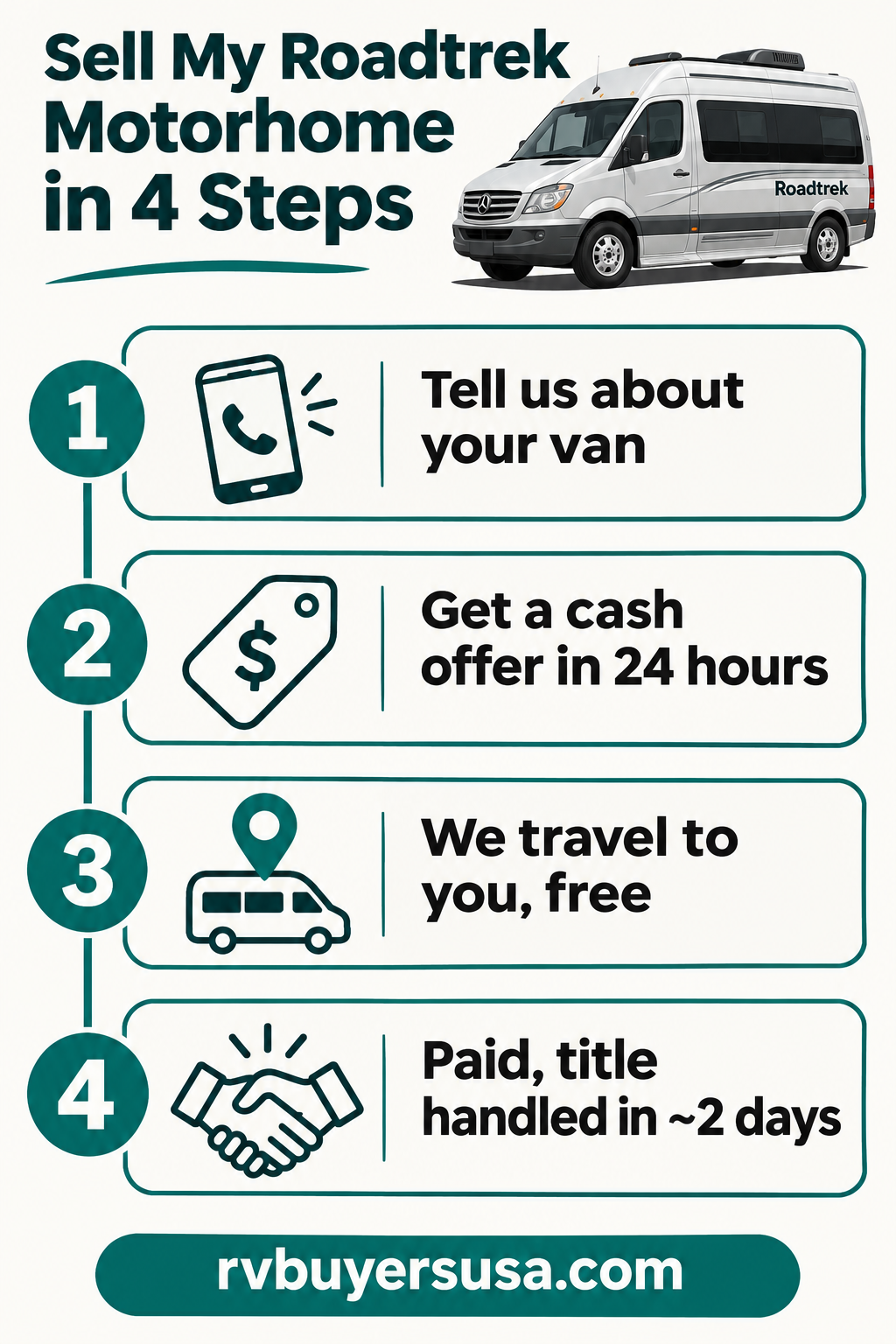
How our direct cash offer works for Roadtrek owners
We’re a nationwide cash buyer that deals in motorhomes, and Class B vans like Roadtrek are right in our lane. These are motorized touring coaches, real motorhomes, and we buy them as-is. Here’s how it works from your side of the table.
- You tell us about the van. Model, year, mileage, condition, and a few photos. Nothing fancy, just an honest snapshot.
- We send a cash offer within 24 hours. It’s based on real recent Roadtrek sales, not a generic online calculator that doesn’t understand Class B. No obligation to take it.
- We come to you, free. Anywhere in the contiguous 48 states. You don’t arrange shipping or drive the van to us.
- You get paid and we handle the rest. We take care of the title and DMV paperwork, pay off your loan if there is one, pay you, and drive the van away. Most deals wrap in about two days.
No middlemen, no commissions, no listing fees skimming your proceeds. If you still owe on the van, we pay the lender directly and you keep whatever’s left above the payoff. A lost or out-of-state title is a paperwork problem we deal with every week, not a reason to walk away.
One honest note on eligibility. We buy Roadtrek vans from the last 10 model years, which today means 2016 and newer. If your van is older than that, it falls outside our current buying window. Not sure where yours lands? Send us the year and we’ll tell you in plain language.
When selling fast actually matters most
Plenty of Roadtrek owners aren’t selling because they’re bored with the van. They’re selling because something changed and the timing isn’t optional.
Downsizing into a smaller place with no room to store it. A health change that takes the fun out of the drive. A divorce where the asset needs to become a clean split. An inherited van in a relative’s driveway you never drove. A loan payment you’d rather stop making on something you’re not using. In every one of those cases, a quick, certain sale beats a theoretical extra few hundred dollars you might squeeze out over three months of listings.
That’s the real argument for a cash offer. Not that it’s always the highest number on paper, but that it’s a number you can count on, with a date you can count on, and no strangers in your driveway to get there.
Frequently Asked Questions
How much is my Roadtrek worth?
It depends on the model, year, mileage, and condition, and the honest answer is that the usual pricing guides don’t track Class B vans well. KBB and NADA were built around mass-produced cars and big motorhomes, so their numbers for a Roadtrek are often off in both directions. A better gauge is what comparable Roadtrek vans are actually listed and sold for on RV Trader, RVT, and the Class B forums. We price from real recent sales, not a generic calculator, and give you a firm cash number so you aren’t guessing.
Do Roadtrek Class B vans hold their value?
Yes, better than almost any other RV. Class B camper vans depreciate slower than big Class A coaches and towables because they’re built on a car chassis you can drive and service anywhere, and demand for them stays high while supply is limited. A well-kept Roadtrek from the last several years can still bring a strong share of what it sold for new, which is exactly why a fair cash offer on one is worth taking seriously.
Can I sell my Roadtrek if I still owe money on it?
Yes. A loan balance doesn’t stop the sale. We pay the lender directly to clear the lien and release the title, then any amount above the payoff goes to you. If the van is worth more than you owe, you walk away with the difference. You don’t have to pay the loan off first or front any money to make the deal happen.
What paperwork do I need to sell my Roadtrek motorhome?
Usually the title (or your lender’s payoff details if there’s still a loan), your photo ID, and the registration if you have it handy. Missing the title isn’t a dealbreaker. We handle the DMV and title paperwork as part of every purchase, including lost-title and out-of-state situations, so you’re not standing in line at the DMV or chasing forms you’ve never filled out before.
Is it better to sell my Roadtrek to a dealer or privately?
Each route has a catch. A private sale can bring the highest sticker price but takes weeks or months, means strangers at your home, and dealers won’t credit aftermarket upgrades on a trade. A dealer trade-in is quick but the number is wholesale and usually tied to buying another unit from them. A direct cash buyer sits between the two: a fair, firm offer with none of the waiting, listing fees, or test-drive tire-kickers of a private sale.
How fast can I sell my Roadtrek for cash?
Fast. You get a no-obligation cash offer within 24 hours of sending us the details, and most sales close in about two days once you accept. We travel to you anywhere in the contiguous 48 states at no cost, pay you on the spot, handle the title and DMV paperwork, and drive the van away. There’s no shipping to arrange and no waiting on a buyer’s financing to clear.
What model year Roadtrek vans do you buy?
We buy motorized Class B Roadtrek vans from the last 10 model years, which means 2016 and newer right now. That covers recent models like the Zion, SS Agile, CS Adventurous, and E-Trek. Older Roadtreks fall outside our current buying window. If you’re not sure where your van lands, send us the year and we’ll tell you straight away.
Ready to sell your Roadtrek? Here’s your next step
Grab your van’s year and mileage, snap four or five quick photos, and call us at +1-619-993-1439 or send the details through our site. You’ll have a no-obligation cash offer within 24 hours, we’ll come to you free anywhere in the lower 48, and we’ll handle the title and loan payoff so you don’t have to. If the number works for you, you could have cash in hand and the Roadtrek off your plate in about two days. No fees, no middlemen, no waiting.