
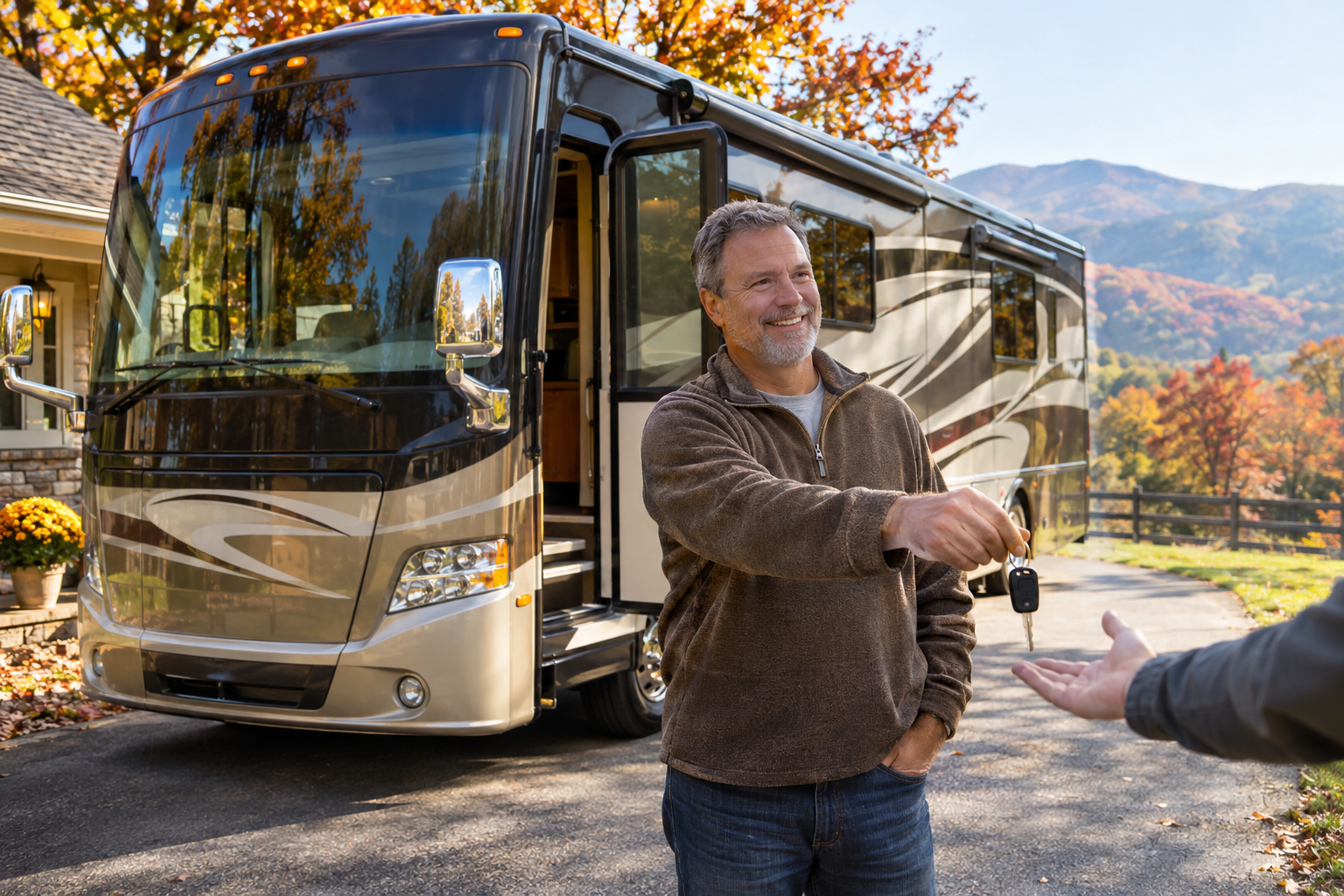
You’ve decided to sell the motorhome. Maybe you’re downsizing, maybe your health changed the travel plans, maybe it’s just been sitting in the driveway racking up a personal property tax bill every year. Whatever got you here, the question is the same: what do I actually have to do to sell my motorhome in Virginia without it turning into a second job?
Here’s the honest version. The Virginia DMV paperwork isn’t complicated once you know the few things that matter. The taxes trip people up, but most of that confusion is about who pays what, and the answer is better than you think. The part that eats months of your life isn’t the state, it’s finding a real buyer who won’t lowball you, ghost you, or hand you a sketchy cashier’s check.
This guide covers the title transfer, the taxes and fees, where Virginia owners actually sell, and why having a cash buyer come to you is usually the fastest way out.
What selling a motorhome in Virginia actually involves
Strip away the noise and there are three moving parts: the title, the taxes, and the buyer. Get those three sorted and the deal closes. Fumble any one of them and it drags.
The title is your proof you own the motorhome and your tool for signing it over. If there’s still a loan on it, that lien has to be cleared before a clean title can change hands, which is a step private buyers hate dealing with. The taxes are mostly the buyer’s problem at the point of sale, with one exception that’s squarely yours: your annual local personal property tax keeps running until you tell the right offices you sold.
Then there’s the buyer, which is where most of the real time and stress lives. A 30-foot Class A isn’t like selling a sedan. The buyer pool is a fraction of the size, and the folks who do reach out are often dealers looking to flip you or scammers looking to flip the script.
How Virginia motorhome title transfer works
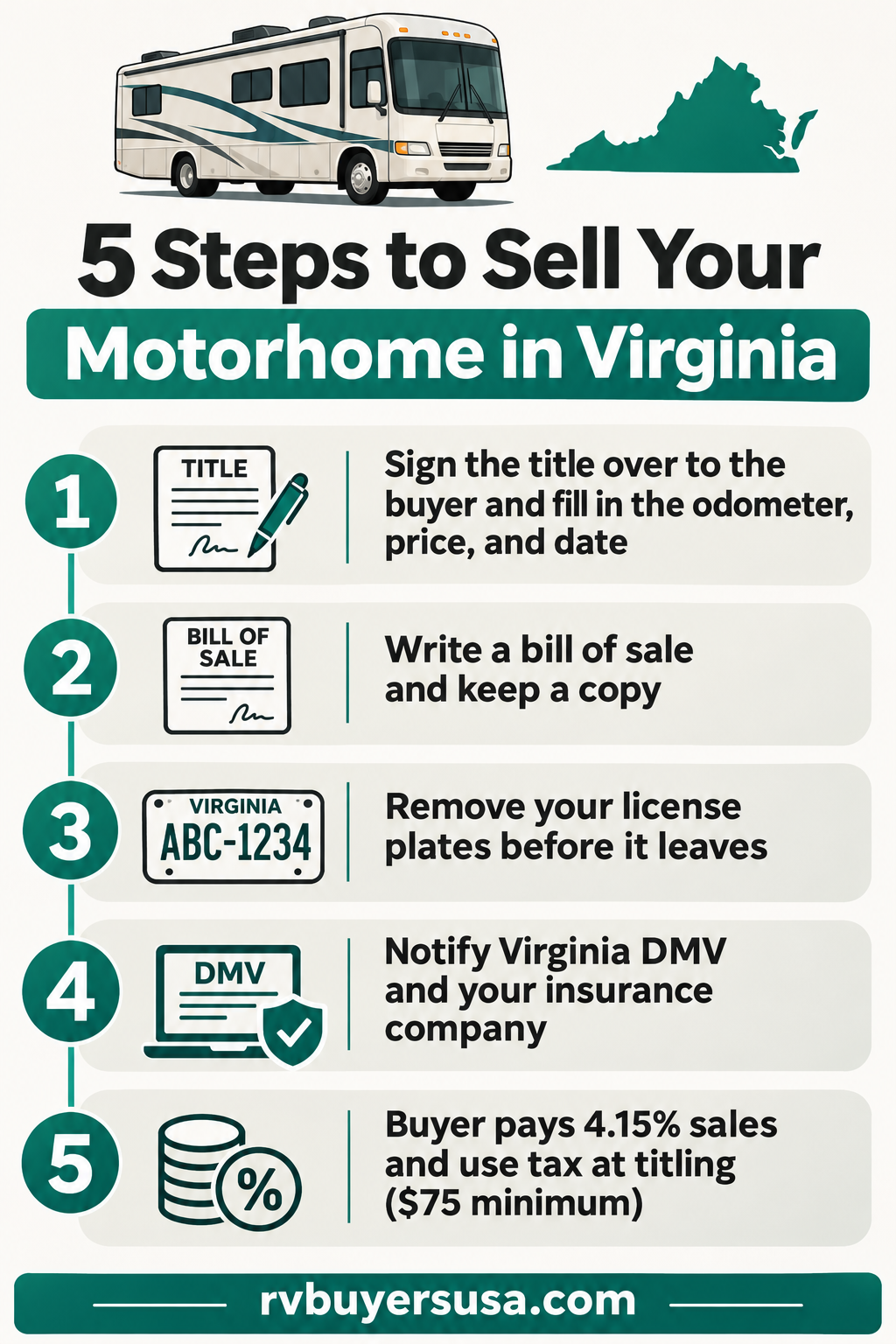
When you sell my motorhome in Virginia the right way, the title does most of the heavy lifting. On the front of your Virginia title there’s a seller’s section, and you fill it out completely before the keys leave your hand.
Here’s what goes on the title and alongside it:
- Your signature as seller. Print and sign your name. If more than one owner is listed on the title, every owner has to sign.
- Buyer’s name and address. Enter it on the line provided so the record points to the right person.
- The odometer reading. Record the actual number off the dash, not a guess.
- Sale price and date. Write in what the buyer paid and the date of sale.
- A bill of sale. This can be a simple statement signed by both parties, or Virginia’s Vehicle Price Certification. Keep a copy for yourself.
Two things people forget. First, take your license plates with you before the motorhome drives off. Plates stay with you in Virginia, and if six months or more are left on your registration you can turn them in and request a refund using Form FMS-210. Second, notify the DMV that you sold it, and tell your insurance company. Skip that notification and the state may still show you as the registered, possibly uninsured, owner, which is a headache you don’t want.
If your title was issued by another state because you moved to Virginia with the coach, you still complete the seller’s section the same way, and the buyer handles the Virginia titling paperwork on their end.
Virginia taxes and fees when a motorhome changes hands
This is the part that lights up the RV forums. One owner on a popular motorhome board put it bluntly: “I am SUPER confused about how the taxes will work.” So let’s clear it up.
Virginia charges a Motor Vehicle Sales and Use Tax of 4.15% on the sale price, with a minimum of $75. The important thing for you: the DMV collects that from the buyer when they title the motorhome in their name. You don’t collect it, you don’t remit it, and it doesn’t come out of your pocket. If someone buys your coach and registers it in Virginia, they pay the 4.15% at the counter.
The tax that is yours to manage is the local one. Virginia counties and cities assess an annual personal property tax on recreational vehicles based on where the unit is garaged. That’s the bill that shows up every year while you own it. The moment you sell, report the sale to the DMV and to your local commissioner of the revenue so they stop assessing you. Owners who skip this step have been known to keep getting taxed on a motorhome that’s been gone for a year.
So the tax picture for a seller is simpler than the forums make it sound. The buyer handles the sales and use tax. You just make sure the paperwork closes the loop on your local assessment.
Your options for selling, and the trade-offs
There’s no single best place to sell a motorhome. There’s the route that fits how fast you want it gone and how much hassle you’ll tolerate. Here’s how the common options compare.
| Option | Speed | Effort for you | The catch |
|---|---|---|---|
| Private sale (Facebook, Craigslist, RV Trader) | Days to many months | High | Showings, tire-kickers, scammers, dealers fishing for a flip, payment risk |
| Dealer trade-in | Fast | Low | Wholesale pricing, and only works if you’re buying from them |
| Consignment lot | Weeks to months | Low | You wait, you keep paying to store it, and the lot takes a cut |
| Nationwide cash buyer that comes to you | About 2 days | Very low | Must be a motorhome, 2016 or newer |
Private sale is the route most people try first, and it’s the one that burns the most time. Owners on the RV boards describe listing on RV Trader and getting inquiries that were “only from dealers and scammers.” Another warned that in most states “the titled owner is liable for damages and personal injury claims” until the buyer actually retitles the vehicle. That’s a real exposure you carry every day the deal drags.
So why do most sellers still start with the private route? Because nobody wants to feel like they left money on the table. Fair enough. Just go in knowing the clock and the liability are part of the price.
Why a nationwide cash buyer that comes to you is often fastest
This is where RV Buyers USA fits. We’re a direct cash buyer of motorhomes, Class A, Class B, and Class C motorized units, 2016 or newer. Not a dealer, not a middleman, not a consignment lot. We buy the coach outright and we travel to you anywhere in the contiguous 48 states, Virginia included.
Here’s what that actually looks like when you sell to us:
- You tell us about your motorhome. We give you a no-obligation cash offer within 24 hours.
- If it works for you, we schedule pickup. We come to your driveway in Virginia, you don’t drive it anywhere.
- We handle the DMV and title paperwork, and we buy it as-is, so you’re not fixing anything first.
- If there’s still a loan on it, we can pay off the existing balance as part of the deal.
- You get paid. Most sales close in about two days.
No listing photos. No strangers in your driveway on a Saturday. No cashier’s check you have to pray clears. No fees or hidden costs chipping away at the number. For an owner selling because of a life change, downsizing, a health issue, a divorce, or settling an estate, that predictability is the whole point.
One thing to be clear about: we buy motorized motorhomes only. We don’t buy travel trailers, fifth wheels, pop-up campers, truck campers, or toy haulers, or any towable RV. If what you’re selling is a Class A, B, or C motorhome from 2016 or newer, we’re the fast lane.
Frequently Asked Questions
How do I transfer the title when I sell my motorhome in Virginia?
On the Virginia title, you sign and print your name as the seller, fill in the buyer’s name and address, record the actual odometer reading, enter the sale price, and date it. Every owner listed on the title has to sign. Hand the signed title to the buyer along with a bill of sale, and they take it to the DMV to retitle and register the motorhome in their name.
Who pays the sales tax when a motorhome is sold in Virginia?
The buyer pays it, not you. Virginia charges a 4.15% Motor Vehicle Sales and Use Tax on the sale price, with a $75 minimum, and the DMV collects it from the buyer when they title the motorhome. As the seller, you don’t collect or remit this tax. The one tax you want to stop is your own local personal property tax, which is why notifying DMV and your county that you sold the unit matters.
Do I have to pay personal property tax on a motorhome in Virginia?
Yes, while you own it. Virginia personal property tax on recreational vehicles is assessed locally by your county or city and billed every year based on where the motorhome is garaged. Once you sell, report the sale to both the DMV and your local commissioner of the revenue so they stop assessing you. If you don’t, you can keep getting a bill for a motorhome you no longer own.
What paperwork do I need to sell an RV in Virginia?
You need the signed Virginia title with the odometer and sale price filled in, and a bill of sale signed by both parties or a Vehicle Price Certification. If there’s a loan, you also need the lien released or paid off so a clear title can transfer. Keep a copy of everything, remove your plates, and keep proof that you notified DMV of the sale.
Where is the best place to sell a motorhome in Virginia?
It depends on how fast you want it gone. Facebook Marketplace, Craigslist, and RV Trader reach private buyers but attract tire-kickers, scammers, and dealers fishing for a flip. Dealer trade-ins and consignment lots are easier but take a cut or a lowball. A nationwide cash buyer that travels to you is usually the fastest route because there’s no listing, no showings, and no waiting for a buyer to find financing.
How long does it take to sell a motorhome?
A private sale can take anywhere from a couple of days to several months, depending on price, condition, and the season. Some owners get lucky and sell in a week; many list for months and keep dropping the price. A direct cash buyer is far more predictable. RV Buyers USA sends a no-obligation offer within 24 hours and typically closes in about two days.
Is it safe to sell my motorhome to a cash buyer?
It is when you work with a real, established buyer rather than an anonymous stranger. The risky part of a private sale is payment and liability: fake cashier’s checks, buyers who want the title before funds clear, and the fact that you stay liable until the motorhome is retitled. A professional buyer like RV Buyers USA pays cash, handles the title paperwork, and takes the unit off your hands so you’re not left exposed.
Ready to sell? Get your cash offer first
Before you spend a weekend writing a listing and fielding lowballers, see what a straight cash offer looks like. Call RV Buyers USA at (619) 993-1439 or request a quote online, tell us the year, make, and model of your Class A, B, or C motorhome, and you’ll have a no-obligation cash offer within 24 hours. If the number works, we come to you anywhere in Virginia, handle the title and DMV paperwork, pay off any loan, and close in about two days. No fees, no middlemen, no driveway strangers.