

What if your most cherished memory-maker is actually the biggest anchor dragging down your divorce settlement? Your RV isn’t just a vehicle; it’s a high-value asset that requires a specific exit strategy. Unlike a bank account, dividing an rv asset in a separation agreement involves navigating rapid depreciation, outstanding liens, and specialized storage costs. You’re looking for a clean break, but the complexities of title transfers and market volatility can turn a simple split into a legal nightmare.
We understand that you want a fair financial outcome without the stress of a long, drawn-out sale. This comprehensive 2026 guide provides the legal frameworks, valuation methods, and practical strategies you need to equitably divide your RV. You’ll learn how to handle underwater loans, choose the right division strategy, and ultimately secure the fastest path to liquidation. We’ll give you a clear roadmap to turn your shared liability into liquid capital so you can move forward with confidence.
Key Takeaways
- Understand why RVs are classified as motorized personal property and how rapid depreciation complicates equity splits compared to traditional real estate.
- Master the use of J.D. Power guides to establish a fair market value and decide which valuation tier belongs in your legal documents.
- Learn the specific legal clauses required for dividing an rv asset in a separation agreement, including essential protections for insurance and maintenance costs.
- Compare the financial impact of buyouts versus asset offsets to determine the most equitable way to handle your motorhome or travel trailer.
- Discover why immediate liquidation for cash provides the cleanest break, removing the stress of private showings and ongoing storage fees.
Why Dividing an RV Asset in a Separation Agreement is Unique
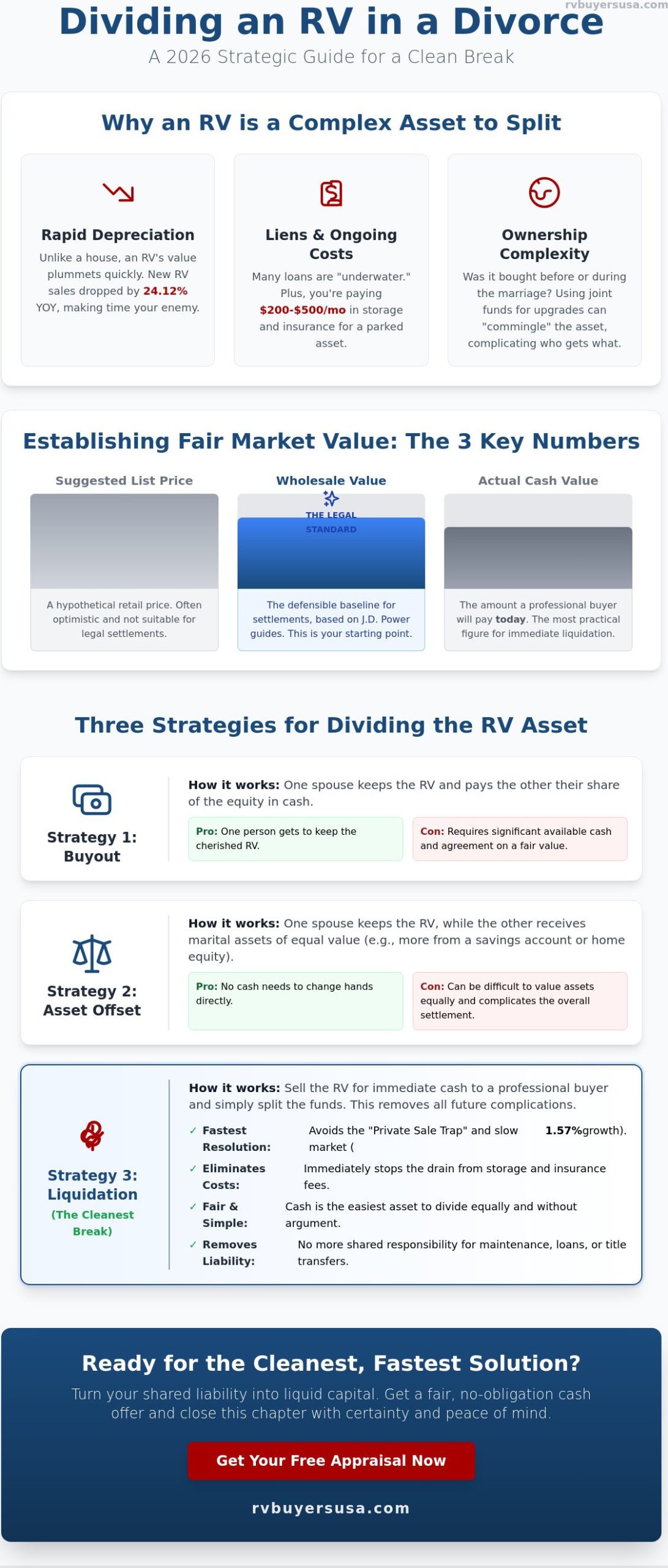
An RV is a motorized personal property asset, making it fundamentally different from real estate or savings accounts. In a legal setting, it’s typically governed by equitable distribution or community property laws. Unlike a house, a vehicle faces rapid depreciation. In early 2026, new RV sales dropped by 24.12% year-over-year, which means dividing an rv asset in a separation agreement is a race against a ticking clock. If you delay the settlement by just a few months, your Class A motorhome or fifth wheel could lose significant value before you ever reach the closing table.
The “Lien Factor” is another unique hurdle. Many couples find themselves “underwater” because the loan balance exceeds the actual market value. If you owe more than the J.D. Power guide suggests, you’re splitting a liability rather than an asset. You must also factor in monthly storage and insurance costs. A unit sitting in a lot can cost between $200 and $500 per month in fees while providing no benefit to either party. Legal agreements require objective numbers. Your memories of family vacations don’t have a line item in a settlement, so focus on the fair market value for a clean break.
Marital vs. Separate Property in RV Ownership
Determining ownership starts with the title date. If you bought the travel trailer before the marriage with your own savings, it’s likely separate property. However, using joint bank accounts for repairs or monthly installments can “commingle” the asset. Commingled assets occur when one spouse uses marital income to pay for upgrades, such as new lithium batteries or solar arrays, on an RV originally owned by the other spouse before the marriage. Once funds are mixed, the non-owning spouse may be entitled to a portion of the vehicle’s equity.
The Emotional Burden of the ‘Adventure Machine’
Shared custody of a vehicle rarely works. Unlike a vacation cottage, an RV requires constant mechanical maintenance, winterization, and specialized storage. Splitting these duties between two people in the middle of a divorce is a recipe for conflict. Many owners fall into the “Private Sale Trap,” holding onto the unit for a high-value buyer. With the used market showing only 1.57% growth in February 2026, the cost of storage will likely eat any potential profit. It’s often better to take an instant cash offer and move on. Speed and certainty are your best friends when dividing an rv asset in a separation agreement.
Valuing Your RV for a Fair Settlement
Getting a realistic price on paper is the only way to ensure fairness when dividing an rv asset in a separation agreement. As of May 2, 2026, the J.D. Power (formerly NADA) RV value guide remains the gold standard for legal valuations. However, couples often clash because they look at the wrong column. You’ll see “Suggested List” versus “Wholesale” values. In a legal settlement, the wholesale or trade-in value is the most defensible baseline. It represents the cash value available today, whereas the suggested list is a hypothetical retail price that doesn’t account for the current 24.12% decline in new motorized sales.
High-value Class A motorhomes often require a professional appraisal to account for specific wear and high-end features. If you’ve invested in 2026-standard upgrades like 600Ah lithium battery banks or high-efficiency solar arrays, don’t expect a dollar-for-dollar return. These additions make the unit easier to sell but rarely increase the book value by more than a fraction of their cost. For a clean break, focus on the Actual Cash Value (ACV). This is the amount a professional buyer would pay to take the vehicle off your hands immediately, which is the most practical figure for dividing your property and debts without leaving room for future litigation.
The Three Numbers You Need to Know
You must distinguish between trade-in value, private party value, and ACV. A “patient sale” valuation assumes you can wait months for a private buyer. A “forced sale” valuation reflects the reality of a legal deadline. To establish a solid baseline for your negotiations, consult a professional RV valuation guide. Knowing these figures prevents one spouse from feeling cheated if the unit eventually sells for less than the optimistic price seen in online classifieds.
Dealing with Outstanding RV Loans
Calculating equity is simple math: take the estimated market value and subtract the current loan payoff. If the result is positive, you have a net asset to split. If it’s negative, you’re “upside down.” This is common in 2026 due to the steep market shifts earlier this year. When an RV is underwater, the agreement must specify who is responsible for the remaining debt after a sale. You might choose to split the loss 50/50 or have one spouse take a larger share of another asset to offset the liability. If you need a guaranteed figure to bring to the table, you can get a competitive cash offer to lock in your equity position today.
Three Strategies for Dividing the RV Asset
Once you establish a realistic cash value, you have three primary paths to resolve ownership. Divididing an rv asset in a separation agreement requires choosing the option that minimizes long-term financial risk for both parties. You can keep it, trade it, or sell it. Each choice has specific legal and tax implications that depend on your equity position and your ability to maintain the vehicle solo.
Liquidation is often the most “divorce-friendly” option, especially for high-maintenance Class A or B motorhomes. Selling the asset and splitting the cash proceeds creates a clean break. It eliminates the need for ongoing communication about maintenance, storage fees, or insurance. With the used RV market showing a modest 1.57% growth as of February 2026, selling now can lock in a fair price before further depreciation occurs. This strategy removes the burden of a high-value liability from both credit reports simultaneously.
Pros and Cons of the Spouse Buyout
In a buyout, one spouse keeps the RV and pays the other 50% of the established equity. This sounds simple, but it requires the keeping spouse to refinance the loan into their name alone. With May 2026 interest rates for used RVs sitting around 6.24% for those with excellent credit, refinancing can significantly increase monthly payments. You must also handle the title transfer through your state’s DMV to ensure the departing spouse is legally removed from the registration. Don’t risk a buyout if the vehicle is a “money pit” with looming mechanical issues; you might end up with more liability than asset.
The Offset Method: Balancing the Books
The offset method allows one spouse to keep the RV while the other takes an asset of equal value, such as a car, a savings account, or equity in the marital home. This is a common tactic when dividing an rv asset in a separation agreement because it avoids the hassle of a sale. However, professional appraisals are critical here. If you overestimate the value of a fifth wheel or travel trailer, the spouse keeping it may feel “buyer’s remorse” later when they realize the asset depreciates faster than the retirement account their ex-spouse received. Avoid informal “handshake” offsets. Every trade must be documented in writing to prevent future challenges in court.
- Buyout: Best for spouses who have the income to refinance and a passion for the lifestyle.
- Offset: Ideal for couples with multiple high-value assets who want to avoid selling.
- Liquidation: The fastest way to get cash and end the financial connection.
Essential Clauses for Your RV Separation Agreement
Vague language in a legal document leads to expensive courtroom arguments. When dividing an rv asset in a separation agreement, you need ironclad clauses that cover the logistical reality of owning a vehicle. Unlike a bank account, an RV requires active management. If your Class A sits through a winter without proper care, its value will plummet before the ink is dry on your settlement. You must treat the vehicle as a business asset that requires a clear exit strategy.
Your agreement must include a ‘Status Quo’ clause. This specifies who is responsible for monthly insurance premiums and storage fees until the unit is sold or transferred. Given that interest rates for used RV loans remain as high as 7.99% for some borrowers in May 2026, the cost of carrying this debt can quickly erode your equity. You must also define maintenance responsibilities. Specify who pays for winterization, tire replacement, or unexpected generator repairs. Finally, set a hard sale timeline. A 60 or 90 day deadline prevents one spouse from intentionally delaying the process to maintain access to the vehicle or avoid a final payout.
- Right of First Refusal: This allows one spouse to match any legitimate third-party offer if they decide they want to keep the unit at the last minute.
- Access Rights: Define who holds the keys and where the vehicle must be parked during the listing period.
- Fund Distribution: Outline whether proceeds pay off the loan first or if they go into a joint escrow account.
Protecting the Asset During the Transition
Shared use of the RV during a separation is a recipe for disaster. One person’s weekend trip could result in a cracked windshield or a blown transmission, leaving the other spouse with a diminished asset. Ensure your insurance policy remains active and lists both parties as loss payees to protect both financial interests. A ‘No-Use’ clause for high-value motorhomes explicitly prohibits both spouses from using the vehicle for recreational travel or residential purposes from the date the agreement is signed until the final sale is completed.
Defining the Sale Process in Writing
Don’t leave the sale price to chance. Your legal document should specify a minimum acceptable offer based on current J.D. Power data. You must also agree on who selects the selling platform or buyer. While private sales might promise a higher price, they introduce the hassle of endless showings and potential liability. Many couples find that working with a professional buyer is the only way to ensure a fast, clean break. To avoid these complexities and move on with your life, you can get an instant cash offer today and remove the RV from your legal negotiations entirely.
The Cleanest Break: Liquidating Your RV for Immediate Cash
Lingering assets keep you tied to a past you’re trying to leave behind. While buyouts and offsets are valid strategies, they often prolong the negotiation process and leave room for future conflict. Selling to a professional cash buyer is the fastest way to finalize dividing an rv asset in a separation agreement. It converts a high-maintenance liability into a liquid sum that you can split and walk away from today. You don’t need to worry about the 24.12% motorized sales decline or fluctuating market demand. You get a hard number, a signed check, and total closure.
Avoid the ‘Private Sale Trap’ at all costs. Trying to sell a Class A motorhome or a fifth wheel privately during a separation is a logistical nightmare. It requires coordinated schedules for showings, deep cleaning the unit, and dealing with ‘stranger-danger’ from unvetted buyers. RV Buyers USA eliminates these hurdles. We are a nationwide company that offers a simplified, no-nonsense process. We come to you, whether the unit is at your home or in a remote storage facility. We handle the heavy lifting so you can focus on your future.
Streamlining the Legal Paperwork
Legal disputes thrive on ambiguity. An instant cash offer provides a definitive, documented value that you can hand to your attorney immediately. This “hard number” removes the guesswork from your court documents and prevents arguments over hypothetical “asking prices.” We handle all the complex title work and DMV paperwork, ensuring both parties are legally protected. If your travel trailer or toy hauler has an outstanding bank lien, we coordinate the payoff directly with the lender. This speed allows you to finalize your separation agreement weeks or even months faster than a traditional sale.
Moving Forward Without the Hassle
The moment the bill of sale is signed, your financial responsibility ends. You stop paying for insurance, storage fees, and winterization. This is the psychology of the “clean break.” You aren’t just selling a vehicle; you’re removing a shared burden that requires constant communication with an ex-spouse. Whether you have a Class B van or a luxury fifth wheel, we provide the expert service you need to exit the asset with confidence. Don’t let a depreciating vehicle stall your progress. Get a no-obligation cash offer for your RV today and simplify your separation agreement once and for all.
Secure Your Financial Future and Finalize Your Settlement
You now have the legal strategies and valuation tools needed to handle your high-value asset with precision. From mastering J.D. Power standards to implementing “No-Use” clauses, you’ve learned how to protect your equity during a difficult transition. Dividing an rv asset in a separation agreement is ultimately about speed and certainty. Don’t let a depreciating Class A motorhome or fifth wheel stall your legal progress or drain your bank account with ongoing storage fees.
We’re here to provide the clean break you deserve. As an A+ rated professional acquisition firm, we specialize in high-speed, nationwide service. We come to you for pickup and take care of every detail; we handle all DMV and title paperwork so you don’t have to. You get a fair price without the stress of private showings or dealership low-balls. Get a free appraisal and an instant cash offer for your RV asset right now. Take control of your financial situation and start your next chapter today.
Frequently Asked Questions
Can I sell the RV before the separation agreement is finalized?
You can sell the vehicle immediately if both parties provide written consent through an interim order or a signed mutual release. Liquidating the asset early is often a strategic move to avoid the 24.12% year over year decline in motorized RV values reported in early 2026. This allows you to lock in a cash price before further depreciation occurs and eliminates ongoing storage costs during legal negotiations.
What if my spouse’s name is on the title but I made all the payments?
In most states, the RV is considered marital property if it was acquired during the marriage, regardless of whose name is on the title or who made the payments. Legal frameworks like equitable distribution look at the source of funds and the intent of the purchase. You may be entitled to a larger share of the proceeds if you used separate, non-marital funds for the down payment or major upgrades.
How do we handle an RV that is currently underwater?
When dividing an rv asset in a separation agreement that has negative equity, you must decide how to split the remaining debt. You can sell the unit and pay the “gap” between the cash offer and the loan balance using other marital savings. Alternatively, one spouse can take a larger share of another asset, like a car or retirement account, to offset the liability of the outstanding loan.
Does a separation agreement automatically transfer the RV title?
No, a separation agreement is a legal contract that instructs the parties to act, but it does not physically change the title. You must still visit the DMV or provide a power of attorney to remove a name from the registration. Failure to complete this step leaves the departing spouse legally liable for accidents, registration fees, and any future toll violations associated with the vehicle.
Who is responsible for RV insurance while we are waiting for a sale?
The spouse who has physical possession of the RV typically pays the insurance, but the agreement should specify a 50/50 split of the premiums until the sale is finalized. Both names should remain on the policy as loss payees to protect your financial interests. If the unit sits in storage, you must maintain comprehensive coverage to protect against theft, fire, or weather damage during the separation period.
Can we include a ‘shared use’ schedule in our separation agreement?
You can legally include a shared use schedule, but it is rarely recommended by professionals. Sharing a high-maintenance asset like a Class A motorhome leads to disputes over fuel levels, cleaning standards, and mechanical wear. Most owners find that a clean break through liquidation is better for their mental health and financial stability than trying to coordinate road trips with an ex-spouse.
What happens if my spouse refuses to sign the bill of sale for the RV?
If your agreement mandates the sale of the asset and a spouse refuses to sign, you must petition the court for a motion to enforce. A judge can appoint an official to sign the title on the refusing spouse’s behalf. This process is common when dividing an rv asset in a separation agreement if one party becomes uncooperative. Avoid this delay by choosing a professional buyer who handles all the legal paperwork for you.
Is an RV considered a ‘motor vehicle’ or ‘real estate’ in asset division?
An RV is legally classified as motorized personal property, even if you use it as a primary residence. It follows the same title laws as a car or a truck rather than the deed recording processes used for houses. This distinction is critical because it means the asset depreciates rapidly and can be moved across state lines, which complicates the valuation and physical recovery of the vehicle during a dispute.