
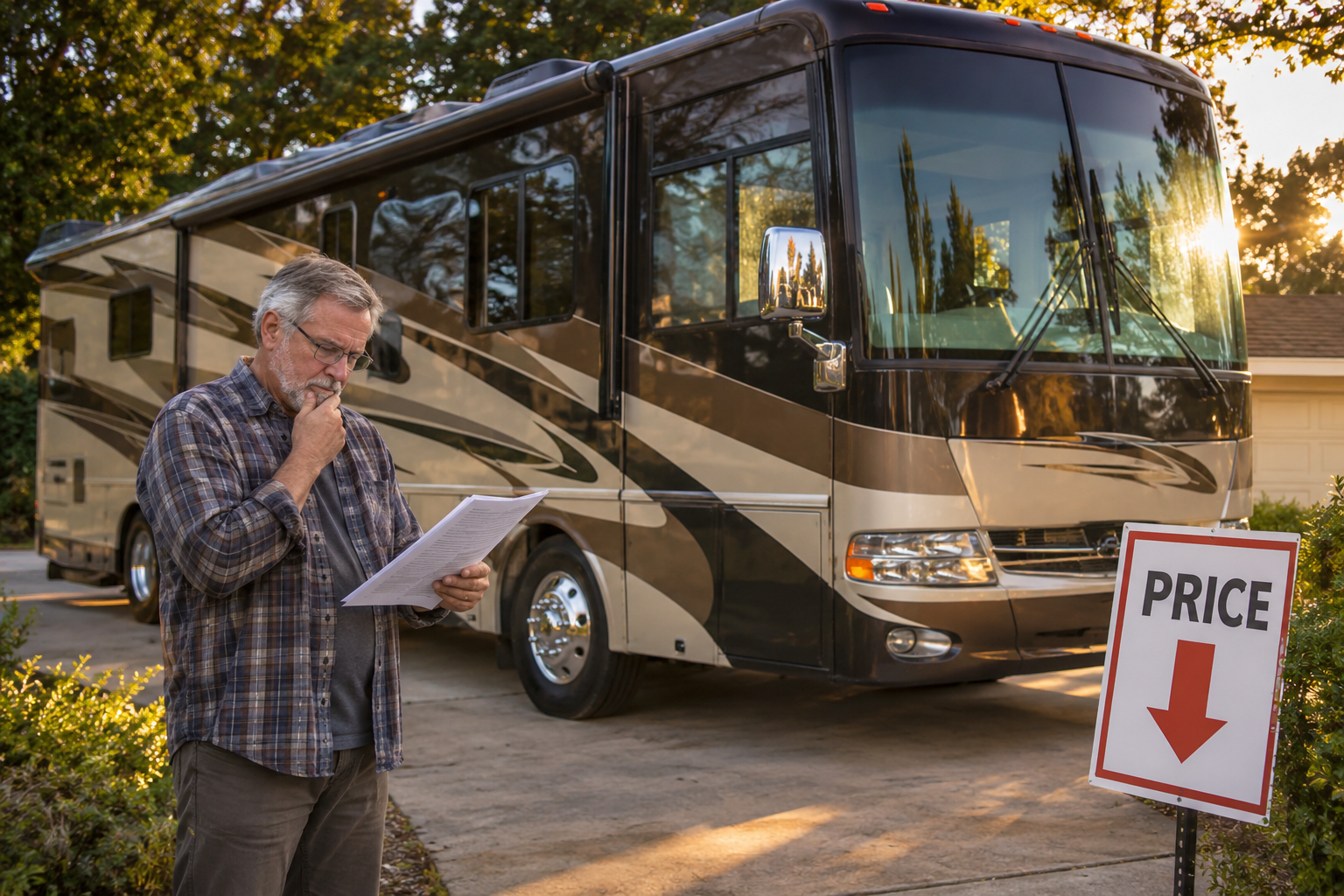
Here’s a number that stings the first time you see it. Drive a brand-new motorhome off the dealer lot and it can be worth 20 percent less by the time you get home. Not after a year of trips. That afternoon.
Motorhome depreciation is the quiet cost of ownership nobody puts on the sticker. You feel it later, when you decide to sell and the offers come in lower than you pictured. Understanding how the curve actually works, when the value falls fastest and when it levels off, is the difference between selling at a smart moment and hanging on while your coach quietly loses thousands more. Let’s walk through the real timeline.
The First Year Is Brutal
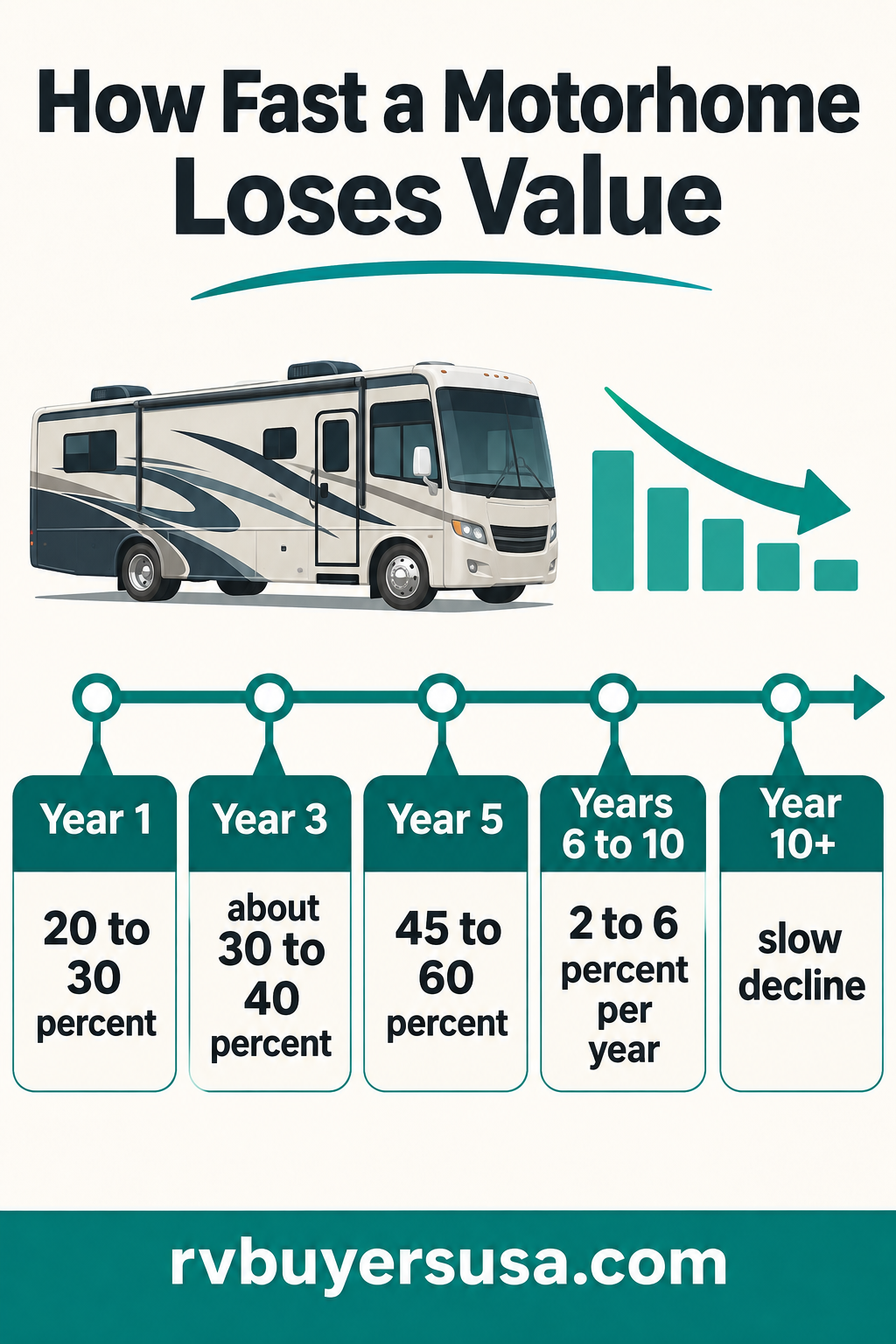
Year one is where a motorhome loses the most value, fast. A new coach typically drops 20 to 30 percent in the first twelve months, and Class A motorhomes sit at the high end of that because they cost the most to begin with. On a $150,000 coach, that’s $30,000 to $45,000 gone in a single year of ownership.
Why so steep? The moment a motorhome is titled to you, it becomes a used unit, and used units compete on price against every other coach on the market. Dealers price aggressively on new inventory, so a one-year-old coach can’t hold near its original number no matter how few miles are on it. The market simply resets it.
This is also why buying used is smart and selling a nearly-new coach hurts. If you bought new and you’re thinking about selling in year one or two, know going in that you’re on the steepest part of the slide. It doesn’t mean you shouldn’t sell. It means you should be realistic about the number and not wait for a rebound that isn’t coming.
Years Two Through Five: Still Falling, But Slower
After that first-year cliff, the drop keeps going but eases up. Through years two to five, a motorhome loses roughly 8 to 12 percent of its value each year. By the end of year five, most coaches have shed 45 to 60 percent of what they sold for new.
Put real numbers on it. A Class A that stickered at $120,000 is often worth somewhere between $50,000 and $65,000 at the five-year mark. A Class C that sold for $90,000 might land around $55,000 in the same window. The exact figure swings on mileage, condition, and how in-demand the brand and floorplan are, but the shape of the curve is consistent across almost every coach.
Class matters here too. Class C motorhomes commonly lose around 38 percent by year five, while Class A units, carrying bigger engines and more expensive systems, tend to lose a larger dollar amount even if the percentage looks similar. The more the coach cost new, the more raw value it can bleed off in these middle years.
Year Six and Beyond: The Curve Flattens
Here’s the good news if your coach is older. Once a motorhome passes the five-year mark, depreciation slows way down. From about year six through year ten, you’re looking at roughly 2 to 6 percent a year. After ten years, it flattens even more, and a well-maintained coach can hold a fairly stable value for a long stretch.
This is why an older, cared-for motorhome can be a genuinely good buy, and why owners of ten-year-old coaches are sometimes surprised their unit is still worth real money. The heavy depreciation already happened to the first owner. What’s left is a slower, gentler decline tied mostly to age, mileage, and how the coach has held up.
The catch is that maintenance becomes the whole story at this stage. A neglected older coach with a soft roof, a tired engine, or water intrusion can fall off the curve entirely, while a clean, serviced one holds firm. Past year five, condition does more to set your price than the calendar does.
What Actually Drives the Number
Age sets the baseline, but three other factors move your coach up or down within that range. Get honest about these before you guess what your motorhome is worth.
Mileage is the big one, especially on gas coaches. A high odometer reading signals engine and drivetrain wear, and buyers price that in immediately. Two coaches of the same year can be thousands apart on mileage alone.
Condition can claw value back. A dry, clean interior, working appliances, fresh tires, and a folder of service records tell a buyer the coach was loved, and that’s worth paying for. Water damage does the opposite, and it does it fast. A low-mileage coach with a leak can be worth less than a higher-mileage one that stayed dry.
Then there’s demand. Popular brands and layouts, diesel pushers, and coaches in sought-after sizes hold value better than oddball floorplans or brands that have faded. You can’t change your coach’s badge, but you can price it against what similar units are actually selling for, not what you hope it’s worth.
How to Beat the Curve: Sell Before the Next Drop
You can’t stop a motorhome from depreciating. What you can control is timing. And the math is simple: value only moves one direction, so the longer you hold a coach you’ve stopped using, the more it costs you.
Think about what a sitting motorhome actually runs you. Insurance, registration, storage, and the slow drip of depreciation every single month, whether you drive it or not. If your coach isn’t earning that back in trips you genuinely take, waiting to sell isn’t protecting your investment. It’s shrinking it.
That’s where selling to a direct cash buyer changes the calculation. RV Buyers USA buys motorhomes directly, for cash, across the contiguous 48 states. We buy Class A, B, and C coaches, the motorized units only, from model year 2016 and newer. We do not buy travel trailers, fifth wheels, or any towable. You skip the months of listing and lowball offers that let depreciation keep eating your number while you wait for a private buyer.
The process is quick on purpose, because speed is the point when value is falling. Tell us the year, class, mileage, and condition through a short form. We send a fair, no-pressure cash offer within 24 hours based on current market data. Accept it and we come to your location, handle the title transfer, bill of sale, and DMV paperwork, and pay, usually within about two days. We buy as-is, so there’s nothing to fix or detail first, and if you still owe on the coach, we can pay off the loan directly.
Frequently Asked Questions
How much do motorhomes depreciate in the first year?
A new motorhome typically loses 20 to 30 percent of its value in the first year, with Class A coaches on the higher end of that range. A large chunk of that drop happens the moment it leaves the dealer lot, the same way a new car does. This is why buying a lightly used coach and selling near the end of that first year are very different financial positions.
How much is my motorhome worth after five years?
By year five, most motorhomes have lost roughly 45 to 60 percent of their original price. A coach that cost $120,000 new is often worth somewhere in the $50,000 to $65,000 range at that point, depending on class, mileage, and condition. Well-kept, lower-mileage units land at the top of the range.
Do motorhomes depreciate faster than travel trailers?
Generally yes. Larger motorized coaches carry an engine, transmission, and chassis that all age and add to the value that can be lost, so Class A and Class C motorhomes tend to depreciate faster in dollar terms than smaller units. The bigger and more expensive the coach was new, the more total value it sheds over the first several years.
At what age does a motorhome stop depreciating so fast?
The steepest drop is over by about year five. From roughly year six through year ten, depreciation slows to about 2 to 6 percent a year, and after ten years it flattens further as long as the coach is maintained. This is why the first few years cost you the most value, and why waiting rarely helps once you know you’re going to sell.
Does mileage or condition matter more for motorhome value?
Both matter, but they hit differently. High mileage signals engine and drivetrain wear and pulls the price down hard on gas coaches especially. Condition, meaning a dry, clean, well-maintained interior with service records, can add thousands back. A low-mileage coach with water damage can be worth less than a higher-mileage one that was cared for.
When is the best time to sell to avoid more depreciation?
The best time to sell is as soon as you know you’re done using it. Every month a motorhome sits, it keeps losing value while still costing you insurance, storage, and registration. If the coach isn’t earning its keep in trips, selling now almost always beats selling later, because the value only goes one direction.
Want to know where your coach sits on the curve today? Tell us about your motorhome using our quick form, and we’ll send a fair, no-obligation cash offer within 24 hours. Accept it and we come to you anywhere in the 48 states, handle every bit of paperwork, and pay, usually within about two days, before depreciation takes another bite.