
In this article
Pricing your RV wrong costs you time, money, or both. To get it right: research what comparable rigs are actually selling for on RV Trader and NADA Guides, understand how depreciation has affected your specific make and model, factor in any upgrades or deferred maintenance, and get a professional appraisal before you name a number. RV Buyers USA offers a free appraisal if you want a fast, no-guesswork starting point.
You’ve logged the miles, made the memories, and now it’s time to sell. Maybe you’re upgrading to something bigger. Maybe the kids are grown and the 40-foot Class A feels like overkill. Maybe you found a deal you can’t pass up — but only if you move your current rig first. Whatever the reason, the moment you decide to sell, you face the same question every RV owner does: What is this thing actually worth?
Knowing how to determine your RV’s true market value is the difference between a deal that feels good and one that leaves you wondering what you left on the table. Get the number wrong in either direction and you pay for it. Price too high and your listing sits for months while buyers scroll past. Price too low and you’ve essentially handed a stranger a check on the way out the door. Getting it right isn’t guesswork — it’s a process. Follow it, and you can walk away from the sale confident you got what your RV was genuinely worth.
Here’s how to do it.
Start With the Market, Not Your Gut
The most common mistake RV sellers make is pricing based on what they feel the RV should be worth — what they paid, what they put into it, what it means to them. The market doesn’t care about any of that. It cares about what comparable rigs are actually selling for right now.
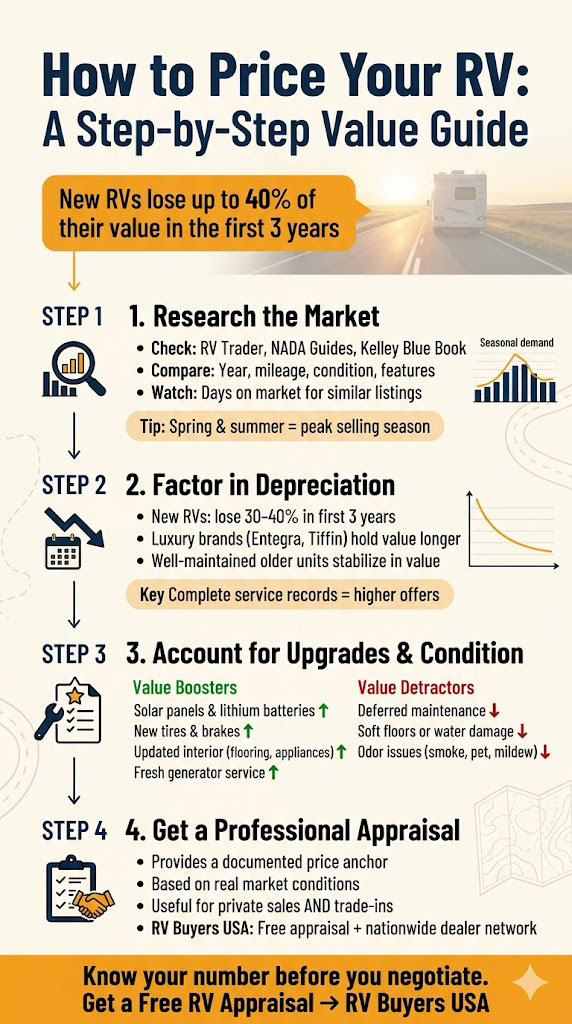
Before you post a price anywhere, spend real time on RV Trader, NADA Guides, and Kelley Blue Book. These platforms give you a broad view of what’s currently listed and, more importantly, what’s actually moving. Pay close attention to listings that are similar in make, model, year, mileage, and condition. A Class C from 2018 with 45,000 miles is a very different product than the same model with 12,000 miles and a garage queen history — and buyers know the difference.
Don’t just look at asking prices, either. Asking prices tell you what sellers want. What you need to know is what buyers are paying. Look for patterns: Are similar rigs dropping in price after sitting for 90 days? Are certain floorplans or brands generating multiple inquiries and selling fast? That’s real market intelligence, and it should anchor your pricing strategy.
Timing matters too. The RV market runs on seasons. Spring and early summer are peak selling periods — families are planning trips, snowbirds are on the move, and buyers are motivated. If you’re listing in October or November, you may need to price more aggressively to compete, or consider holding until demand picks back up. Knowing where you are in the seasonal cycle is part of reading the market honestly.
Understand How Depreciation Has Affected Your Rig
Every RV depreciates. That’s not pessimism — it’s just physics and finance. The question isn’t if your RV has lost value since you bought it, but how much and how fast.
New RVs depreciate sharply out of the gate. Most lose somewhere between 30 and 40 percent of their value in the first three years alone, and that curve continues — though it tends to flatten out over time. A well-maintained ten-year-old motorhome may hold relatively stable value if the systems are solid and the cosmetics are clean. A neglected five-year-old unit can be nearly impossible to move at any reasonable price.
Brand matters here too. Luxury manufacturers like Entegra Coach and Tiffin Motorhomes tend to retain value longer than mid-range brands because demand for them stays strong even as they age. Buyers who want a Tiffin Phaeton know exactly what they’re looking for — and they’ll pay accordingly. On the other end of the spectrum, entry-level brands built to a price point tend to depreciate faster and face more resistance on the secondary market.
One of the best things you can do to offset depreciation’s effect on your sale price is documentation. A complete set of service records signals to a buyer that this RV was cared for — that problems were caught early, that the engine and chassis were serviced on schedule, and that you weren’t the kind of owner who deferred maintenance until something broke. That paper trail is worth real money. Buyers pay more when they trust what they’re buying.
Account for What You’ve Added (and What Needs Work)
Not all improvements translate equally into resale value, but the right upgrades can meaningfully increase what a buyer is willing to pay — and reduce friction in the negotiation.
Technology upgrades tend to resonate strongly with today’s buyers. Solar panel systems and lithium battery banks have moved from novelty to expectation among serious full-timers and boondockers. Satellite TV and internet connectivity upgrades can be a real differentiator if the buyer plans to spend significant time off-grid or working on the road. These aren’t cheap add-ons — position them accordingly in your listing.
Mechanical and safety-related work carries significant weight too. New tires are a big one. Anyone who’s done even basic research on RV ownership knows that tire condition is non-negotiable for safety, and fresh tires with documented purchase dates remove a major buyer objection before it’s ever raised. Same goes for new batteries, recently serviced brakes, and any recent engine or transmission work. Buyers are quietly doing the math on what they’ll have to spend after purchase. Help them see that the number is low.
Interior condition is what buyers see first, and first impressions stick. Updated flooring, clean upholstery, functioning appliances, and a unit that smells like nothing — not cigarette smoke, not pet odor, not mildew — will consistently outperform comparable units that have been lived in hard. Even relatively inexpensive cosmetic updates can shift a buyer from interested to committed.
On the flip side, be honest with yourself about deferred maintenance and known issues. If the slide-out seals are failing, if there’s a soft spot in the floor, if the generator needs work — price those realities in. Buyers who discover problems during inspection will either walk or negotiate hard. Either way, you lose more than you would have if you’d accounted for it upfront.
Get a Professional Appraisal Before You Set a Final Number
Here’s where a lot of sellers skip a step they shouldn’t. All the research in the world gives you a range — it doesn’t give you a precise valuation tied to your specific unit in its current condition in its current market. That’s what a professional appraisal does, and it’s the final piece of knowing how to determine your RV’s true market value with real confidence.
Services like RV Buyers USA offer free RV appraisals that give you a concrete number based on current market conditions, your RV’s actual specifications, and regional demand. That’s not a small thing. An appraisal from a professional buyer with access to a nationwide dealer network isn’t just a number — it’s a negotiation anchor. When a private buyer tries to lowball you, you have a documented basis for your price. When a dealership makes a trade-in offer, you know immediately whether it’s fair.
Professional appraisals also tend to come with a streamlined path to sale if you decide you’d rather not deal with the private market process. Inspections, paperwork, logistics — all of it can be handled by the buyer, which saves you time and eliminates the friction of coordinating with strangers. If you’ve ever listed a vehicle privately and dealt with tire-kickers, no-shows, and last-minute renegotiations, you know exactly how much that friction is actually worth.
At minimum, get the appraisal. Use it as a floor for your private sale price. Know your number before you walk into any conversation with a buyer or a dealership.
Put It All Together
Understanding how to determine your RV’s true market value comes down to four things working together: what the market says comparable rigs are selling for right now, what depreciation has done to your specific unit, what your upgrades and condition add or subtract, and what a professional appraisal confirms. When all four inputs align, you have a defensible, realistic price — one that attracts serious buyers without leaving money behind.
The sellers who struggle are the ones who skip steps. They post a number based on gut feel, ignore seasonal dynamics, and get blindsided when buyers push back hard. The sellers who move their rigs quickly and walk away satisfied are the ones who did the homework first.
Do the homework. Get the appraisal. Price with confidence.
And if you’re ready to skip the back-and-forth entirely, reach out to RV Buyers USA for a free appraisal and a competitive offer from buyers who are ready to move.
