
Kelley Blue Book doesn’t actually value RVs. It’s a surprising fact for many, yet thousands of owners still rely on a generic rv blue book value estimator expecting a guaranteed price. You’ve probably seen conflicting numbers across different sites, leaving you unsure if you’re leaving money on the table. We know the anxiety of trying to price a high-value asset in a shifting market where new RV registrations dropped 21.87 percent in March 2026. You need a valuation that reflects real-world demand, not just a static number on a screen.
It’s stressful to worry about losing money because of a bad estimate. We believe you deserve a fair, professional assessment that respects your time and your investment. This guide provides the tools to accurately estimate your RV’s worth and explains how to turn that Blue Book value into a real-world cash offer. We’ll examine the latest J.D. Power standards and the specific market factors that determine what your Class A, B, or C motorhome is truly worth in today’s economy.
Key Takeaways
- Learn how an rv blue book value estimator provides a baseline and why the industry shifted from NADA to J.D. Power.
- Identify the specific mechanical and aesthetic factors that move your rig’s price above or below the book average.
- Recognize the “Asking Price Trap” to avoid overestimating your return based on misleading online listings.
- Discover the streamlined process to convert a theoretical book value into a concrete, immediate cash offer for your asset.
What is an RV Blue Book Value Estimator?
An rv blue book value estimator is a specialized digital tool designed to calculate the current fair market value of a recreational vehicle. While the term “Blue Book” is borrowed from the automotive industry, the mechanics of RV valuation are far more complex. For over 40 years, the National Automobile Dealers Association (NADA) served as the primary data source. Today, J.D. Power has taken the helm, maintaining the industry’s most comprehensive database of transaction prices and depreciation curves. Lenders, dealers, and insurance companies rely on these metrics to set loan limits and payout values. They need a standardized baseline to minimize risk.
You can’t treat an RV like a used sedan. A car’s value is largely driven by year and mileage. An RV’s value is a mix of automotive health and residential integrity. An estimator attempts to bridge this gap. It provides a starting point for negotiations, ensuring you don’t enter a sale blind. It’s the difference between guessing a price and knowing your asset’s worth. Using a professional rv blue book value estimator strips away the guesswork and replaces it with data-driven confidence.
The Primary Sources for RV Valuations
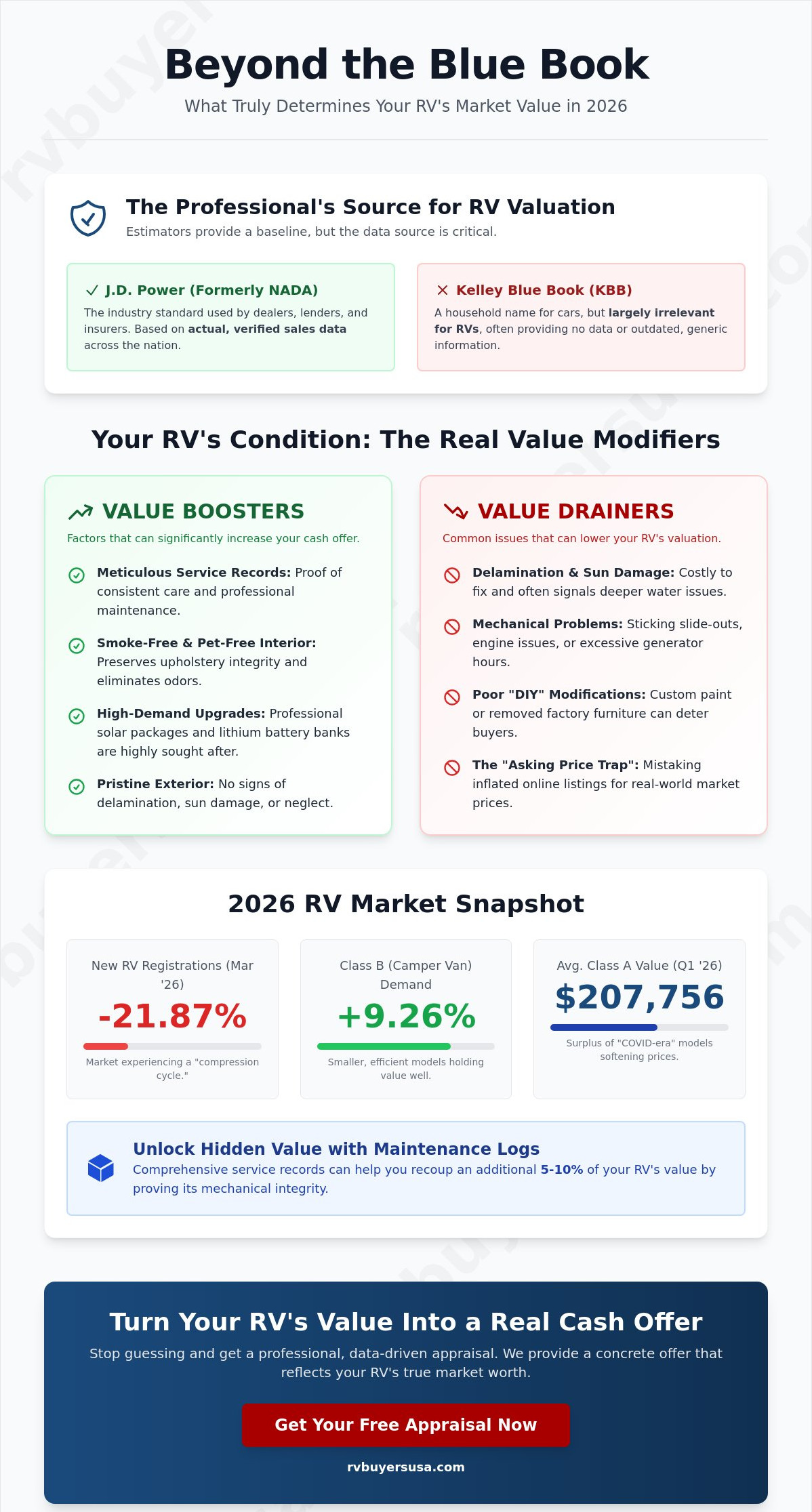
J.D. Power is the undisputed authority for base pricing. It uses actual sales data from across the country to generate low and average retail values. Most professional buyers use this as their primary guide. RV Trader offers a different perspective. It provides real-time market data based on active listings. This shows you what other sellers hope to get, not necessarily what they’ll receive. Kelley Blue Book (KBB) is a household name for cars, but it’s largely irrelevant for the RV market. Searching for a motorhome or fifth wheel on KBB usually yields no results or generic, outdated information. Stick to sources that specialize in the RV industry.
Key Information You Need for an Accurate Estimate
To get a precise number, you need more than just a brand name. Accuracy depends on the details you feed the estimator. Start with the basics: the year, the specific make, and the exact model number. For motorized units like Class A or Class C motorhomes, you must track both mileage and engine hours. A generator with 2,000 hours suggests much heavier use than one with 200 hours. You also need a comprehensive list of optional equipment. Aftermarket lithium batteries, solar arrays, or upgraded suspension systems can significantly boost your real-world value. Don’t leave these off the list. Every detail counts when you’re looking for a fair price.
Factors That Influence Your RV’s Real-World Value
An rv blue book value estimator provides a baseline, but it can’t see your rig. It doesn’t know if your engine hums or if your slide-outs grind. Mechanical health is non-negotiable. If your generator hours are excessive or your slides stick, your value will drop below the official RV value guide average. Aesthetic wear matters just as much. Delamination and sun damage are expensive to fix and often signal deeper water damage issues. Buyers look for signs of neglect, so a clean, well-maintained exterior is vital for a top-dollar valuation.
Ownership history acts as a secondary verification of quality. A smoke-free and pet-free interior is a major selling point that maintains the integrity of the upholstery. Service records are equally important. They prove you didn’t just drive the RV; you cared for it. Market demand also plays a role. In early 2026, the industry entered a “compression cycle.” While new RV registrations fell by 21.87 percent in March 2026, the used market remained disciplined. Demand for Class B units actually grew by 9.26 percent, showing that smaller, efficient models are holding their worth better than some luxury segments.
Depreciation Patterns in 2026
Class A motorhomes typically experience the steepest depreciation during their first five years. The market is currently seeing a surge of “COVID-era” models from 2020 to 2022. This surplus means buyers have more options, which can soften the pricing for those specific years. In Q1 2026, the average value for a Class A motorhome sat at $207,756. Comprehensive maintenance logs can help you recoup 5-10% of your vehicle’s value by proving its mechanical integrity.
The Role of Optional Equipment
Not all upgrades are created equal. In the 2026 market, professional solar packages and lithium battery banks are high-value additions. These functional upgrades align with the current trend toward off-grid capability. However, be careful with cosmetic “DIY” changes. Removing factory furniture or using custom interior paint can actually hinder your resale value. Stick to upgrades that improve the utility of the unit. If you’re curious about how your specific upgrades affect your bottom line, you can get a professional appraisal to see the real-world impact.
Blue Book vs. Market Reality: Why the Numbers Differ
Don’t fall into the “Asking Price” trap. Many sellers browse listings on RV Trader and assume those figures represent actual value. In reality, those numbers are often aspirational. They represent what a seller hopes to get, not what a buyer is willing to pay. An rv blue book value estimator provides a data-driven baseline, but it can’t account for the immediate friction of the 2026 market. High interest rates have significantly cooled buyer enthusiasm. As of April 30, 2026, average used RV loan rates reached 7.69 percent. This surge in borrowing costs means buyers have less room in their monthly budgets, forcing actual sale prices below the theoretical book value.
Regional demand and fuel costs also create massive valuation gaps. A Class A motorhome might be highly liquid in the Sunbelt but nearly impossible to move in the Pacific Northwest during the winter. Book values often lag behind these shifts. When diesel prices fluctuate, the demand for large, fuel-hungry engines can drop overnight. This is especially true for older Class A and C models, which face stiffer competition from newer, more fuel-efficient Class B units that saw a 9.26 percent growth in registrations in early 2026. If your estimator isn’t factoring in these real-time economic pressures, the number it gives you is just a guess.
Retail Value vs. Wholesale Value
Retail value is the price a dealer expects from a consumer. It includes their overhead, marketing, and profit margin. Wholesale value is what a professional buyer will pay you for the asset today. The gap between these two is much wider for RVs than for cars. Dealers must budget for extensive reconditioning, potential appliance failures, and the high cost of holding a large unit on their lot. Understand that no one will pay you full retail for a used unit because they can’t offer the warranties or financing a dealership provides.
The ‘Clean’ Condition Myth
Most owners overrate their rig’s condition. It’s a natural bias, but it leads to disappointment. On an rv blue book value estimator, “Excellent” condition is reserved for units that look and smell brand new. Most well-loved RVs fall into the “Average” or “Rough” categories once a professional inspector looks at the roof seals and tire age. Reality hits hard when it’s time to sign. Check out our How to Value Your RV: A Seller’s Guide to learn how to objectively grade your unit before seeking an offer.
How to Turn Your RV Value into a Cash Offer
Gathering your documentation is the first move in a successful sale. You need the Title, the VIN, and every maintenance record in your file. These documents prove ownership and validate the care you’ve put into the asset. Once your paperwork is ready, consult an rv blue book value estimator to establish your floor and ceiling prices. Don’t rely on a single source. Use multiple platforms to find a realistic range that accounts for the current market compression where new registrations have dropped by over 21 percent. This data gives you the leverage needed for a fair negotiation.
Factor in the hidden costs of a private sale before you list. Most buyers expect a used unit to be in showroom condition. If you have worn tires, a cracked windshield, or a leaking roof seal, you’ll need to pay for these repairs upfront to secure a top-tier price. Compare this to the net profit of a direct sale. While a private buyer might offer more on paper, the time, repair costs, and marketing fees often eat that margin. Direct acquisition firms offer a simpler path to liquidity without the administrative burden of traditional selling methods.
The Pitfalls of Private RV Sales
Selling a high-value asset privately is a full-time job. You’ll deal with unqualified browsers and no-shows who waste your weekends. With used RV loan rates sitting at 7.69 percent as of April 30, 2026, many private buyers struggle to secure financing. This leads to deals falling through at the last minute. You also face significant liability and safety concerns when inviting strangers to your home for walkthroughs. Handling the title transfer and DMV paperwork yourself adds another layer of stress that most owners simply don’t need.
Direct Cash Acquisition: The Efficient Alternative
Immediate liquidity is often more valuable than chasing a theoretical retail price. We specialize in the acquisition of Class A, B, and C motorhomes, along with fifth wheels and travel trailers. Our process eliminates the need for expensive detailing or mechanical repairs. We offer free nationwide pickup and handle every piece of the administrative puzzle. You get a fair price and a clean transition without the months of waiting associated with consignment or private listings. If you want to skip the headaches, get a cash offer today and move on to your next adventure.
Why RV Buyers USA is Better Than a Generic Estimator
A generic rv blue book value estimator is a helpful starting point, but it’s fundamentally limited. It can’t account for the current 7.69 percent interest rates on used RV loans or the specific condition of your slide-outs. We provide real-world cash offers that move beyond theoretical book values. Our team focuses exclusively on Class A, B, and C motorhomes, along with Fifth Wheel and Travel Trailer acquisitions. We understand the nuances of these high-value assets. You won’t wait for a buyer to secure financing or deal with the uncertainty of a market in flux. We provide the certainty that a calculator simply cannot offer.
Our nationwide service removes the logistical burden of selling. Whether you’re in California or Vermont, we come to your doorstep. This is a critical advantage given the expanding emissions regulations in these states as of 2026. You don’t need to worry about compliance fees or transport logistics. We prioritize transparency above all else. There are no hidden fees, no consignment delays, and no administrative hurdles. You get immediate liquidity, allowing you to move on from your asset in days rather than months. This speed matches the momentum of a professional acquisition process.
Our Professional Appraisal Process
Our experts look deeper than an rv blue book value estimator ever could. We evaluate the actual utility of your solar upgrades and the health of your engine. This professional appraisal ensures your offer reflects the true market potential of your rig. The transaction moves fast. We often complete the entire process from initial offer to final pickup in just a few days. We also take over the administrative heavy lifting. Our team manages title transfers and DMV filings, ensuring a clean legal break from the vehicle without the typical paperwork headaches.
The Secure Way to Liquidate Your RV
Selling a high-value motorhome privately carries significant risk. Online listings attract scammers and unqualified browsers who compromise your privacy and safety. We provide a secure, professional alternative. You’ll communicate directly with seasoned experts who value your time and offer a guaranteed transaction. This eliminates the anxiety of fraud and the frustration of no-shows. When you’re ready for a serious transaction, Get Your Professional Cash Offer from RV Buyers USA and experience a simplified way to sell your asset for its true worth.
Move Beyond the Estimate to a Real Transaction
An rv blue book value estimator provides a theoretical starting point, but it doesn’t put money in your bank account. You’ve seen how mechanical health and shifting 2026 market trends create a gap between book values and actual sale prices. Don’t let your asset sit while depreciation eats away at your equity. You now have the tools to distinguish between an aspirational listing and a realistic valuation. It’s time to stop guessing and start the process of liquidating your asset with confidence.
Choose the path of immediate liquidity and professional service. We offer a streamlined acquisition process that removes the administrative burden and safety risks of private sales. Our team provides a professional appraisal by Class A experts, followed by free nationwide pickup and immediate cash payment with zero fees. We handle the title work and DMV filings so you don’t have to. This is the efficient alternative to the traditional market.
Get a Real Cash Offer for Your RV Today
You’ve done the hard work of researching your rig’s value. Now take the final step to secure a fair price for your motorhome or trailer. We’re ready to make your transition clean and uncomplicated.
Frequently Asked Questions
Is J.D. Power the same as NADA for RV values?
Yes, J.D. Power is the current owner and operator of NADAguides. It serves as the industry standard for base pricing and depreciation data across the country. Most professional buyers and lenders use this specific rv blue book value estimator to determine loan-to-value ratios. While the name changed, the methodology of tracking nationwide transaction data remains consistent with the original NADA standards.
How much does mileage affect my motorhome’s Blue Book value?
Mileage is a significant driver of value for motorized Class A, B, and C units. An rv blue book value estimator typically applies a deduction if your mileage exceeds the national average for that specific model year. For instance, a motorhome with 80,000 miles will value much lower than an identical unit with 15,000 miles because of the expected wear on the drivetrain and suspension components. Engine hours on the generator also play a secondary role in this calculation.
Can I get a Blue Book value for a travel trailer or fifth wheel?
You can certainly get a valuation for towable units like Fifth Wheels and Travel Trailers. These estimators focus on the manufacturer’s build quality, floor plan popularity, and optional equipment packages rather than mechanical mileage. Since there is no engine to track, the condition of the exterior seals, roof integrity, and interior appliances becomes the primary factor in the final number. Maintenance history is vital for towables to prove the unit is leak-free.
Why is my RV worth less than the online estimator says?
Estimators often provide a “Retail” value that doesn’t reflect the wholesale cash market or the current 7.69 percent interest rates for used loans. If your unit has sun damage, delamination, or outdated tires, it will fall into a lower condition category than you might expect. Most online tools assume “Average” or “Clean” condition, but real-world wear and tear can quickly drop a rig into the “Rough” category, significantly lowering the offer.
Do aftermarket upgrades increase my RV’s resale value?
Professional solar installations and lithium battery upgrades often add tangible value in today’s market. However, cosmetic DIY changes like custom interior paint or removing factory furniture can actually decrease your value. Buyers want functional reliability and factory-standard builds. Always keep your receipts for professional upgrades to prove their worth during an appraisal, but don’t expect a dollar-for-dollar return on most cosmetic modifications.
What is the best way to sell my RV fast for a fair price?
Selling directly to a professional acquisition firm is the fastest way to secure a fair price without the stress of the private market. You avoid the months of waiting associated with consignment and the safety risks of meeting strangers for walkthroughs. We provide immediate liquidity and handle all logistics, which is often more financially beneficial than paying storage and insurance costs while waiting for a private buyer to secure high-interest financing.
How do I find the VIN on my RV for a valuation?
You can find your 17-digit VIN on the federal certification label, which is usually located on the driver’s side front corner of the exterior. For motorized units, it’s also frequently found on the steering column, the door frame, or the dashboard. If the exterior labels are faded, check your insurance card, registration, or title documents. You’ll need this number for any accurate professional valuation or title transfer.
Does RV Buyers USA buy RVs with bank liens?
We absolutely acquire RVs that have existing bank liens or outstanding loans. Our team handles the entire payoff process directly with your lender to ensure the title is cleared properly and legally. Once the loan is satisfied, we pay you the remaining equity immediately. This service removes the administrative burden from the seller and guarantees a clean transition of ownership without you having to coordinate with the bank yourself.