
If you own an RV and you’re thinking about selling, you’ve probably asked the same question every seller eventually asks: does timing actually matter? The short answer is yes — and the difference between selling at peak season versus the off-season can run into the thousands of dollars. The longer answer involves knowing exactly when buyers are looking, what they’re willing to pay, and what to do when the timing isn’t ideal.
The good news is that the RV market operates on a fairly predictable cycle. Once you understand it, you can make a strategic decision about when to list — or make an informed choice to sell quickly now rather than wait and risk sitting on a depreciating asset for another season.
This guide breaks down the RV selling calendar, explains what drives buyer behavior at each time of year, and gives you a clear answer on when to sell, when to wait, and when selling to a direct cash buyer makes more sense than trying to time the market at all.
Why RV Selling Season Follows a Predictable Pattern
The RV market is seasonal in the same way that outdoor recreation is seasonal. Buyers get excited about camping when the weather is warming up and summer plans are forming. They start browsing in late winter, make purchasing decisions in spring, and the market cools significantly once summer is over and people are shifting focus to fall and the holidays.
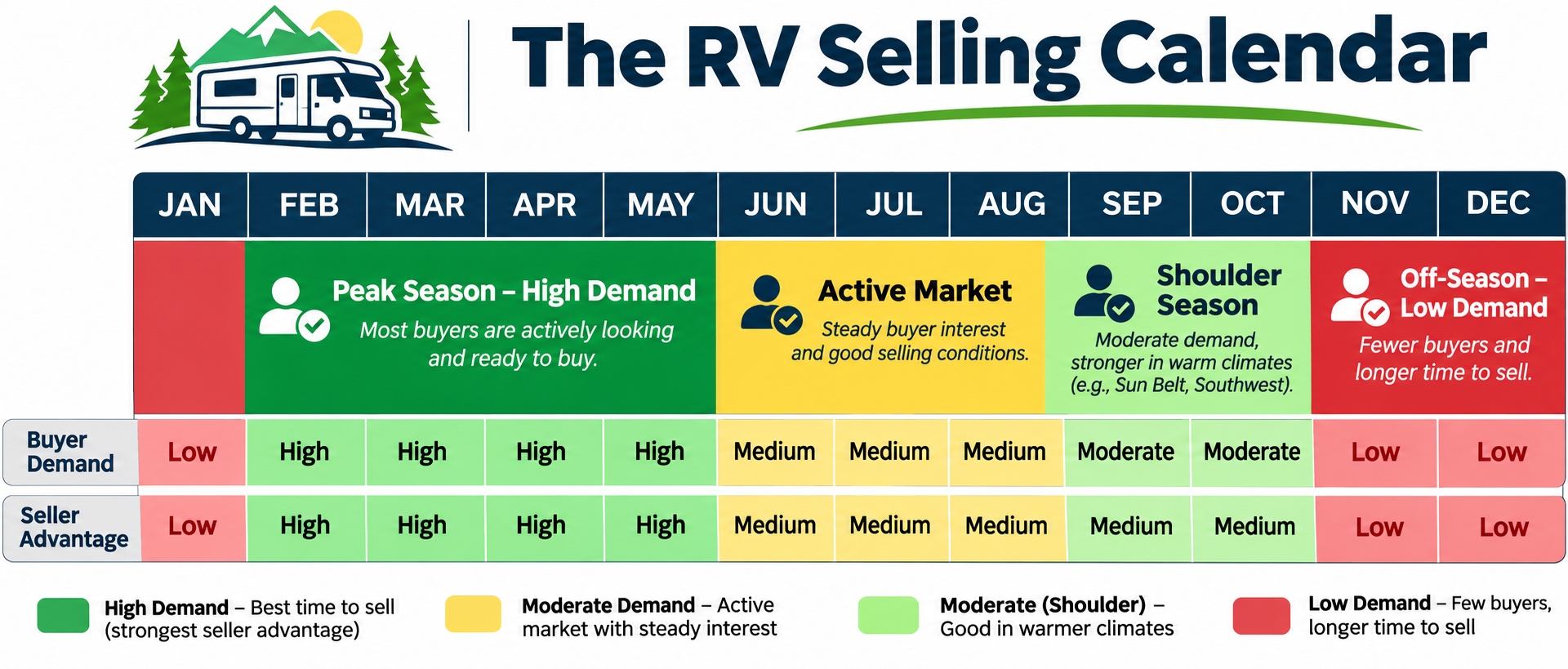
This isn’t just anecdotal — it tracks directly with search volume data. Searches for “buy an RV” and “used RV for sale” spike sharply in February and March, peak in April and May, and begin declining in August. By November and December, buyer activity drops to its annual low in most markets, particularly in colder climates like the Midwest.
Understanding this pattern helps you make a better decision — but it doesn’t mean you should automatically wait for peak season. There are real costs to holding an RV: insurance, storage, registration, and the ongoing depreciation that hits RVs at roughly 15-25% in the first few years. Sometimes selling now, even slightly below peak price, is smarter than paying to hold an asset for 6 months.
The Best Months to Sell: February Through May
If you have flexibility on timing, February through May is the window you want. This is when buyer motivation is highest, competition among buyers increases (more buyers competing for the same inventory), and you’re most likely to get multiple inquiries quickly if your listing is priced correctly and presented well.
February marks the start of the buying season even in cold climates. Buyers are researching online, building wishlists, and preparing for summer travel. Many are ready to commit and take delivery before the camping season officially begins. If you list in February with a clean, well-photographed ad and accurate pricing, you can have a sale complete by March — prime position.
March and April are the peak of peak season. Inventory sells fastest, buyer urgency is highest (they want the RV before their first planned trip), and you’re least likely to need to drop your price to move the unit. If you’re selling privately, this is your best window.
May is still strong but starts showing the first signs of a seller’s market cooling. Buyers who haven’t yet found what they want start getting picky, and some decide to wait until fall or next year.
Shoulder Season: What Happens in Summer and Fall
June through August is a mixed period. The number of active buyers drops as people shift from planning to actually using their RVs. However, the buyers who are active in summer tend to be serious — they’ve missed the spring window and they need to buy. Prices are softer than spring peak, but motivated buyers still exist, particularly for well-priced units in good condition.
September and October see a secondary uptick in some markets as buyers start thinking about fall trips — leaf-peeping routes, hunting season, and similar outdoor activities that favor RV travel. In warmer climates (the Southwest, Florida, the South), fall is actually one of the stronger selling periods since it marks the start of the snowbird migration season.
In Midwest markets specifically, September-October is still viable but noticeably softer than spring. Price your unit 5-10% below comparable spring listings if you want to move quickly during this window.
The Worst Time to Sell: November Through January
The holiday window — roughly mid-November through January — is the slowest period in the RV market in most of the country. Buyers are focused on the holidays, budgets are committed to other things, and anyone thinking about spring camping isn’t ready to pull the trigger yet.
This doesn’t mean you can’t sell in winter — it means your pool of buyers is significantly smaller, and the buyers who are active tend to be price-sensitive deal-hunters. If you need to sell in this window, expect to price more aggressively than you would in spring, or consider whether a direct buyer who purchases in any season is a better fit for your situation.
One exception: if your RV is in a category that appeals to snowbirds or full-timers, winter isn’t necessarily dead. Buyers who live in their RVs or who are planning a winter-to-spring migration don’t follow the same seasonal calendar as the weekend camper market.
When Timing Doesn’t Matter: Selling to a Direct Cash Buyer
The seasonal calendar matters for private sales and dealership trade-ins — but it matters much less when you sell to a professional cash buyer. Cash buyers like RV Buyers USA operate year-round. They’re not planning a summer camping trip; they’re running a business that acquires inventory in every season.
This creates a real option for sellers who can’t or don’t want to wait for peak season:
- You need to sell before a move, a divorce, an estate settlement, or a financial deadline
- Your RV has been sitting and you’re paying storage and insurance on something you’re not using
- You’ve listed privately and had no serious offers after 30+ days on the market
- You don’t want to deal with the paperwork, negotiation, and logistics of a private sale
The tradeoff with a direct cash buyer is straightforward: you give up the possibility of the highest possible private-sale price, and you gain speed, certainty, and zero hassle. For many sellers, that tradeoff is clearly worth it — especially when you factor in the real cost of holding costs, and the uncertainty of how long a private sale will take.
| Selling Method | Best Season | Speed | Price Potential | Effort |
|---|---|---|---|---|
| Private sale (Facebook Marketplace, RVTrader) | Feb–May | 2–8 weeks | Highest | High — photos, listings, negotiation, paperwork |
| Dealership trade-in or consignment | Mar–Apr | Immediate–weeks | Below market (30–40% below NADA) | Low |
| Direct cash buyer (RV Buyers USA) | Any time | Days | Fair market offer, no negotiation games | Minimal — one call, one inspection |
How to Maximize Your Price Regardless of When You Sell
Timing is one lever. Presentation and pricing are the other two — and they apply in every season. A well-prepared RV sells faster and for more money than an identical unit that’s dirty, has deferred maintenance, and is priced with wishful thinking.
Before listing (or before a cash buyer comes to inspect), do the following:
- Deep clean the interior and exterior. Buyers form opinions instantly. A clean RV signals that it’s been cared for; a dirty one raises questions about what else hasn’t been maintained.
- Fix the obvious things. A broken awning arm, a slide that’s slow, a leaking faucet — these are easy to fix and disproportionately hurt your price when buyers see them.
- Gather your records. Maintenance logs, warranty documentation, and the title (clear of any liens) in hand from day one shows professionalism and removes friction from the close.
- Price from data, not sentiment. Check NADA Guides and active listings on RVTrader for comparable units. Emotional attachment to what you paid is the single biggest reason sellers leave money on the table — or don’t sell at all.
Frequently Asked Questions
What is the best month to sell an RV?
March and April are generally the strongest months to sell an RV in most U.S. markets. Buyer demand peaks in spring as people are planning summer travel, and competition among buyers keeps prices firm. February is also strong if you can list early — serious buyers are already researching before camping season begins.
Does it take longer to sell an RV in winter?
Yes, in most cases. The winter market (November through January) sees significantly fewer active buyers, particularly in northern and Midwest states. Units that do sell in winter often require more aggressive pricing to attract the smaller buyer pool. If you can wait until spring, you’ll typically see faster results and stronger offers.
Can I sell my RV fast if I need to sell now?
Yes. If timing is critical, selling to a direct cash buyer is the fastest path — you can go from initial contact to payment in a matter of days rather than weeks. Companies like RV Buyers USA make offers year-round and handle all the paperwork, so you don’t have to wait for the right season or the right private buyer.
How much does seasonal timing affect RV sale price?
In a typical market, a well-presented RV sold at peak season (March-April) can command 10-15% more than the same unit sold in the off-season (November-January). The gap is larger for seasonal units like pop-ups and travel trailers that appeal primarily to summer campers, and smaller for full-time-capable units like Class A motorhomes.
Is it worth waiting for spring if my RV is sitting now?
It depends on your holding costs. Calculate what you’re paying monthly for insurance, storage, and registration, then multiply by the number of months until peak season. If that total approaches or exceeds the price premium you’d get by waiting, selling now — even to a cash buyer at a slightly lower price — may be the smarter financial decision.
What type of RV sells fastest in any season?
Towable trailers (travel trailers and fifth wheels) in the mid-range price bracket ($15,000–$40,000) tend to move fastest in any season because they appeal to the widest buyer pool. Class B and Class C motorhomes are also relatively quick sellers. Larger Class A diesel pushers have a narrower buyer pool and often take longer regardless of season.
Should I sell to a dealer or a private buyer?
Dealers offer speed and simplicity but typically pay 30-40% below private market value — they need margin to resell. Private buyers offer the highest potential price but take the most time and effort. A direct cash buyer from a company like RV Buyers USA sits between the two: competitive fair-market offers with the speed and simplicity of a dealer transaction.
Ready to find out what your RV is worth right now, regardless of the season? RV Buyers USA makes fair cash offers year-round with no games, no pressure, and no hidden fees. Contact us today for a free, no-obligation offer — most sellers have a number in hand within 24 hours.