
Did you know that a new travel trailer loses up to 20% of its market value the moment you pull it off the dealer’s lot? It’s a staggering hit to your wallet before you even reach your first campsite. You’ve likely spent hours browsing floorplans and imagining weekend getaways, but the sticker price is only the beginning of the story. To avoid a major financial headache, you must understand what is the true cost of owning a travel trailer in 2026. Between 8.49% interest rates on mid-range loans and national gas prices averaging $4.457 per gallon, the numbers add up fast.
We understand the excitement of hitting the open road, but we also know the anxiety of unexpected “money pit” repairs. This breakdown provides the comprehensive reality of ownership, covering everything from $65 nightly private park fees to the $433 monthly cost of indoor storage. You’ll learn how to calculate a realistic annual budget and discover the heavy impact of depreciation on your long-term investment. We’ll give you the facts you need to enjoy the lifestyle without the sticker shock, ensuring you have a clear exit strategy when it’s time to sell.
Key Takeaways
- Account for “Day One” essentials like weight distribution hitches and state taxes to see the full financial picture beyond the dealer’s sticker price.
- Calculate what is the true cost of owning a travel trailer by including rising professional storage rates and specialized insurance premiums in your monthly budget.
- Prepare for the “RV Tax” by budgeting 1% to 3% of your unit’s value for annual maintenance and specialized parts that often exceed standard home repair costs.
- Analyze the five-year depreciation curve to understand how your trailer’s market value drops and how to protect your equity from the “drive-off” penalty.
- Identify the specific signs that carrying costs are exceeding your lifestyle value so you can plan a clean, hassle-free exit before the asset loses more value.
Beyond the Sticker Price: Initial Purchase and “Day One” Costs
The sticker price is a starting line, not the finish. If you want to know what is the true cost of owning a travel trailer, you have to factor in the Total Cost of Ownership (TCO). This includes every dollar spent from the moment you sign the title until you hand over the keys to the next owner. Most buyers focus on the monthly payment. They forget that “Day One” often requires thousands in extra cash for taxes, registration, and essential safety hardware. A Recreational vehicle purchase involves more than just the unit itself; it’s a commitment to a mobile infrastructure.
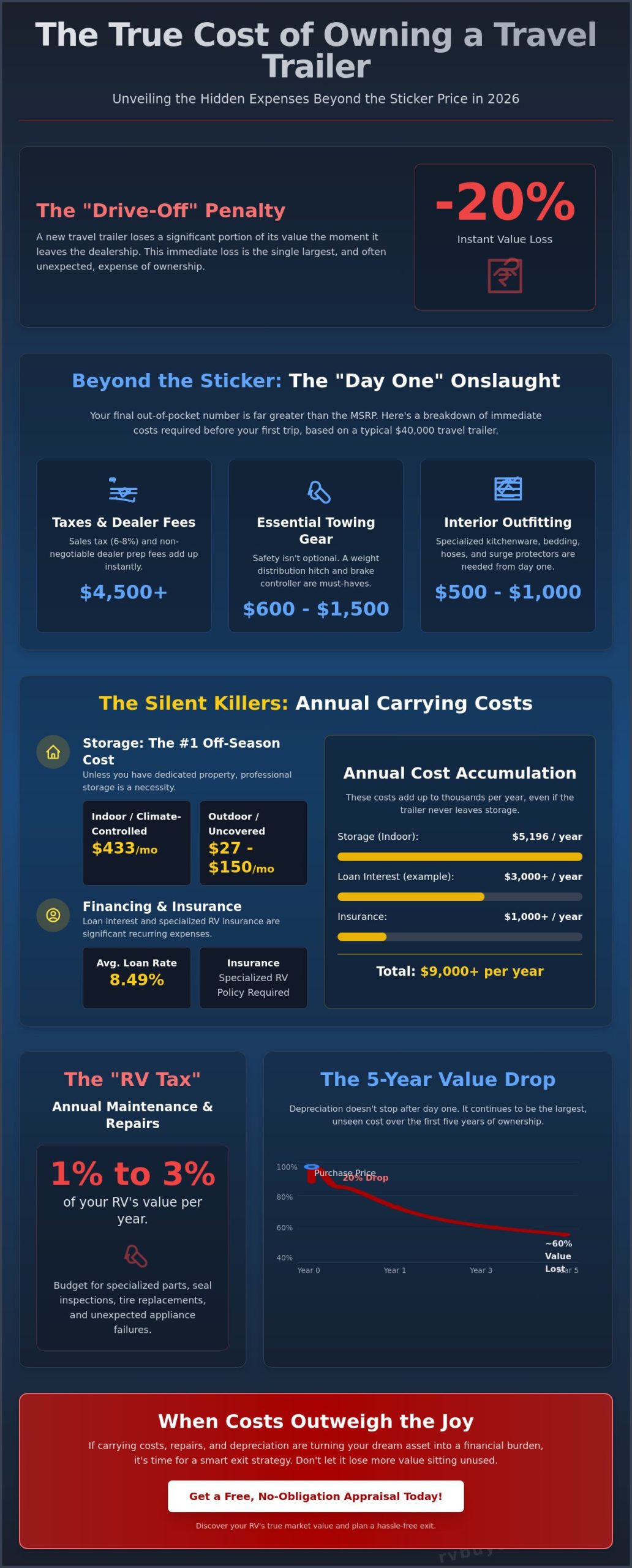
Government fees hit first. In 2026, sales tax remains a massive upfront hurdle. California buyers face a base rate of 7.25% plus local fees. Texas owners start at 6.25%. On a $40,000 trailer, that’s $2,500 to $3,000 gone instantly. Add registration fees and title documentation, and you’ve spent a vacation’s worth of money before the tires even roll. Don’t fall for the “Starter Kit” trap at the dealership either. Dealers often bundle low-quality hoses, levelers, and surge protectors at a premium. You’ll likely replace these within a year for higher-grade gear that actually protects your investment.
The Acquisition Equation
MSRP is a mirage. Your final out-of-pocket number includes dealer prep fees and freight charges that can add $2,000 to the bill. Financing adds another layer. With average new RV loan rates sitting at 7.53% in May 2026, a long-term loan can double the trailer’s cost over its life. Even cash buyers face opportunity costs. That money could have earned 5% in a high-yield account. Always get a professional appraisal before buying used. It prevents you from overpaying for a unit with hidden water damage or structural issues.
Essential Outfitting and Towing Gear
Safety isn’t optional. You must invest in a high-quality weight distribution hitch and a reliable brake controller. These components keep you stable on the highway and can cost between $600 and $1,500. Don’t skip a Tire Pressure Monitoring System (TPMS) or sway control hardware. These tools prevent catastrophic blowouts and white-knuckle driving sessions.
- Kitchen and Bedding: Budget $500 to $1,000 for lightweight, break-resistant dishes and specialized RV bedding.
- Safety Tech: TPMS and sway bars are essential for highway stability.
- Vehicle Limits: Check your Gross Vehicle Weight Rating (GVWR). If the trailer is too heavy, you might need a $50,000 truck upgrade to tow it safely.
Calculate these costs early. Understanding the “Day One” reality ensures your dream of the open road doesn’t turn into a financial nightmare before your first trip.
The Silent Killers: Carrying and Fixed Annual Costs
Your trailer costs money even when it isn’t moving. These carrying costs are the “silent killers” of an RV budget because they never take a vacation. In 2026, professional storage and insurance rates have climbed significantly due to increased demand and land values. When people ask what is the true cost of owning a travel trailer, they often overlook the $5,000 or more spent annually just to keep the asset parked and protected. These are non-negotiable expenses that hit your bank account whether you take ten trips a year or zero.
Storage is your biggest hurdle. If you don’t have a massive driveway and a friendly HOA, you’re paying for a lot. Indoor, enclosed storage now reaches over $433 per month in high-demand areas. Even basic outdoor, uncovered spots range from $27 to $150 monthly. Don’t risk HOA fines by parking on the street. Those penalties can hit $100 per day in some neighborhoods. Protective covers or ceramic coatings are smart cost-avoidance measures, but they add to your initial setup fees and require regular re-application to remain effective.
Storage and Protection
Climate-controlled storage is the gold standard, but it’s a premium line item. It prevents seal degradation and interior mold, potentially saving you thousands in future repairs. If you choose an open lot, you’ll save cash monthly but spend more on maintenance later. Always check local zoning laws before parking at home to avoid surprise legal fees or citations from local code enforcement officers.
Insurance and Roadside Security
Don’t just add your trailer to your car insurance. You need specialized coverage. Total Loss Replacement is vital for newer units. It ensures you get a new trailer of the same model if yours is destroyed, rather than a depreciated cash check. For those living on the road, full-time travel trailer insurance ranges from $1,500 to $4,000 per year. Specialized roadside assistance is also mandatory. Towing a trailer requires heavy-duty equipment and winching capabilities that standard auto plans don’t provide. If you have a blowout on a tandem axle, a standard tow truck won’t be enough.
Don’t forget the “Membership Tax.” Roadside security and specialized camping clubs add another $100 to $300 annually to your overhead. State fees vary wildly too. South Dakota uses weight-based registration between $150 and $400, while Missouri charges a flat $32. A real-world 5-year cost analysis highlights how these small fees compound into a major financial commitment. If these fixed costs are outweighing your time on the road, it’s easier to sell your RV for a fair price and reclaim your monthly budget today.
Maintenance, Repairs, and the “RV Tax”
Maintenance isn’t a suggestion; it’s a requirement for survival. To understand what is the true cost of owning a travel trailer, you must apply the 1% to 3% rule. This means budgeting between 1% and 3% of your trailer’s original purchase price for annual upkeep. If your unit cost $60,000, set aside $600 to $1,800 every year. This fund covers the “RV Tax,” which is the premium you pay for specialized parts and labor. Unlike standard home fixtures, RV components must withstand constant road vibration and extreme temperature swings. A simple faucet replacement can cost double the price of a residential model because of these unique specifications.
Seasonal transitions add another layer of expense. Professional winterization and de-winterization protocols are essential for owners in colder climates. Skipping these steps leads to burst pipes and ruined water heaters. You also face “hidden” wear items that demand attention regardless of mileage. Trailer tires typically require replacement every five years because of UV exposure and dry rot. Roof seals need a full inspection every 90 days. A single ignored crack in the sealant can invite water damage, which is the leading cause of total loss for towable units.
Preventative Maintenance Schedule
Stay ahead of the bills with a strict quarterly schedule. Inspect all exterior seals, lubricate slide-out mechanisms, and check battery health every three months. Annually, you must repack wheel bearings and service major appliances like the furnace and water heater. DIY maintenance saves cash on labor, but it costs significant “opportunity time.” If you aren’t comfortable on a ladder or working with electrical systems, factor in the high cost of professional shop time.
Major Repair Contingencies
Major appliances have finite lifespans. AC units, refrigerators, and water heaters often require replacement after seven to ten years of use. In 2026, finding qualified RV technicians is increasingly difficult. This shortage drives labor rates higher and creates weeks-long service backlogs. Always keep a contingency fund for these “big ticket” failures. If your repair list is growing faster than your travel map, it might be time to stop the bleeding. We buy travel trailers in any condition, offering a fast way to exit the “money pit” cycle without the stress of expensive repairs.
Depreciation: The Largest Expense You Never See
Depreciation is the most significant financial hit you’ll take, yet it doesn’t show up on a monthly bank statement. It’s a “ghost” expense that only reveals itself when you try to sell. If you want to calculate what is the true cost of owning a travel trailer, you must account for the “Drive-Off” penalty. New travel trailers typically lose 15% to 20% of their value in the first year alone. This means a $40,000 unit could lose $8,000 in market value before you finish your first season. Depreciation is a non-cash expense until the day of sale, but it’s constantly eroding your equity.
The five-year depreciation curve in 2026 shows that the steepest decline happens early. Most units lose the bulk of their resale value within the first 60 months. Brand reputation plays a massive role here. Premium names like Airstream often hold their value better than entry-level, stick-and-tin models. Understanding your current market position is vital for financial planning. Use our expert guide to learn how to value your RV and see where your equity stands today.
Factors That Accelerate Value Loss
Market value isn’t just about age. Smoking, pet odors, and deferred maintenance will slash your residual value instantly. While you might love your custom interior paint or unique shelving, “customizations” rarely add value. In most cases, they actually decrease it because they limit the pool of potential buyers. Market saturation also impacts the individual seller. When dealerships have excess inventory of new units, the value of your used trailer drops to remain competitive against newer models with full warranties.
Calculating Your Real Annual Cost
To find your actual cost of ownership, use this formula: (Purchase Price + All Carrying and Maintenance Expenses – Resale Value) / Years of Ownership. Let’s look at a hypothetical 3-year ownership example for a $35,000 trailer. If you spend $9,000 on storage, insurance, and maintenance over three years, and the resale value drops to $22,000, your total expenditure is $22,000. This averages out to $7,333 per year. This number is far higher than most owners anticipate when they first look at a monthly loan payment. If your trailer’s value is dropping faster than you can use it, you can sell your RV fast for a fair cash offer and stop the financial drain immediately.
When the Costs Outweigh the Joy: Exiting Gracefully
RV ownership should be about the freedom of the open road, not a growing list of monthly bills. If you find your unit sitting in storage for 11 months of the year, the math has likely stopped working in your favor. When you finally calculate what is the true cost of owning a travel trailer, including the $5,000 in annual carrying costs and the 20% first-year depreciation penalty, liquidation often becomes the smartest financial move. Recognizing the “financial bleed” early allows you to recoup your equity before the next major maintenance cycle or another year of value loss hits your bottom line.
Selling a trailer involves its own set of hidden expenses. Professional detailing to make a unit “showroom ready” can cost between $300 and $600. Premium listing fees on national marketplaces often run $100 per month. Beyond the money, the time cost is significant. You’ll spend weeks answering messages from “tire-kickers” who never show up or offer pennies on the dollar. Private sales also carry legitimate risks, such as fraudulent payments or complex title paperwork errors that can leave you legally liable long after the trailer is gone.
The Private Sale vs. Professional Acquisition
Consignment might seem like a hands-off solution, but it comes at a steep price. Most dealerships charge a commission of 10% to 15% on the final sale price. On a $30,000 trailer, you’re handing over $4,500 just for the privilege of letting it sit on their lot. During that time, the unit continues to depreciate, and the dealer will always prioritize selling their own new inventory over your used model. We provide the antithesis to this frustration. Our “We come to you” model removes every hurdle. You don’t need to clean, repair, or advertise your unit to get a fair deal.
Taking the Direct Path to Liquidation
We act as the problem solver for owners who want a clean exit. Our process is streamlined to match the speed of your life. We offer a direct, nationwide service that strips away the anxiety of selling a high-value asset. There are no hidden fees and no high-pressure sales tactics. We handle all DMV and title paperwork, ensuring your transition out of ownership is uncomplicated and secure.
- Step 1: Provide your trailer details for a professional appraisal.
- Step 2: Receive a firm, competitive cash offer.
- Step 3: Schedule a convenient, nationwide pickup at your location.
Stop the depreciation and reclaim your monthly budget today. Get a professional cash offer for your travel trailer today and experience a truly hassle-free sale.
Take Control of Your RV Financial Future
Owning a travel trailer should be about making memories; it shouldn’t be about managing a mounting pile of bills. You’ve seen how carrying costs, the “RV tax” on repairs, and the steep five-year depreciation curve can silently drain your savings. Understanding what is the true cost of owning a travel trailer gives you the power to make a smart financial pivot before your equity disappears. If the math no longer supports the lifestyle, it’s time to stop the bleeding and reclaim your monthly budget today.
RV Buyers USA has provided expert acquisition services since 2003. With over 20 years of industry experience, we specialize in making the exit process seamless and secure. We offer direct-cash payments and handle all professional title management to eliminate your stress. Our team provides free nationwide pickup, so you never have to worry about the logistics of moving an unused unit. Skip the consignment fees and the frustration of private listings.
Ready to stop the expenses? Get an instant cash offer for your travel trailer now. We make it easy to move forward with confidence and cash in hand.
Frequently Asked Questions
Is it cheaper to stay in hotels or own a travel trailer?
Hotels are generally cheaper for travelers who spend fewer than 40 nights on the road per year. When you account for the $4.457 per gallon gas average and $65 nightly private park fees, the overhead of ownership is high. Travel trailers only become cost-effective when used frequently enough to offset the thousands spent on storage and insurance. If you only travel twice a year, the “per night” cost of a trailer often doubles that of a luxury hotel suite.
How much should I budget for annual travel trailer maintenance?
Budget between 1% and 3% of your trailer’s original purchase price for annual upkeep. For a $50,000 unit, this means setting aside $500 to $1,500 every year to handle seals, bearings, and appliance servicing. To understand what is the true cost of owning a travel trailer, you must realize that maintenance prevents catastrophic failures like water damage. Neglecting these small costs leads to massive repair bills that can total 20% of the unit’s value in a single shop visit.
Do travel trailers hold their value better than motorhomes?
Travel trailers often hold their value better because they lack complex engines and transmissions that fail over time. A motorhome faces mechanical depreciation on top of its living quarters’ wear and tear. However, travel trailers still face a 15% to 20% value drop in the first year. While they are more stable long-term assets than Class A or Class C units, they are still depreciating assets that lose significant market value every season they sit unused.
What is the average monthly cost of RV insurance in 2026?
The average monthly cost for recreational travel trailer insurance is approximately $50. This is based on a national average annual premium of $594 as of May 2026. If you live in your trailer full-time, expect to pay significantly more. Full-time policies range from $125 to $333 per month because they include liability coverage similar to a homeowner’s policy. Always get a specific quote for your unit, as rates vary based on your state and the trailer’s total replacement value.
Can I deduct travel trailer interest on my taxes?
You can often deduct the interest if the trailer is used as a second home. The IRS allows this deduction if the unit has basic sleeping, cooking, and toilet facilities. This can help offset what is the true cost of owning a travel trailer by lowering your taxable income. You must use the trailer for at least 14 days or 10% of the days you rent it out. Always consult a tax professional to ensure your specific unit and usage meet current 2026 tax code requirements.
How often do travel trailer tires really need to be replaced?
Replace your trailer tires every five years regardless of how much tread is left. UV exposure and long periods of sitting in storage cause the rubber to rot from the inside out. This dry rot leads to catastrophic blowouts on the highway that can cause thousands in skirt and wheel well damage. Most owners only cover a few thousand miles a year, so the tread looks new while the structure is failing. Don’t risk a $3,000 repair bill to save a few hundred dollars on new rubber.
Does living in a travel trailer full-time save money?
Full-time living only saves money if you avoid expensive resort-style parks. With private RV parks averaging $65 per night, your monthly “rent” can hit $1,950 before utilities or insurance. Add in a full-time insurance policy that can cost $4,000 annually, and the savings compared to a traditional apartment may disappear. Many people find that the lifestyle is about the experience rather than the savings, as the total monthly spend often mirrors a fixed-address lifestyle in many states.
What is the most expensive part of owning a travel trailer?
Depreciation is the most expensive part of ownership, often costing more than maintenance and storage combined. A trailer that costs $45,000 can lose $9,000 in value during its first 12 months. This “silent” expense doesn’t hit your bank account monthly, but it’s a massive loss of equity that you realize on the day of sale. Because this loss is so heavy in the first five years, many owners choose to sell early to a professional buyer to stop the financial drain.