
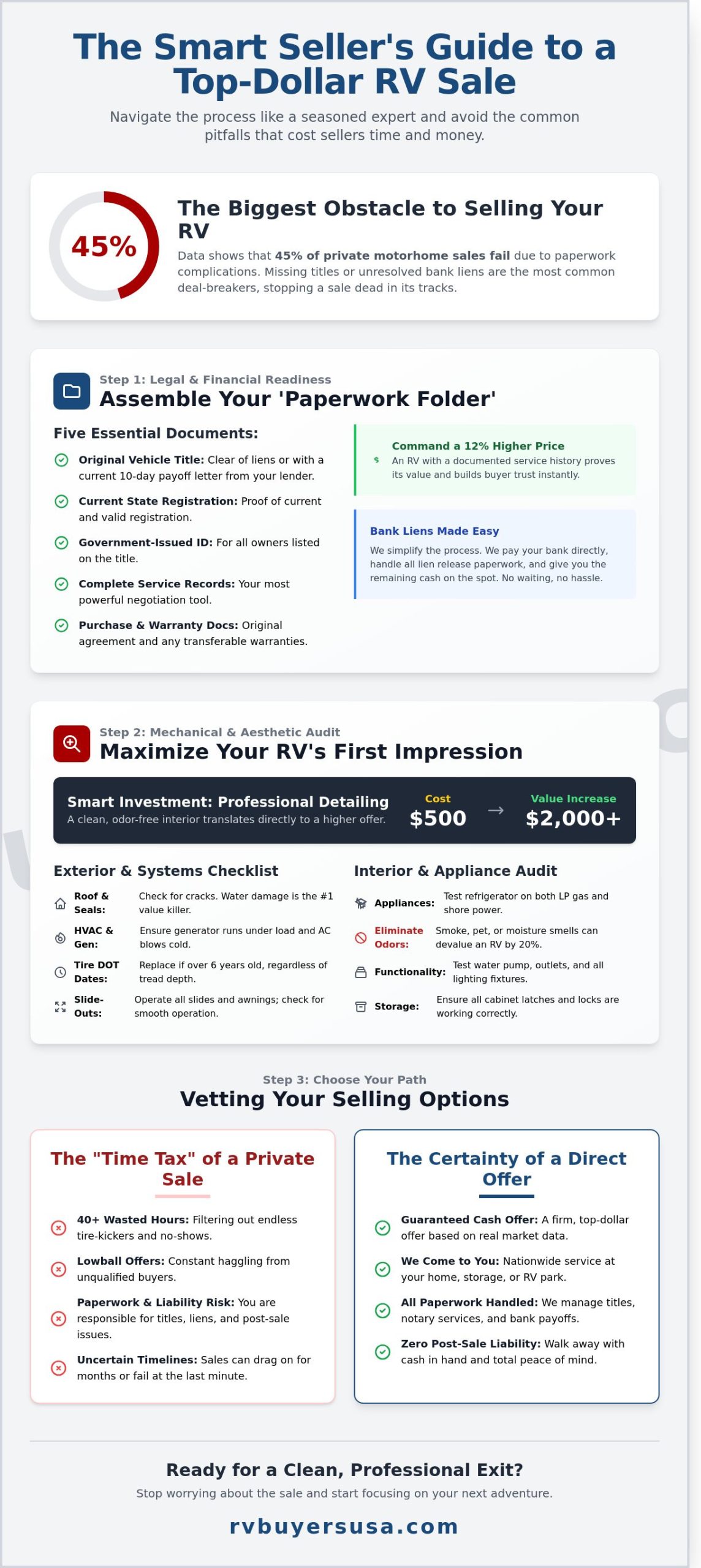
What if the biggest obstacle to selling an rv isn’t the market value, but the 15 pages of DMV paperwork you didn’t see coming? Data from the last 12 months indicates that 45% of private motorhome sales fail because of title complications or unresolved bank liens. You’ve maintained your Class A or fifth wheel with care, and you shouldn’t have to waste 40 hours filtering out tire kickers who just want to browse. It’s time to stop worrying about lowball offers and start focusing on a clean, professional exit.
We agree that you deserve a transaction grounded in reliability and total transparency. This guide promises to help you master every stage of the process so you can secure a top-dollar cash offer without the typical dealership headaches. We are providing a comprehensive checklist that covers everything from title preparation to the final hand-off. You’ll gain the tools to handle the sale like a seasoned expert and enjoy the convenience of a nationwide service where we come to you. You’ll finish this article ready to walk away with zero post-sale liability and cash in hand.
Key Takeaways
- Build a professional “Paperwork Folder” to ensure your title and legal documents are deal-ready to avoid common transaction deal-breakers.
- Master the “First Impression” rule by identifying the specific mechanical and aesthetic upgrades that maximize value for Class A and B motorhomes.
- Navigate the 2026 market landscape using real-world data to set a competitive price when selling an rv for top dollar.
- Compare the hidden “Time Tax” of private listings against the speed and certainty of a guaranteed nationwide cash offer.
- Protect your interests during the final transaction with a legally binding Bill of Sale and the essential Release of Liability form.
The Pre-Sale Documentation Audit: Legal and Financial Readiness
Selling an rv starts long before you hand over the keys. In professional acquisitions, documentation is the single biggest deal-breaker. If your paperwork isn’t ready, the deal stops. A missing title or an unresolved lien can delay a sale by 30 days or kill it entirely. You need a dedicated “Paperwork Folder” to prove you own the asset and have maintained it properly. This preparation ensures you get top dollar without the back-and-forth typical of private sales.
Your folder should contain these five essentials:
- Original Vehicle Title (Clear of liens or with current payoff info)
- Current State Registration
- Government-issued ID for all owners listed on the title
- Complete Service Records and maintenance logs
- Original Purchase Agreement and warranty documents
Service records are your best leverage. An RV with a documented history of annual roof seals and generator oil changes often commands a 12% higher price than a “mystery” unit. If you lost your title, don’t panic. Contact your local DMV immediately for a duplicate. This process usually takes 14 to 21 business days depending on your state. We handle nationwide transfers every day, so we know how to navigate these hurdles quickly to keep your sale on track.
The Title and Ownership Checklist
Verify that your title is accurate today. Check for typos in the VIN or outdated owner names. If the RV is held in a trust or is part of an estate, you’ll need the legal “Short Certificate” or trust documents to prove you have the authority to sell. States like Arizona, Kentucky, and Ohio require a notary for title transfers. Don’t wait until the buyer is in your driveway to find this out. We simplify this by reviewing your documents digitally before we arrive at your door.
Navigating Bank Liens and Payoffs
Most modern RVs carry a balance. Call your lender and request a “10-day payoff letter.” This document shows exactly what’s owed plus interest over the next 10 days. If you’re “upside-down” and owe $5,000 more than the RV’s current market value, you’ll need to cover that difference at the time of sale. Professional buyers make this easy. We pay your bank directly, handle the lien release paperwork, and give you the remaining cash instantly. It’s a clean break. No waiting for the bank to mail you a title first. We take care of the heavy lifting while you focus on your next move.
Physical Condition Checklist: Mechanical and Aesthetic Audit
Your RV’s value isn’t just a number in a book. It’s a direct reflection of how well you’ve maintained the unit over the years. The “First Impression” rule is absolute. For Class A and Class B motorhomes, curb appeal acts as a proxy for mechanical health. A buyer who sees faded gelcoats or cracked seals assumes the engine and transmission have been equally neglected. This mental shift can cost you $3,000 to $7,000 in negotiating power before the buyer even steps inside the coach.
Perform a DIY mechanical walkthrough before scheduling any professional appraisal. You need to know your rig’s flaws to avoid surprises. Prioritize repairs that impact safety or core functionality. Fixing a broken water pump is a smart $150 investment. However, replacing dated upholstery rarely provides a 1:1 return on investment. Focus on the high-impact areas that professional buyers and seasoned travelers scrutinize most during a walkthrough.
Exterior and Systems Checklist
- Roof and Seals: Inspect the roof every 90 days. Check for “alligatoring” or cracks in the sealant. Water damage is the number one value killer in the RV industry.
- The “Big Three”: Verify the generator starts under load, the HVAC maintains a 20-degree temperature drop from the intake, and the leveling jacks deploy without hydraulic leaks.
- Tire DOT Dates: Look for the four-digit code on the sidewall. If your tires are more than 6 years old, they’re considered end-of-life. Tread depth doesn’t matter if the rubber is aging out.
- Slide-Outs and Awnings: Listen for grinding or popping. Lubricate the tracks and check the rubber gaskets for UV damage or tearing.
Interior and Appliance Audit
Cleanliness translates directly to cash. A professional detailing service costing $500 can often increase your final sale price by $2,000 or more. It removes the “lived-in” feel that makes private buyers hesitant. Test your refrigerator on both LP gas and shore power. A failed cooling unit is a $1,400 repair that will be flagged during any serious inspection.
Identify and eliminate odors immediately. Moisture, pets, and smoke can devalue a travel trailer or fifth wheel by 20% instantly. If these repairs and cleaning tasks seem like too much work for your schedule, you can always sell your RV as-is for a fair price and skip the stress. We handle the dirty work so you don’t have to. Check every light fixture and ensure the water heater functions on all heat sources to prove the unit is truly road-ready.
Market Research: Pricing Your RV for a 2026 Sale
The 2026 market is a different beast than the post-pandemic frenzy of 2021. Back then, used units often sold for more than their original MSRP. Today, inventory levels have stabilized and interest rates for RV loans hover around 7.8%, making buyers much more selective. You need a data-driven strategy for selling an rv if you want to avoid watching your asset sit idle for months. Success requires looking past outdated guidebooks and focusing on what buyers are actually paying right now.
Don’t rely solely on J.D. Power or NADA Guides. These tools are helpful starting points, but their data often lags behind real-time market shifts by 90 to 120 days. Professional buyers look at “Real World” sold data from auction houses and private transaction records from the last 30 days. You must also account for external factors like fuel prices. When diesel averages $4.50 per gallon, the demand for heavy Class A motorhomes drops by as much as 18%, while fuel-efficient Class B vans see a price premium.
Avoid the “Emotional Pricing” trap. You might feel your RV is worth more because of the $5,000 solar package you installed or the memories of family trips. The hard truth is that buyers rarely pay more than 20 cents on the dollar for aftermarket upgrades. Price your rig based on current market demand, not your personal attachment or the balance of your remaining loan.
Valuation Tools and Comparison Frameworks
To find an accurate price, locate three “Comparables” within a 500-mile radius that share your exact floorplan and mileage range. Understand the three tiers of valuation: Wholesale is the baseline cash value; Trade-in is typically 10% higher; and Private Party is the theoretical ceiling. Be realistic. The “asking price” you see on major listing sites is usually 15% higher than the final transaction price. If a similar rig is listed for $100,000, it likely sells for $85,000. For a deeper breakdown of how regional markets affect your number, review this guide to selling my rv and accurately valuing your motorhome before you set your final asking price.
The Cost of Waiting: Depreciation and Holding Costs
Every month your RV remains unsold, it bleeds money through holding costs. Calculate your monthly overhead. If you pay $200 for storage, $150 for insurance, and $100 for basic maintenance, your RV costs you $450 every 30 days. A standard motorhome typically loses 38% of its original manufacturer’s suggested retail price within the first five years of its life. Waiting six months for a slightly higher private offer often results in a lower net profit than taking a fast cash offer today. We eliminate these carrying costs by providing an immediate, hassle-free exit from your investment. When selling an rv, speed is often more profitable than patience.
Vetting Your Selling Options: Private Sale vs. Consignment vs. Direct Cash
Choosing the right method for selling an rv determines how much money stays in your pocket and how much stress you endure. Most owners default to social media marketplaces or classified sites. This path introduces a heavy “Time Tax.” Data from 2023 shows that private RV listings stay active for an average of 65 days before a serious buyer emerges. You spend those two months answering repetitive messages and coordinating schedules for people who may never show up.
Consignment offers a middle ground, but it carries significant financial weight. Dealerships typically charge a commission between 10% and 15%. If your motorhome sells for $80,000, you pay $12,000 just for the privilege of parking it on their lot. There is no guarantee of a sale date. Your asset sits outside, exposed to the elements, while you continue to pay insurance and storage costs. Direct cash buyers eliminate these variables. Professional acquisition is the fastest path to liquidation because it bypasses the retail waiting game entirely.
- Private sales often take 60 to 90 days to finalize.
- Consignment fees range from 10% to 15% of the gross sale price.
- Professional buyers provide funding in as little as 24 hours.
Safety is a valid concern for any seller. You might wonder if you can trust a buyer who comes to your house. Professional organizations provide verifiable credentials, transport insurance, and secure payment methods. We prioritize your security by handling every detail of the transaction before we ever arrive at your driveway. This transparency removes the “stranger danger” associated with meeting random individuals from the internet.
The Private Sale Reality Check
The private market is full of “tire kickers” and “no-shows.” Statistics indicate that 75% of online inquiries fail to result in a physical viewing. Beyond the frustration, the risk of fraud is real. Scammers frequently use sophisticated cashier’s check schemes or wire transfer reversals to steal high-value assets. Additionally, private buyers often hit a wall with financing. Most major lenders refuse to provide loans for RVs older than 10 years. This leaves you waiting for a cash-heavy buyer who rarely exists in the private sector.
The “Hassle-Free” Advantage of Direct Acquisition
RV Buyers USA removes the burden of preparation. You don’t need to spend $600 on professional detailing or $1,500 on minor mechanical repairs. We buy your Class A, B, or C motorhome, fifth wheel, or travel trailer in its current condition. Our process includes free nationwide pickup and immediate funding, often within 24 hours of an agreement. When you subtract the 15% consignment fee and the cost of repairs, our direct offer frequently results in a higher net profit. We come to you, verify the unit, and put cash in your hand without the wait.
The Final Transaction Checklist: Closing the Deal Safely
Finalizing the process of selling an rv requires more than a handshake. You need to lock down the legal details to ensure you aren’t held responsible for the vehicle once it leaves your driveway. Start by drafting a comprehensive Bill of Sale. This document must include the VIN, the final sale price, the date of the transaction, and the odometer reading. Explicitly state that the vehicle is being sold “as-is” to prevent future disputes over mechanical issues. Both parties should sign two copies so you each have an original for your records.
Secure payment is your top priority. Never release the title until funds are fully cleared. Distinguish between “pending” transfers and “available” funds in your account. Scammers frequently use fraudulent ACH transfers that appear in your balance but bounce 48 hours later. Stick to verified bank wires or visit the buyer’s local branch to witness the printing of a cashier’s check. Once the money is safe, call your insurance provider and roadside assistance companies like Good Sam or Coach-Net. Most insurers offer pro-rated refunds for unused premiums, so cancel the policy the moment the buyer takes possession.
Handover and Logistics
Prepare the unit for its new owner by performing a final digital and physical sweep. Clear all saved locations from the integrated GPS and reset any smart tech, such as Wi-Fi boosters or thermostat apps, to factory settings. This protects your privacy and prevents the buyer from accessing your accounts. Gather all keys, fobs, and the thick binder of appliance manuals for the handover. If you are selling a towable, verify the buyer’s equipment. A 15,000-pound fifth wheel requires a Class V hitch and a properly rated truck. Don’t let a buyer tow away an unsafe rig that could cause an accident on their way home.
Post-Sale Liability Management
Your responsibility doesn’t end when the RV pulls away. You must notify your state DMV that the vehicle has been sold within 24 to 48 hours. Many states, such as California and Florida, provide online “Notice of Transfer and Release of Liability” forms. This step is vital because it stops you from receiving automated toll violations, parking tickets, or being named in lawsuits if the new owner causes a collision. A signed Bill of Sale serves as your definitive legal shield because it establishes a clear paper trail that transfers all future liability and risk to the new owner.
- Remove License Plates: Take your plates off the RV immediately. In many jurisdictions, the plates stay with the seller, not the vehicle.
- Destroy or Transfer: Either destroy the old plates or visit the DMV to transfer them to your new motorhome within 30 days.
- Cancel Memberships: End your subscriptions to satellite radio or RV-specific GPS services to avoid recurring charges.
Selling an rv through a professional service like RV Buyers USA eliminates these headaches entirely. We handle the paperwork, provide immediate cash, and come to your location anywhere nationwide. This ensures a clean break and a stress-free exit from RV ownership without the risks of private party transactions.
Finalize Your Sale and Secure Your Equity Today
Selling an rv doesn’t have to be a multi-month ordeal filled with tire-kickers and low-ball offers. You now have the professional blueprint for a successful exit, from organizing your 2026 market valuation data to finalizing the legal title transfer. Success depends on preparation and choosing the right path for your timeline. Whether you’re managing a Class A diesel pusher or a lightweight travel trailer, the difference between a headache and a payday is your choice of buyer. Skip the stress of private listings and the 15% commissions typical of consignment lots. As an A+ rated professional acquisition firm, we specialize in making this process seamless. We handle the complex paperwork and the logistics so you don’t have to spend your weekends cleaning or showing your unit. Our team provides immediate cash funding for all RV classes and manages every detail of the title work. Stop waiting for the right buyer to call. Take the fast track to a clean exit and put your equity back in your pocket today. Get your instant cash offer and schedule a free nationwide pickup today! We come to you anywhere in the country, ensuring your transition is fast, fair, and completely hassle-free.
Frequently Asked Questions
Is it better to sell my RV privately or to a dealer?
Selling privately often nets a price 10% to 15% higher on paper, but a professional buyer like RV Buyers USA eliminates the months of waiting and high marketing costs. Private sales involve significant risks like fraudulent checks and “tire-kickers” who never commit. We offer a competitive cash offer and nationwide service, meaning you get a fair price without the 90-day average wait time of a private listing.
How do I sell an RV if I still owe money to the bank?
You can sell your RV by coordinating a payoff directly with your lender using a 10-day payoff quote. When you work with us, we handle the bank communications and pay the lender directly to clear the lien. If your payoff is $45,000 and our offer is $50,000, you walk away with the $5,000 difference in cash immediately. We make the process of selling an rv with a loan simple and transparent.
What paperwork is required to sell an RV in the US?
You need the original title, a signed bill of sale, and a valid government ID to complete the transaction in all 50 states. Some regions, like California or Texas, require specific forms such as a Release of Liability or an Odometer Disclosure Statement. We streamline this by providing all necessary legal documents. This ensures the transfer of your Class A or Class C motorhome is 100% compliant with DMV regulations.
Do I need to fix everything on my RV before selling it?
No, you don’t need to fix every minor issue before selling your unit to a professional buyer. While a broken $2,500 AC unit might deter private buyers, we buy units in as-is condition. Spending $500 on professional detailing often yields a better return than major mechanical repairs. We handle the refurbishing, so you don’t have to waste weeks at a repair shop waiting for parts.
How long does it typically take to sell an RV?
A private sale typically takes 60 to 90 days, while our professional process takes as little as 24 to 48 hours. Market data shows that 70% of private listings require at least two price drops before finding a buyer. We skip the waiting game entirely. Once you accept our offer, we come to you, inspect the vehicle, and finalize the payment within a single business day.
Can I sell my RV if the title is in someone else’s name (deceased relative)?
You can sell the RV if you have a certified copy of the death certificate and legal proof of executorship or a Transfer on Death affidavit. Requirements vary, but 42 states allow for a simplified probate process for assets valued under $50,000. Our team understands these legal hurdles. We guide you through the specific paperwork needed to transfer the title legally and quickly without unnecessary stress.
What is the safest way to receive payment for a high-value RV?
A bank wire transfer or a verified cashier’s check is the safest method for high-value transactions over $10,000. Avoid personal checks or digital apps like Venmo, which have low daily limits and high fraud risks. We prioritize your security by providing immediate payment via wire transfer or certified funds. You’ll see the money in your account before we even hook up the trailer or drive away.
Should I remove my license plates after selling the RV?
Yes, you should always remove your license plates immediately after the sale is finalized. In states like Florida or Washington, you must return these plates to the DMV or transfer them to another vehicle within 30 days to avoid fines. Removing the plates protects you from being held liable for any tolls or traffic violations the new owner might incur. It’s a critical step for your legal and financial protection.