

Handing over your keys without the right documentation is like leaving your front door unlocked in a crowded city. You’ve worked hard to maintain your Class A motorhome or travel trailer, but a single administrative error can leave you liable for accidents or taxes long after the vehicle is gone. You’re likely asking, what paperwork do i need to sell my rv to ensure the deal is ironclad. It’s normal to feel anxious about DMV errors or the complex process of releasing a bank lien in the current market.
If you’re still weighing your options, this overview of the best way to sell an rv breaks down each path before you tackle the paperwork. This guide provides the definitive 2026 checklist to master the administrative side of your sale and eliminate future liability. You’ll learn exactly how to clear a title, which states now require notarized documents, and how to navigate the latest fee increases in states like Washington and California. We’ve simplified the paperwork requirements so you can move from “for sale” to “sold” with total peace of mind and immediate confidence.
Key Takeaways
- Master the “Big Three” documents to establish a legal foundation for your transaction and ensure a smooth transfer of ownership.
- Identify the specific maintenance records and warranty documents that can increase the final offer for your motorhome or travel trailer.
- Learn how to file a Release of Liability and Odometer Disclosure to protect yourself from post-sale legal or financial headaches.
- Discover exactly what paperwork do i need to sell my rv when a bank lien is involved, including how to handle payoff letters and title releases.
- Understand how a professional acquisition service eliminates the administrative burden by managing all DMV and lien paperwork on your behalf.
The Big Three: Essential Documents for Every RV Sale
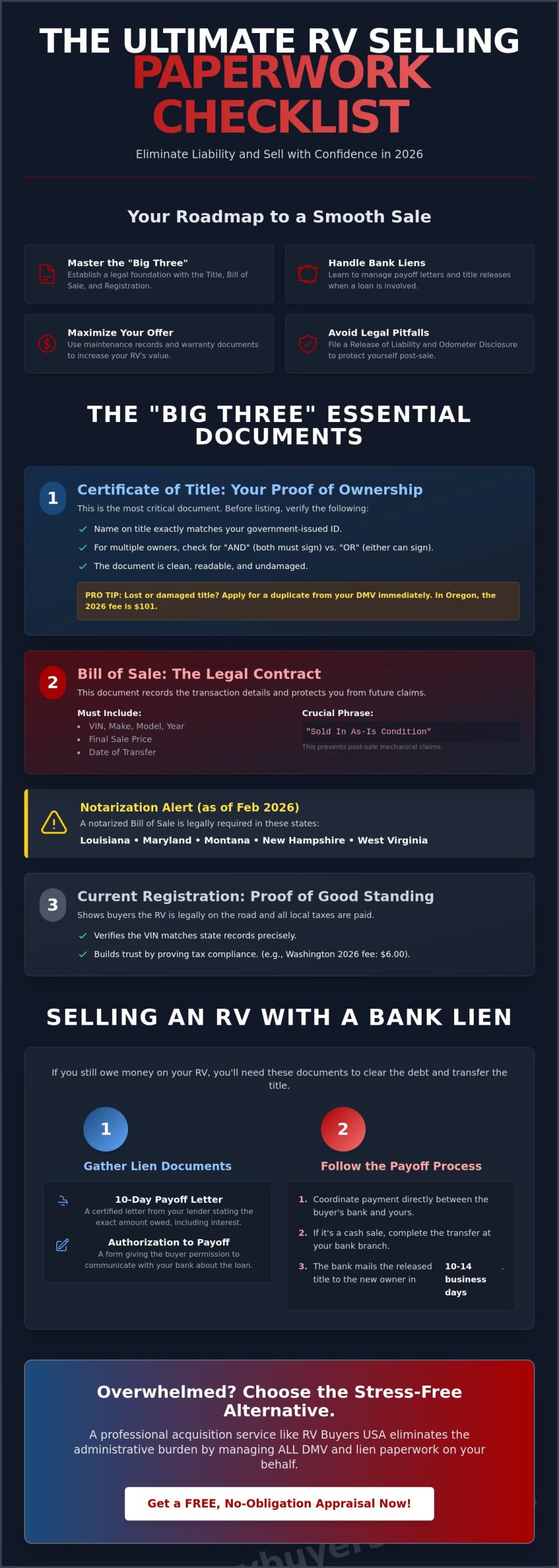
Selling a high-value asset requires more than a handshake; it requires a paper trail that terminates your liability and transfers ownership without a hitch. If you are asking what paperwork do i need to sell my rv, you must start with the foundational trio: the title, the bill of sale, and the current registration. These documents prove you have the right to sell the vehicle and protect you from future legal claims. In 2026, state-level scrutiny is higher than ever, so precision is your best defense.
The registration serves as the primary tool for VIN verification and tax status. In states like Washington, where registration filing fees increased to $6.00 in early 2026, having a current, valid registration proves that all local taxes are paid. This transparency builds immediate trust with a buyer. It confirms that the recreational vehicle being sold matches the state’s records exactly, preventing delays at the DMV during the transfer process.
The RV Title: The Crown Jewel of the Sale
The Certificate of Title is your definitive proof of ownership. Before you list your Class A or Class C motorhome, pull the physical document and inspect it. Ensure the name on the title matches your government-issued ID exactly. If multiple owners are listed, pay close attention to the conjunction. An “And” requires both parties to sign, while an “Or” allows either owner to sell the vehicle independently. This small detail often stalls sales at the last minute.
If your title is lost or damaged, you must act before finding a buyer. Apply for a duplicate title through your state DMV immediately. In Oregon, for example, the title fee is $101 as of 2026. Don’t wait until the day of the sale to discover a coffee stain has made your VIN unreadable. A clean, crisp title is the fastest way to get paid.
Crafting a Legally Binding Bill of Sale
The bill of sale is the legal contract that records the transaction details. It should include the VIN, make, model, and year for accurate identification. To protect yourself, clearly state that the sale is in “As-Is” condition. This specific phrasing prevents future mechanical claims if a component fails after the buyer takes possession. Record the final sale price and the exact date of the physical transfer to establish a clear timeline for the end of your liability.
Depending on your location, you may need a third party to witness the signing. As of February 2026, the following states require a notarized bill of sale for vehicle transactions:
- Louisiana
- Maryland
- Montana
- New Hampshire
- West Virginia
When you understand what paperwork do i need to sell my rv, you strip away the anxiety of the process. Having these three documents organized and ready for signatures ensures you can close the deal the moment a fair offer hits the table.
Navigating Bank Liens and Financing Paperwork
Selling an RV with an active loan adds a layer of complexity, but it shouldn’t stall your sale. Many sellers find themselves asking what paperwork do i need to sell my rv when a bank still holds the title. The process requires transparency and a specific set of financial documents to satisfy both the lender and the buyer. Your goal is to prove exactly how much is owed and how the debt will be cleared. Clear communication here prevents the buyer from feeling like they are taking on your debt.
Start by obtaining a certified payoff letter from your lender. This document must show the “10-day payoff” amount, which accounts for daily interest accrual through a specific date. You’ll also need an “Authorization to Payoff” form. This legal document gives the buyer or their financial institution permission to discuss the account details with your bank. The RV Industry Association highlights that the used RV market is growing, but savvy buyers will walk away if the lien process isn’t clearly defined from the start.
Step-by-Step: Selling an RV You Still Owe Money On
First, contact your lender’s payoff department. Request the 10-day payoff figure in writing. Once you have a buyer, coordinate the payment directly between their bank and yours. This is the safest method for both parties. If the buyer is paying cash, meet at your bank branch to finalize the wire transfer. Understand that banks don’t release titles instantly. It usually takes 10 to 14 business days for the physical title to be mailed to the new owner after the funds clear. If this administrative weight feels too heavy, you can sell your RV directly to a professional buyer who manages the entire lien payoff and title transfer process for you.
The Role of the Lien Release Document
A “Title with Lien” is legally encumbered. You cannot complete a transfer at the DMV without a formal Lien Release. This document is the bank’s official statement that they no longer have a financial claim to your Class A motorhome or travel trailer. In states like Florida or Texas, titles are often electronic (ELT). In these cases, the lender notifies the DMV electronically once the loan is satisfied. You must verify that this release is recorded before the buyer attempts to register the vehicle in their name. For high-value transactions, consider using an escrow service to hold the funds until the lien release is confirmed, protecting both parties from financial risk.
Supporting Documents to Maximize Your RV Resale Value
Legal requirements like titles and bills of sale are just the starting point. If you want to secure the highest possible price for your Class A motorhome or travel trailer, you need to prove the vehicle’s worth through a comprehensive paper trail. Most sellers ask what paperwork do i need to sell my rv to stay legal, but savvy sellers ask what they need to stay profitable. Supporting documents remove the “risk premium” that buyers use to negotiate your price down. They transform a used vehicle into a verified, high-value asset.
Start by gathering every receipt for recent upgrades. If you’ve invested in a 400-watt solar kit or upgraded to lithium-ion batteries, these components add significant market value. However, without the original receipts and installation dates, these are just parts. Documentation proves the quality of the components and the professional nature of the work. This level of transparency makes the official title transfer process feel like a safe investment for the buyer rather than a gamble.
Service History: Building Buyer Confidence
A binder full of professional service receipts is your strongest negotiation tool. While DIY logs are better than nothing, receipts from authorized service centers carry more weight in a high-value sale. Buyers look for proof of specific recurring tasks: oil changes, generator service hours, and annual roof seal inspections. Highlighting major repairs, such as a replaced slide-out motor or a set of tires with a 2025 date code, shows the buyer that the most expensive maintenance items are already handled. This documentation justifies a premium price and builds immediate trust.
Warranties and Equipment Records
Transferable warranties are a massive selling point that many owners overlook. If you have an extended service contract, verify if it can be assigned to a second owner. This protection is rare in private sales and can be the deciding factor for a buyer choosing between two similar units. You should also collect all original owner’s manuals for the complex systems, including leveling jacks, inverters, and even the convection microwave.
Create a “features and quirks” cheat sheet to include with your manuals. Every RV has specific sequences for extending the awning or priming the water heater. Providing these insights shows you’re a responsible owner who cares about the next person’s experience. When you provide the answer to what paperwork do i need to sell my rv with this level of detail, you eliminate the friction that causes deals to fall through at the last minute.
Avoiding Legal Pitfalls: Protection and Liability
The moment you hand over the keys is the moment your legal risk is highest. Many sellers focus only on the payment, but knowing what paperwork do i need to sell my rv means understanding how to shield yourself from the buyer’s future actions. Without the correct post-sale filings, you remain the owner of record in the eyes of the state. This leaves you vulnerable to the buyer’s parking tickets, toll violations, and even liability for accidents they cause. Your goal is a clean break that terminates your responsibility the second the vehicle leaves your sight.
You must act immediately once the bill of sale is signed. Don’t assume the buyer will rush to the DMV to register the vehicle in their name. Some buyers delay this process to avoid the 2026 fee increases seen in states like Washington or Oregon. Protect yourself by taking control of the narrative with state authorities. If you want to skip the legal anxiety and administrative burden entirely, sell your RV to a professional buyer who handles all liability transfers and state filings on your behalf.
The Critical Importance of the Release of Liability
The Release of Liability, often called a Notice of Transfer, is your primary legal defense. This single form tells the state that you no longer own the vehicle and are not responsible for its use. If the new owner abandons the RV or gets a red-light camera ticket, this document is your definitive proof of transfer. Most states now allow you to file this notice online for immediate processing. It is faster than a mail-in form and creates an instant digital record. Always save a timestamped copy or print the confirmation page for your permanent files.
Federal and State Specific Disclosures
Federal law mandates an Odometer Disclosure Statement for most motorhomes. While requirements vary by weight, generally any vehicle less than 20 years old must have its mileage certified at the time of sale. Beyond mileage, you must be transparent about the vehicle’s history. Disclosing a salvage or flood title isn’t just a courtesy; it’s a legal requirement. Concealing these facts can lead to expensive lawsuits years down the road. Honesty in your written disclosure is the best way to prevent future mechanical claims.
Finally, remove your license plates before the buyer drives away. In most jurisdictions, the plates belong to the owner, not the vehicle. Leaving them on is an invitation for the buyer to rack up toll charges on your account. Similarly, cancel your insurance policy the moment the title transfer is complete. You should never provide coverage for a vehicle you no longer control. Following these steps ensures that when the RV leaves your driveway, the legal responsibility goes with it.
The Professional Alternative: We Handle the Paperwork
The administrative burden of selling a high-value asset can be overwhelming. Coordinating with lenders and navigating state-specific fee increases often feels like a full-time job. You’ve been asking what paperwork do i need to sell my rv, and while the checklist is clear, the execution is where most private sales fail. Tiny errors on a title or a missing lien release can stall a deal for weeks. RV Buyers USA eliminates this friction by managing every administrative task from start to finish.
Our service is designed for owners who value their time and legal security. Whether you’re selling a Class A motorhome or a travel trailer, we handle the title, DMV filings, and lien payoff coordination. You don’t need to spend hours at the DMV. You won’t wait on hold with your bank’s payoff department. We provide immediate liquidity and a professional closing process that terminates your liability on the spot. We focus on a clean, uncomplicated transition for every owner.
Broad geographic reach allows our team to come directly to your location. We finalize all documents on-site, ensuring the paperwork is legally sound before we leave with the vehicle. This mobile service model removes the logistical nightmare of moving a large RV just to complete a sale. We specialize in the professional acquisition of Class A, B, and C motorhomes, Fifth Wheel trailers, travel trailers, and toy haulers.
A Streamlined Process for Busy Owners
Our team uses advanced verification tools to check your title and registration instantly. This professional approach provides a level of security that a private sale handshake simply cannot match. We eliminate the risk of title rejection by ensuring every signature and disclosure meets federal and state standards. You get the peace of mind that comes from a seasoned expert handling the fine print. We strip away the anxiety of the sale by making the process transparent and incredibly fast.
Ready to Skip the Red Tape?
Sellers choose our white-glove document management because it removes the stress of out-of-state title transfers and complex bank releases. We act as the problem solver for every logistical hurdle. The definitive answer to what paperwork do i need to sell my rv is simple: let us handle it for you. Why spend your weekend chasing DMV forms when you can close the deal today? Get a Free Appraisal and Let Us Handle the Paperwork.
Take Control of Your RV Sale Today
Selling your Class A motorhome or travel trailer shouldn’t be a logistical nightmare. You now have the definitive answer to what paperwork do i need to sell my rv to protect your financial interests and legal standing. By organizing the “Big Three” documents and securing a formal release of liability, you eliminate the risk of post-sale headaches and state-level penalties. Transparency with maintenance records and lien payoffs ensures you get the highest value for your asset in the current market. These steps transform a complex administrative task into a secure, professional transaction.
If the red tape feels like an unnecessary burden, choose the path of maximum efficiency. RV Buyers USA has been a leader in the industry since 2003, bringing decades of acquisition expertise to every transaction. We provide full DMV and title transfer management as part of our streamlined service. You can skip the paperwork headache and get a cash offer today with the added benefit of free nationwide pickup and immediate payment. Move forward with confidence and turn your RV into immediate liquidity without the stress of the DMV.
Frequently Asked Questions
Do I need a notary to sell my RV?
Notary requirements depend entirely on your state’s specific laws. As of 2026, Louisiana, Maryland, Montana, New Hampshire, and West Virginia require a notarized bill of sale to finalize the transaction. Other states may require the title signature itself to be notarized. Always check your local DMV guidelines before the buyer arrives to ensure your signatures are legally recognized.
Can I sell an RV if I lost the physical title?
No, you cannot legally transfer ownership without a valid physical title. You must apply for a duplicate title through your state DMV before closing the sale. In Oregon, for example, the fee for a replacement title is $101 in 2026. Secure this document early to avoid losing a motivated buyer while waiting for the state to process your request.
How do I sell my RV if I still have a bank loan on it?
You must obtain a certified 10-day payoff letter from your lender to start the process. This document provides the exact amount needed to clear the lien and release the title. If you’re wondering what paperwork do i need to sell my rv with a loan, this payoff letter is your most critical tool. The buyer or their bank pays your lender directly to satisfy the debt.
Is a Bill of Sale required if I have the title?
Yes, a Bill of Sale is a vital legal contract that protects both parties. While the title proves ownership, the Bill of Sale records the specific terms of the transaction, including the “As-Is” status and the final purchase price. It serves as your primary receipt and legal defense against any future claims regarding the vehicle’s mechanical condition at the time of transfer.
Should I keep my license plates after selling the RV?
Yes, you should always remove your license plates before the buyer drives away. In most jurisdictions, the plates are linked to the owner, not the vehicle itself. Leaving them on the RV makes you liable for any tolls, parking tickets, or traffic violations the new owner incurs. Take the plates to your local DMV to officially cancel the registration and end your liability.
What is a Release of Liability form and why do I need it?
A Release of Liability, or Notice of Transfer, is a state form that officially notifies the DMV that you no longer own the vehicle. You need it to terminate your legal responsibility for the RV. Filing this form immediately after the sale prevents the state from holding you accountable for accidents or abandoned vehicle fees caused by the new owner.
Does RV Buyers USA handle all the DMV paperwork for me?
Yes, our team manages every aspect of the title, DMV, and lien payoff administrative process. We specialize in the acquisition of Class A, B, and C motorhomes, as well as travel trailers and toy haulers. You get immediate cash and professional document handling, which eliminates the need for you to visit the DMV or coordinate with bank payoff departments yourself.
What paperwork is needed for a Class A vs. a Travel Trailer?
The core requirements for both are the title, bill of sale, and registration. However, Class A, B, and C motorhomes typically require a federal Odometer Disclosure Statement because they are self-propelled vehicles. Travel trailers and fifth wheels are generally exempt from odometer requirements but still require a clean title. Understanding what paperwork do i need to sell my rv ensures you have the right disclosures for your specific vehicle type.