

Did you know the used RV market grew by 6.56% in March 2026, even as new sales declined? Despite this demand, many owners still feel trapped by rising storage fees and the looming threat of environmental fines for an aging vehicle. If you are tired of the clutter and the costs, you are likely wondering what to do with an unwanted rv without losing money on the deal. It is a common struggle to face a non-running unit and feel overwhelmed by complex title paperwork or the high price of professional towing.
You don’t have to settle for expensive disposal fees or the uncertainty of the scrap yard. This guide reveals how to transform your recreational vehicle into cash or navigate a responsible exit strategy with zero stress. We will explore the latest 2026 tax deduction rules under the OBBBA Act, current scrap values for Class A and Class C units, and the streamlined acquisition process that removes the vehicle from your property quickly. Stop paying for an asset you don’t use and start your transition to a clean driveway today.
Key Takeaways
- Perform a quick 10-minute inspection to determine if your vehicle is a high-value asset or scrap metal.
- Learn exactly what to do with an unwanted rv to avoid environmental fines and high landfill fees.
- Compare the reality of 2026 tax deductions against the speed and certainty of a direct cash offer.
- Skip the stress of private listings and consignment by choosing a professional acquisition model with free nationwide pickup.
- Secure immediate liquidity for your Class A, B, or C motorhome through a simplified three-step process.
Assessing Your Unwanted RV: Is It Junk or a Hidden Asset?
Many owners assume that if they aren’t using their vehicle, it has automatically lost all its value. That is rarely the case. Before you decide what to do with an unwanted rv, you need to understand where it sits on the asset spectrum. A recreational vehicle that looks rough on the outside might still house a robust chassis or high-end components that buyers find desirable. Your goal is to separate sentimental or aesthetic frustration from the actual mechanical and structural worth of the unit.
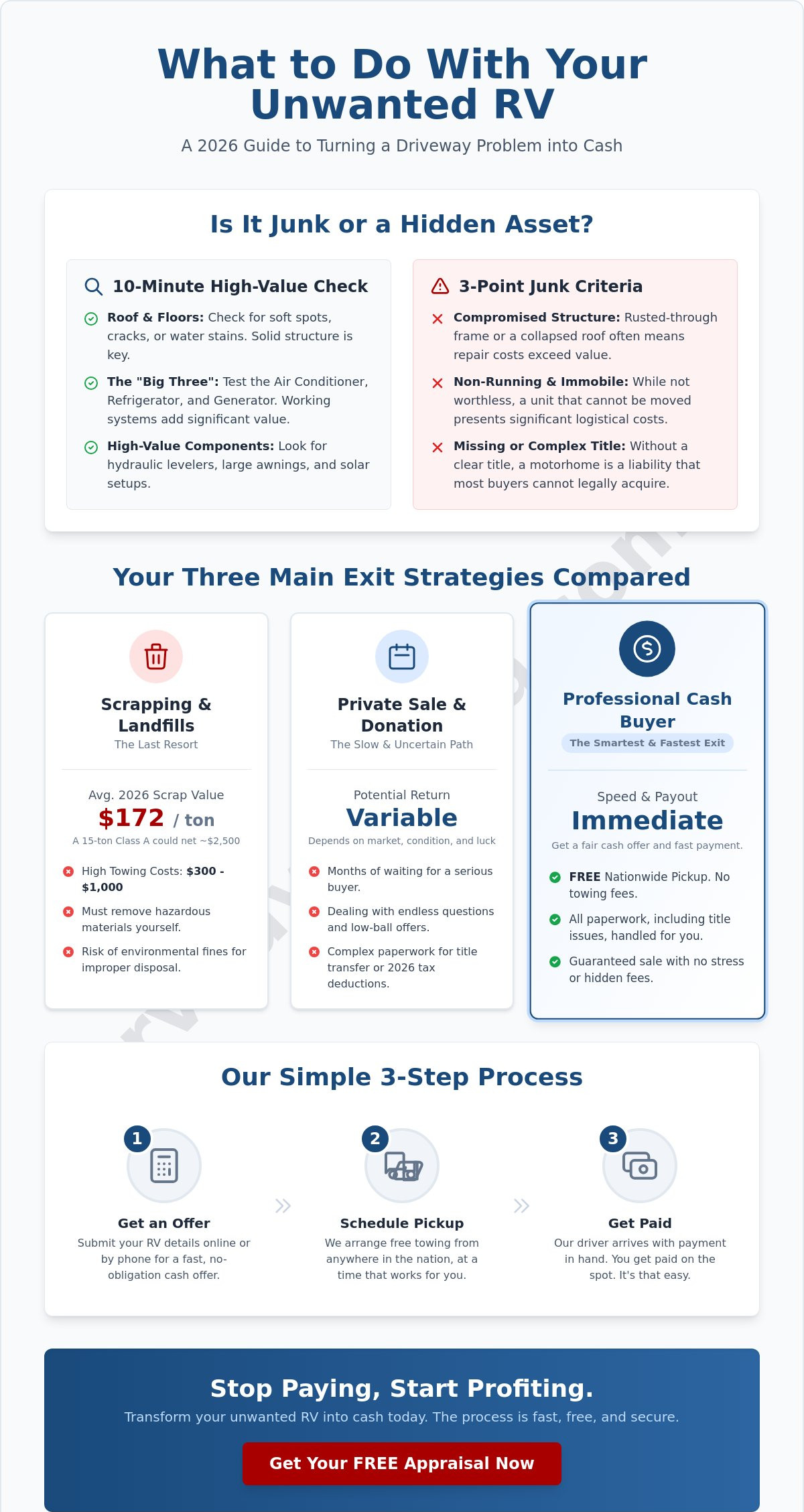
Start with a 10-minute visual inspection. Walk the perimeter and check the roof for soft spots, cracks, or visible tears. Inside, look for water stains on the ceiling and soft sections in the flooring. These are the primary indicators of structural health. Next, test the “Big Three”: the AC units, the refrigerator, and the generator. If these three systems work, your unit’s market value is significantly higher. A working generator or a specialized RV fridge can be worth a high amount on its own. Compare your findings to NADA guides. If the market value exceeds the repair costs, you have a sellable asset. If repairs are double the value, it is time to look at professional acquisition experts who specialize in these units.
The 3-Point Junk Criteria
Determining if a unit is truly “junk” comes down to three factors. First, structural integrity is paramount. If the frame is rusted through or the roof has collapsed, the cost of restoration often exceeds the value. Second, evaluate the mechanical state. A “stationary” unit that won’t turn over is more difficult to move, but it isn’t necessarily worthless. Finally, check your title status. You must have the legal right to sell or dispose of the unit. Without a clear title, even a pristine motorhome is a liability that most buyers won’t touch.
When an Unwanted RV Still Has Value
Don’t write off your vehicle just because it’s dated. Class A and Class C motorhomes often retain value because their heavy-duty chassis are built for longevity. There is a massive secondary market for “project” units where buyers look for solid bones to renovate. High-value components like hydraulic leveling systems, large awnings, and solar power setups can also make an older unit attractive to professional buyers. If the core systems are intact, you have a liquid asset rather than a disposal problem. Professional buyers often look past cosmetic wear to find the functional value underneath.
Responsible Disposal: What to Do With a Non-Functional RV
Abandoning a dead vehicle on your property or public land is a liability you don’t want. Beyond the eyesore, an aging unit poses real environmental risks as fluids leak and tires degrade. Local authorities use VIN records to track owners, often resulting in heavy environmental fines. If you are currently deciding what to do with an unwanted rv that no longer runs, you must prioritize a legal exit. Responsible disposal ensures you avoid legal headaches while potentially recouping some minor costs from the raw materials.
The “Stripping” method is a smart way to maximize a non-functional unit. Before you scrap the shell, remove high-value interior components. Working refrigerators, stoves, and power inverters have a dedicated market among DIY restorers. Once the unit is stripped of its usable gear, you are left with the chassis and body for final disposal. This reduces the weight you might be charged for at a landfill and puts immediate cash in your pocket. If the logistics of stripping and towing feel overwhelming, you can sell your motorhome directly to experts who handle the heavy lifting for you.
Navigating Local Landfill Requirements
Landfills are a final resort, but they have strict barriers to entry. Most facilities will not accept a unit until you remove all hazardous materials. This includes propane tanks, house batteries, and completely flushed black water tanks. As of early 2026, landfill fees for junk vehicles typically fall between $50 and $100 per ton. You must also bring your documentation. Most transfer stations require proof of RV registration and titling to verify you have the legal right to destroy the vehicle.
Salvage Yards and Scrap Metal
Scrap yards offer a way to get paid for the weight of your vehicle. In 2026, average scrap prices for RVs are estimated at $172 per ton. A heavy Class A Diesel Pusher weighing 15 tons could net you over $2,500 in raw metal value. However, many yards are becoming selective. They often refuse units with high amounts of wood, insulation, and fiberglass because these materials cannot be recycled easily. Always call ahead to confirm if they have the equipment to process oversized recreational frames and if they offer towing services, which can cost between $300 and $1,000 for junk units.
Donating vs. Private Listing: Navigating the Middle Ground
If your unit is still functional but a burden to store, you might consider donating it or listing it privately. Many owners believe these are the simplest ways to figure out what to do with an unwanted rv, but these paths often hide administrative stress and financial disappointment. Don’t assume a “free” exit is actually free. Between potential liability and strict IRS rules, giving away a high-value asset requires careful calculation. You want a clean break, not a year of paperwork and “tire kicker” messages.
Charities are becoming increasingly selective about what they accept. Most reputable organizations will reject a unit that requires significant mechanical work or expensive towing. They want assets they can flip for immediate cash, not a mechanical liability that sits in their lot. If you do find a taker, the tax benefits might be smaller than you expect. For the 2026 tax year, the “One Big Beautiful Bill Act of 2025 (OBBBA)” has set specific limits. If you don’t itemize your deductions, you can only deduct up to $1,000 as a single filer or $2,000 if married filing jointly. This is a fixed cap, regardless of the vehicle’s actual value.
Private sales present their own set of risks. Inviting strangers to your property to inspect a non-running unit is a safety concern. You also face the “Free” listing trap. If a buyer hauls the unit away but fails to transfer the title correctly, you remain legally liable for the vehicle. If they abandon it on a public road or it leaks fluids into the soil, the environmental fines will be mailed to you. Dealing with message fatigue from people who never show up is a massive drain on your time. You need a solution that prioritizes speed and legal finality.
The Reality of RV Donation
Always verify a charity’s 501(c)(3) status before handing over your keys. Most organizations follow the “gross proceeds” rule. This means your deduction is based on what the charity actually gets at auction, not the NADA fair market value. If you itemize, remember that 2026 rules impose a 0.5% Adjusted Gross Income (AGI) floor. Your total deductions must exceed the standard deduction of $16,100 for single filers or $32,200 for married couples to provide any real tax relief.
The Struggles of Private RV Sales
Listing fees on specialized sites like RV Trader can eat into your profit, especially for lower-value units. You will spend hours managing “is this still available” messages and coordinating schedules. The risk of abandonment is the biggest threat. If the buyer doesn’t have the funds to fix or store the unit, they may dump it while it is still in your name. Always finalize the paperwork through a professional service to ensure your name is legally removed from the VIN records.
Maximizing Return: Why Professional Cash Buyers Are the Fastest Exit
Professional buyers offer the most efficient answer for what to do with an unwanted rv. Unlike retail dealers who want showroom-ready inventory, professional acquisition firms focus on the inherent value of the chassis and core systems. This direct purchase model eliminates the months of waiting associated with consignment. You skip the detailing, the mechanical overhauls, and the awkward negotiations. Dealers often lowball trade-ins because they must factor in floorplan interest and retail reconditioning. Professional buyers look at the raw market demand for Class A, B, and C motorhomes, often seeing value where a local dealer only sees a liability.
Security is another major advantage. When you sell privately, you risk fraudulent personal checks or payment plans that never materialize. Professional firms provide immediate liquidity through guaranteed bank wires or cashier’s checks. This ensures the funds are in your account before the vehicle leaves your property. You get a clean, final transaction without the stress of wondering if the payment will clear. It is the most reliable way to turn a stationary asset into usable capital without the typical market delays.
How Professional Appraisal Works
The appraisal process is built for speed. You submit your VIN and high-resolution photos of the interior and exterior to receive a remote offer in hours. This bypasses the need for multiple on-site inspections. While a trade-in value is often tied to the purchase of a new unit, a cash acquisition value is a standalone offer based on current demand. It’s helpful to remember that valuing your RV requires looking at current market auctions rather than just local classifieds. This data-driven approach ensures you receive a fair, competitive price based on real-time industry trends.
Managing Paperwork and Liens
One of the biggest hurdles in deciding what to do with an unwanted rv is the administrative burden. Professional buyers handle all DMV filings and title transfers on your behalf. If your unit still has an active bank lien, the buyer works directly with your lender to coordinate the payoff. This removes the paperwork paralysis that keeps many owners stuck with a vehicle they no longer want. Using a limited Power of Attorney for the vehicle sale allows the buyer to finalize the administrative side without you spending a single afternoon at the DMV. If you want to bypass the red tape entirely, you can get a cash offer for your RV right now.
Selling Your Unwanted RV to RV Buyers USA: The 2026 Process
Stop struggling with the logistical nightmare of what to do with an unwanted rv. While government disposal programs often force you through weeks of paperwork and complex affidavits, our 2026 acquisition model is built for speed. We provide a professional, high-speed alternative to the traditional retail market. Our process is designed to strip away the anxiety of selling a high-value asset by handling the entire transaction in three simple steps. You get immediate liquidity without the stress of preparation, cleaning, or mechanical repairs. We focus on Class A, B, and C motorhomes, along with fifth wheels, travel trailers, and toy haulers.
Our acquisition process is straightforward. First, you provide the basic details of your unit. Second, you receive a competitive cash offer. Third, we schedule a pickup. We handle the heavy lifting that stops most private sales. We offer free nationwide pickup regardless of the vehicle’s condition. It doesn’t matter if your RV is parked in a tight storage lot or sitting on a remote property. We come to you. This removes the $300 to $1,000 towing burden often associated with junking a vehicle. You receive payment at the time of pickup, ensuring a secure and transparent transition. We prioritize your convenience and financial gain.
Nationwide Reach, Personal Service
We coordinate pickups across the entire United States. Our scale allows us to offer the logistical convenience of a local buyer with the financial backing of a large-scale operation. We focus on providing a “clean break” for every seller. This means once the transaction is complete, you have no lingering liabilities or administrative burdens. We specialize in the acquisition of Class A, B, and C motorhomes, as well as fifth wheels and travel trailers. Our team acts as your personal problem solver. We ensure the title transfer is legally sound and finalized immediately, protecting you from future fines or abandonment issues.
Getting Your Free Appraisal Today
Ready to move forward? Have your vehicle’s year, make, model, and general condition ready for our team. We use this data to perform a rapid internal appraisal that reflects the true fair market value in the current 2026 used RV market. We look past cosmetic wear to find the functional value of your chassis and core systems. This ensures you get a fair deal without the lowball tactics of traditional dealers or the uncertainty of scrap yards. Don’t let your vehicle continue to drain your bank account through storage fees and depreciation. Get a cash offer for your unwanted RV now and experience the most efficient exit strategy in the industry.
Clear Your Driveway and Secure Your Cash
You now have a clear roadmap for what to do with an unwanted rv. Whether your vehicle is a non-functional shell or a well-maintained motorhome that simply isn’t being used, you don’t have to keep paying high storage fees. We’ve explored the hidden value in Class A and C units, the risks of private sales, and the streamlined efficiency of professional acquisition. Don’t settle for the confusion of government disposal or the safety risks of inviting strangers to your home to view a junker.
Stop letting a stationary asset drain your resources. We specialize in direct cash purchases with zero hidden costs or preparation requirements. Our team provides free nationwide pickup and expert title and DMV handling to ensure a clean break from your liability. Turn your unwanted RV into cash today with a free appraisal from RV Buyers USA. Secure your immediate liquidity and reclaim your property with one simple phone call. You deserve a stress-free transition that puts money in your pocket today.
Frequently Asked Questions
Can I sell an RV that doesn’t run?
Yes, you can sell a non-running RV to professional acquisition firms. These experts evaluate the vehicle’s worth based on its chassis, core components, and salvageable systems rather than its ability to drive. While a traditional dealer might reject a unit with mechanical failure, professional buyers specialize in these cases. They provide towing and handle the logistics, turning your stationary asset into immediate liquidity without requiring any repairs from you.
How much does it cost to have an old RV hauled away?
Professional towing for a junk RV typically costs between $300 and $1,000 depending on the distance and vehicle size. Some disposal services charge by the foot, with rates around $65 per foot for trailers and $100 per foot for motorhomes. You should also factor in landfill fees, which average $50 to $100 per ton. To avoid these expenses, look for a professional buyer who offers free nationwide pickup as part of their acquisition process.
What happens if I abandon my unwanted RV on my own property?
Abandoning a vehicle on your property can lead to significant legal and environmental consequences. As fluids leak and materials degrade, you face potential fines from local code enforcement or environmental agencies. Additionally, an abandoned unit decreases your property value and creates safety hazards. Instead of leaving it to rot, research what to do with an unwanted rv through professional cash buyers who can remove the liability quickly and legally.
Do I need the title to get rid of an unwanted camper?
You must have a valid title to legally sell, donate, or scrap your vehicle. Landfills and salvage yards require proof of ownership to prevent the destruction of stolen property. If you’ve lost your title, you should contact your state’s DMV to request a duplicate. Professional buyers can often guide you through the paperwork required for a clean title transfer, ensuring your name is legally removed from the vehicle’s records during the sale.
Can I donate an RV that has significant water damage?
Most charities will reject an RV with extensive water damage because it is difficult to auction. Organizations prefer assets they can flip for immediate funds rather than units requiring costly restoration. If a charity does accept a damaged unit, you might still be responsible for the towing costs. Always call ahead to verify their criteria and remember that your tax deduction is limited to the actual gross proceeds from the auction.
How do I transfer the title if I’m selling to a professional buyer?
Transferring the title to a professional buyer is a streamlined process that avoids the typical DMV wait times. You will sign the title over to the purchasing firm, and they will handle the subsequent filings with the state. Many companies use a limited Power of Attorney to manage the administrative side on your behalf. This ensures the transfer is finalized immediately, removing your legal liability for the vehicle the moment it leaves your property.
Will a scrap yard pay me for my old motorhome?
Scrap yards will pay you for your motorhome based on current metal prices, which averaged around $172 per ton in early 2026. However, some yards may deduct fees for processing non-metal materials like wood, fiberglass, and insulation. You must also ensure all hazardous fluids and propane tanks are removed before delivery. While this provides some cash, the total is often lower than what a professional acquisition firm would offer for the same unit.
How long does the professional cash purchase process take?
The professional acquisition process is designed for speed, often providing a cash offer within hours of your inquiry. Once you accept the offer, pickup and payment can typically be scheduled within a few days. This is the most efficient answer for what to do with an unwanted rv when you need to clear your property immediately. It bypasses the weeks of waiting required for private listings or the complex inspection schedules of government disposal programs.